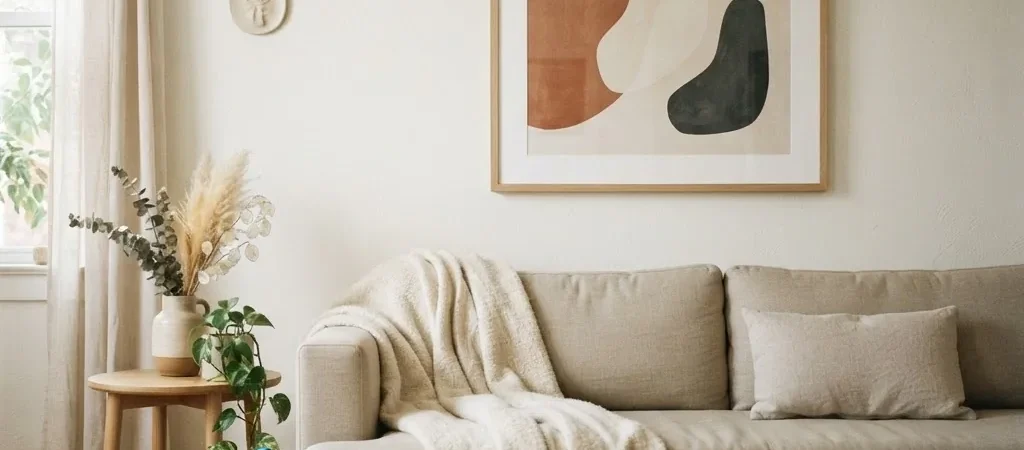
If you have ever stood in the middle of your living room staring at a bare, beige wall and thought, “I want this to look good but I have no idea where to start,” you are in the right place.
Blank walls in a small apartment have a way of making a space feel like a waiting room instead of a home. The good news is that fixing them does not require a big budget, a drill, or a landlord’s permission slip. Growing up in a house full of hand-me-down furniture taught me early that a room’s personality comes from what is on the walls and how the pieces relate to each other, not from how much you spent. Most of my adult decorating life has been in rentals, which means I have gotten very good at making walls feel lived-in without touching a single paint color or leaving behind a hole I cannot explain at move-out.
Here are 21 ideas that actually work, with honest notes on what is worth spending on and what you can skip.
Start Here: The Two Things That Make or Break Any Wall
Before picking a single piece of art or buying a single shelf, it helps to know the two biggest mistakes small-space decorators make. First: hanging things too high. Second: going too small.
On height, the rule that professional galleries and interior designers follow is to hang the center of any piece at about 57 to 60 inches from the floor. That is average eye level for most people and it is the reason gallery walls feel comfortable to stand in front of. When art creeps up to 70 or 75 inches, it disconnects from the room and floats. The DIY Playbook’s guide on hanging art at the right height walks through the math step by step if you want to see exactly how to find your hanging point before you ever touch a nail.
On size: in a small room, your instinct is to choose small art so it does not “overwhelm” the space. This is almost always the wrong call. One piece that fills 50 to 70 percent of the wall width behind your sofa will make the room feel intentional and grounded. A cluster of tiny prints spread out across the same wall makes it feel cluttered and unfinished. When in doubt, go bigger.
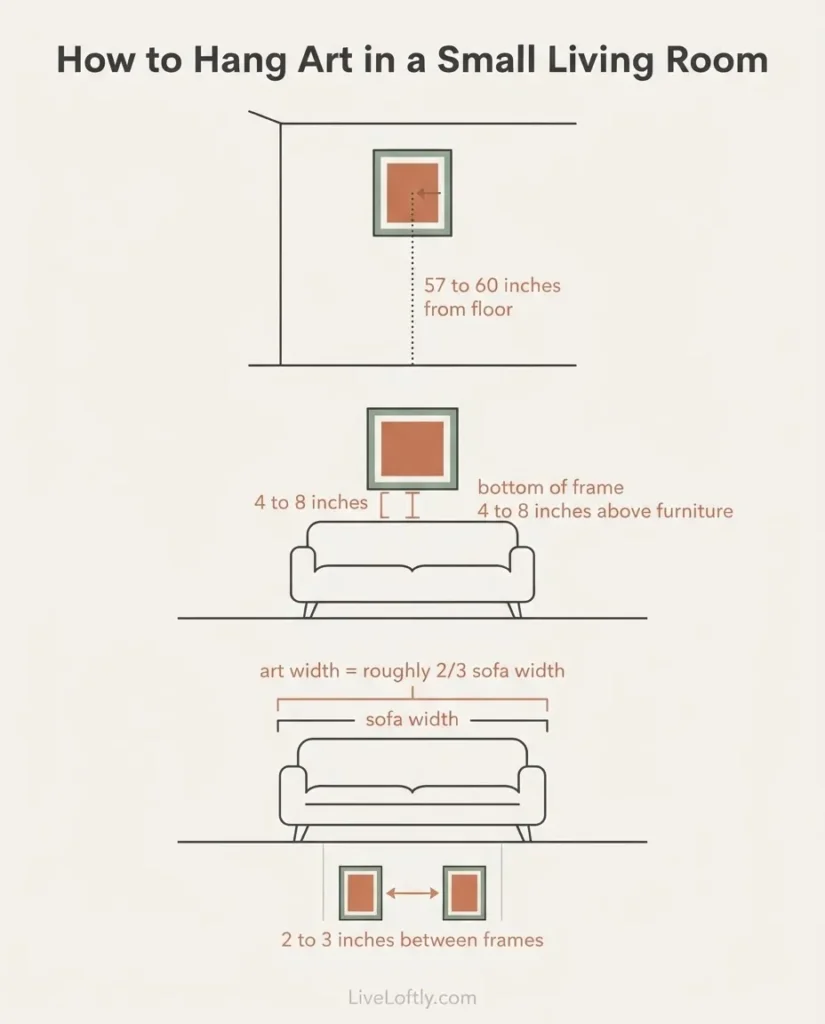
The standard proportion rule is that any art or grouping above a sofa should span roughly two-thirds the width of the sofa below it. So if your sofa is 72 inches wide, your art or gallery arrangement should be roughly 48 inches wide. Keep the bottom of the frame about 4 to 8 inches above the top of the sofa so it looks connected rather than floating on its own.
With those two things in mind, here is what to actually put on your walls.
Section 1: Framed Art and Prints
1. One Large Statement Print
This is the simplest, most transformative thing you can do in a small living room. A single print at the right scale, in a simple frame, hung at the right height will do more for the room than five smaller pieces scattered around. Printable art from sites like Society6, Etsy, or even free download sources means you can get something beautiful for the cost of a frame. Look for muted, earthy tones or simple line drawings, as these tend to feel calm rather than busy in small spaces.
Worth it: A good frame. A cheap-looking frame will drag down even beautiful art. Simple black or natural wood frames photograph well and go with almost everything.
2. A Gallery Wall Done Right
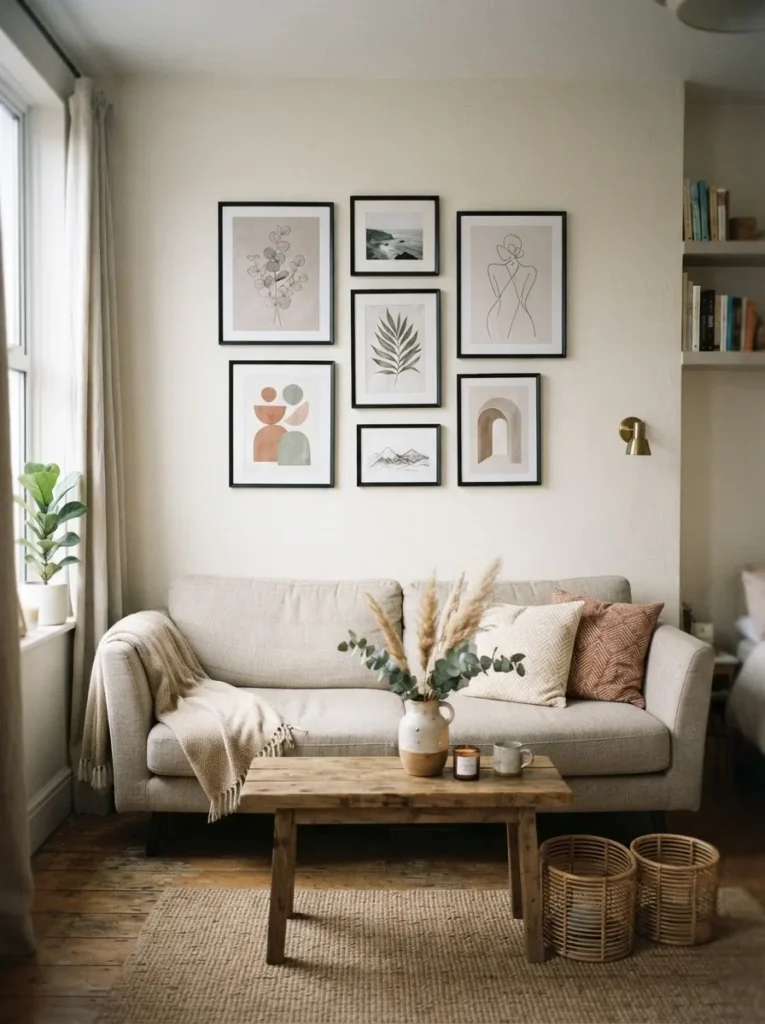
A gallery wall in a small living room works, but only if you treat it as one cohesive object rather than a scattered collection of frames. The key numbers to know: keep 2 to 3 inches of space between each frame (2.5 inches is the most reliable default), and center the entire arrangement at 57 to 60 inches from the floor, just as you would a single piece. Frameology’s 2026 gallery wall rules guide breaks this down clearly, including how to handle the anchor-piece method and why consistent spacing is what separates a polished result from a random collection of frames.
For a small living room specifically, aim for 5 to 7 pieces rather than a sprawling wall-to-wall arrangement. A tighter, more curated cluster reads better in a small space.
3. Ledge Shelves for Rotating Art
Picture ledges (like the ones from IKEA) let you lean frames against the wall without hanging anything. This is one of the most renter-friendly tricks I know because you only need to put two screws in the wall per shelf, and the art itself is completely interchangeable. You can swap prints with the seasons, rearrange frames whenever you feel like a refresh, and nothing is permanent. Lean a mix of sizes: one taller print, one square, one leaned forward slightly in front of the other. The layered depth makes it look much more considered than a single hung piece.
4. Thrift Store Frames, Unified by Paint
If your budget is very tight, thrift stores and garage sales often have interesting frames in the wrong colors. A coat of the same spray paint (matte black, white, or warm gold) on a collection of mismatched thrift frames makes them read as a set. The art inside does not need to be expensive either. Pages from a coffee table book, botanical prints from a calendar, or downloaded printables work perfectly.
Section 2: Mirrors
5. One Large Mirror to Open Up the Room
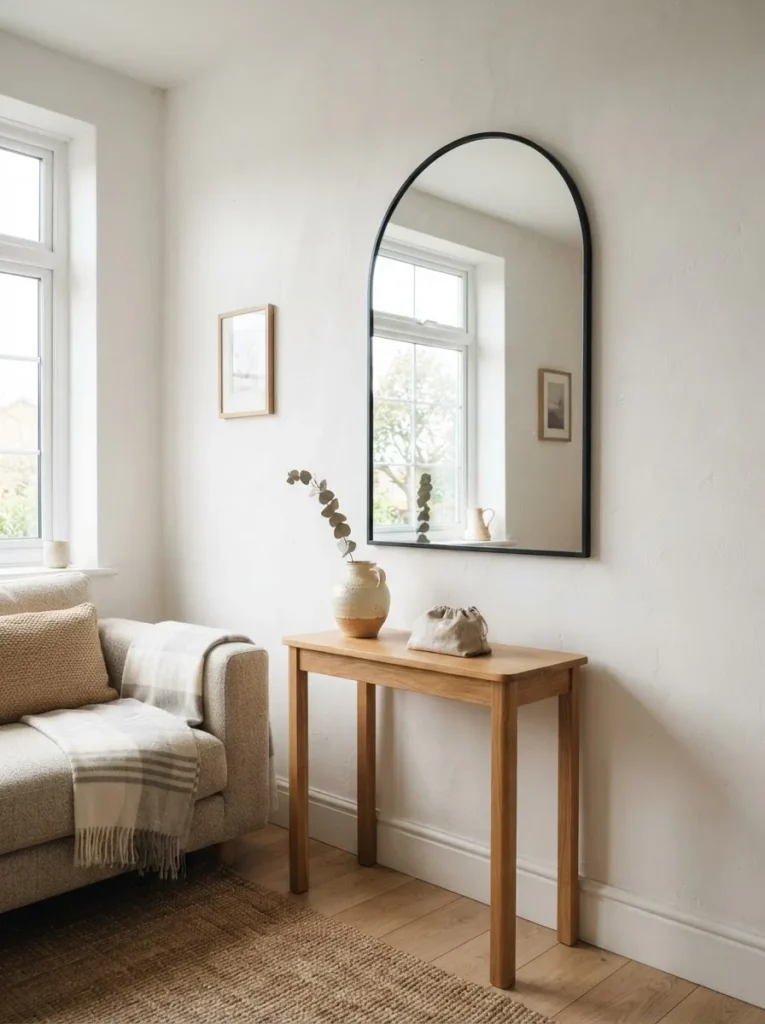
A single large mirror is one of the most effective tools for making a small living room feel less cramped. Apartment Therapy’s mirror guide notes, quoting HGTV designer Vern Yip, that “a single large one is the best way to do it” and that many people make the mistake of using mirrors that are too small or relying on groupings of small mirrors, which do not have the same effect. One oversized mirror with a minimal frame placed to reflect a window or a light source bounces light around the room and makes it feel both larger and brighter.
Hang it at the same 57 to 60-inch center height as you would art. Keep at least a 2-inch border between the frame’s edge and any nearby wall or ceiling.
Skip it: Very ornate or large frames. The frame competes visually and reduces the light-expanding effect. Simple, clean frames work best.
6. A Full-Length Mirror Leaned Against the Wall
For renters who want zero holes in the wall, leaning a full-length mirror against the wall is a clean, modern option that requires no hardware at all. It also does double duty, giving you a place to check your outfit and visually deepening the room. Leaning it at a slight angle looks intentional; perfectly flat against the wall can look like it is waiting to be hung.
7. A Sunburst or Arch Mirror as Decor
When a mirror is stylish enough, it functions as art. Arch mirrors, sunburst mirrors, and rattan-framed round mirrors are popular right now for a reason: they add texture and visual interest beyond just reflection. A single round mirror with a natural rattan frame is one of the least expensive ways to add a boho-warm feel to a living room wall, and they typically hang with a single nail or hook.
Section 3: Floating Shelves and Vertical Space
8. Two or Three Floating Shelves Stacked Vertically
In a small room, the walls above eye level are underused real estate. A set of two or three shelves stacked 10 to 12 inches apart draws the eye upward, which makes ceilings feel higher. Style them with a mix of objects: one or two small plants, a couple of books stacked horizontally, one small framed photo, maybe a simple candle or a small vase. The rule that keeps shelves from looking cluttered is: leave some open space. Aim to fill about 60 to 70 percent of each shelf and leave the rest breathing.
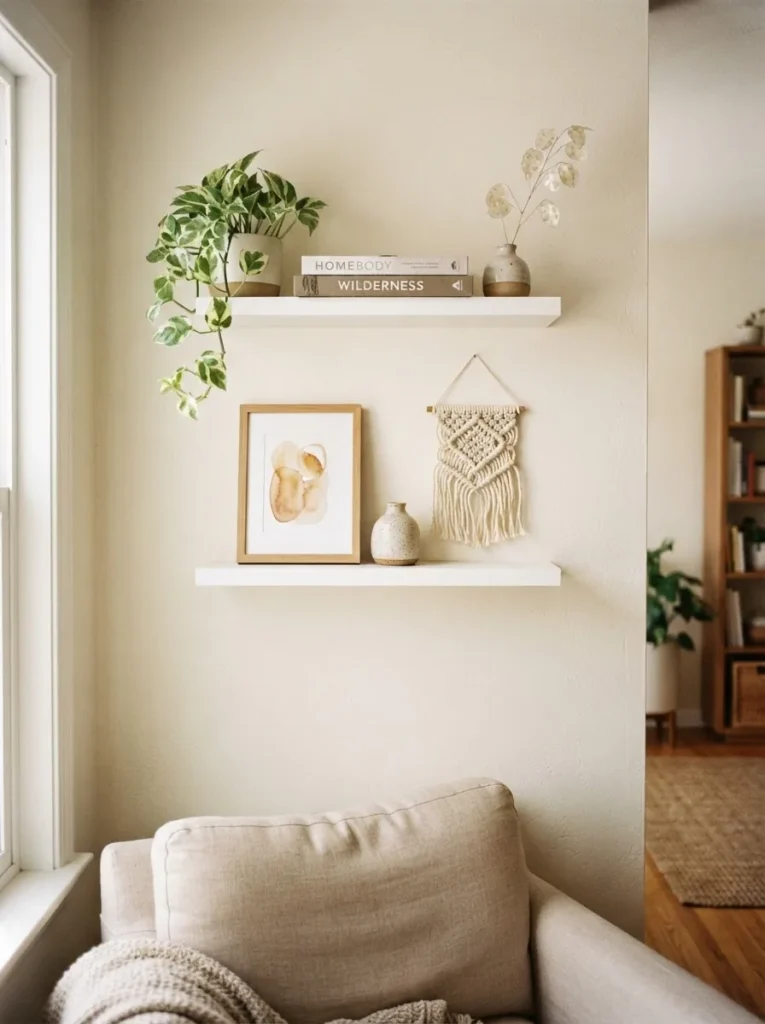
Worth it: Shelves with clean lines and a finish that coordinates with your existing furniture. White, black, natural wood.
9. Corner Shelves to Use Dead Corners
Corner wall shelves take up no floor space and solve the problem of awkward corners that are too narrow for furniture but too bare to ignore. A corner shelf at eye level with a small plant and a few simple objects reads as intentional and fills a spot that otherwise collects nothing but shadows.
10. A Single Shelf Above the Sofa
A single floating shelf installed above and centered on the sofa works especially well in small rooms because it adds storage, display space, and visual interest without requiring a full gallery wall commitment. Keep objects at similar heights on the shelf and include at least one plant (real or a good quality faux) for life and texture.
Section 4: Textiles on Walls
11. A Macrame or Woven Wall Hanging
Woven wall hangings bring texture to a wall in a way that no framed print can match. They are light enough to hang with a single nail, picture hook, or even a strong removable adhesive hook, and they are inherently soft and warm in a way that calms a small room down visually. For small living rooms, look for hangings that are proportionate, roughly 18 to 36 inches wide, rather than large floor-to-ceiling statement pieces that overwhelm a small wall.
12. A Tapestry as an Accent Wall
A large woven tapestry hung across the main wall behind your sofa is one of the most renter-friendly versions of an accent wall. It adds color, pattern, and texture all at once without touching the paint. Most tapestries are light enough to hang with removable adhesive hooks or a simple tension rod mounted just below the ceiling. They fold down flat for moving. If your living room is on the plain side and you want one big move that changes the whole mood, a tapestry is one of the most budget-effective ways to do it.
13. A Fabric Panel or Canvas Print
Stretched canvas prints and fabric-wrapped panels are lighter than framed art and much easier to hang without heavy hardware. They lean naturally on ledge shelves or can be hung with small nails and moved without much wall damage. For small spaces, a single large canvas above the sofa is a cleaner look than a cluster of smaller prints.
Section 5: Damage-Free Hanging for Renters
14. Command Strips (Used Correctly)
Command strips are the most popular damage-free hanging solution for renters, but they only work when you understand their limits. The official 3M Command weight limits guide lists the capacities clearly: small strips hold 1 lb per set, medium strips hold 3 lbs per set, large strips hold 4 lbs, and jumbo sets of 4 strips can hold up to 16 lbs for heavier items like mirrors. The number one mistake is hanging a heavy frame with strips rated for a much lighter load. Weigh your frame before you shop for strips, and then buy one size up from what you think you need.
One more important note: Command strips work best on smooth, clean walls with a satin, eggshell, or semi-gloss paint finish. On textured walls or flat/matte paint, they are significantly less reliable.
15. Removable Adhesive Hooks for Light Objects
For lightweight items such as a small basket, a lightweight macrame piece, a single wreath, or a small framed photo, removable adhesive hooks are a clean solution. They remove without wall damage when you follow the instructions, especially the “slow and steady” pull technique. Do not rush the removal.
16. Washi Tape for Minimal-Art Grids
Washi tape is a gentle, paper-based tape that can create geometric borders, faux frames, and decorative patterns directly on a wall without damaging paint. The caveat: use actual washi tape (the paper-based Japanese variety), not masking tape or decorative vinyl tape, which can leave residue. It is best for very light, low-commitment accents rather than a main focal point.
Section 6: Peel-and-Stick Accents and Wallpaper
17. A Peel-and-Stick Accent Wall Behind the Sofa
A single accent wall behind the sofa using peel-and-stick wallpaper is one of the biggest transformations available to a renter on a reasonable budget. It takes an afternoon, costs a fraction of a professional wallpaper job, and comes off when you move. The key thing renters need to know is that wall prep matters enormously. EazzyWalls’ complete renter’s guide to peel-and-stick wallpaper covers the full process, including why flat or matte paint is risky (the adhesive can pull the paint off during removal), why freshly painted walls need at least 30 days to fully cure before you apply anything, and why testing a sample in a hidden spot before committing to a full wall is smart practice for anyone who wants their deposit back.
For small living rooms, a subtle texture like a linen-look or a soft botanical print adds depth without closing the room in.
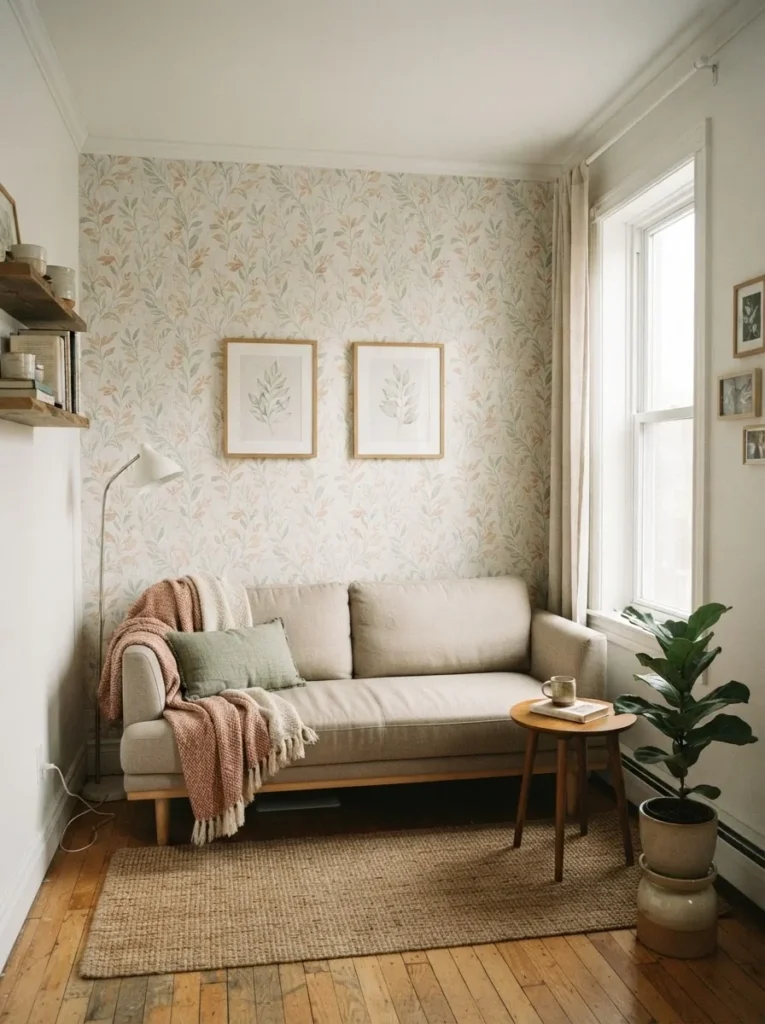
Avoid very dark or very busy patterns on your only large wall.
18. Peel-and-Stick Tile Panels
Peel-and-stick geometric tile panels, usually made from lightweight foam or thin vinyl, can create the look of a 3D paneled wall at very low cost. Applied in a grid pattern on one wall, they add architectural interest without any renovation. They are especially effective in boho or modern Moroccan-inspired living rooms. As with wallpaper, check the paint finish of your wall first and always test a sample patch before covering a full wall.
Section 7: Functional Decor That Earns Its Wall Space
19. A Wall-Mounted Planter or Trailing Plant
A small wall-mounted planter or two with a trailing plant, like a pothos or a string of pearls, adds life to a wall in a way that no print or frame can replicate. Plants bring something genuinely organic to the space, and the trailing growth from a wall-mounted pot creates soft visual movement that makes a room feel less static. Good-quality faux trailing plants work almost as well if your space does not have the light for the real thing.
20. Woven Baskets Arranged as a Cluster
A cluster of three to five woven baskets in graduated sizes, hung on the wall the way you would hang framed art, is a simple and surprisingly effective wall treatment. It works particularly well in boho, coastal, or cottagecore-style rooms. Baskets are lightweight and usually hang easily from a single nail or adhesive hook. Using an odd number of them and varying the sizes slightly gives the arrangement a natural, collected feeling rather than a forced one.
21. Plug-In Wall Sconces
This one is often overlooked as wall decor, but a pair of plug-in wall sconces on either side of a mirror or above a console adds light, symmetry, and warmth that transforms how the whole wall feels, especially in the evening. Unlike hardwired sconces, plug-in versions need no electrician and no wall-cutting. The cord can usually be managed with a cord cover or routed behind furniture. The shift from flat overhead light to warm wall-level light is one of the most calming things you can do in a small living room, and the sconces themselves become part of the wall’s decor story.
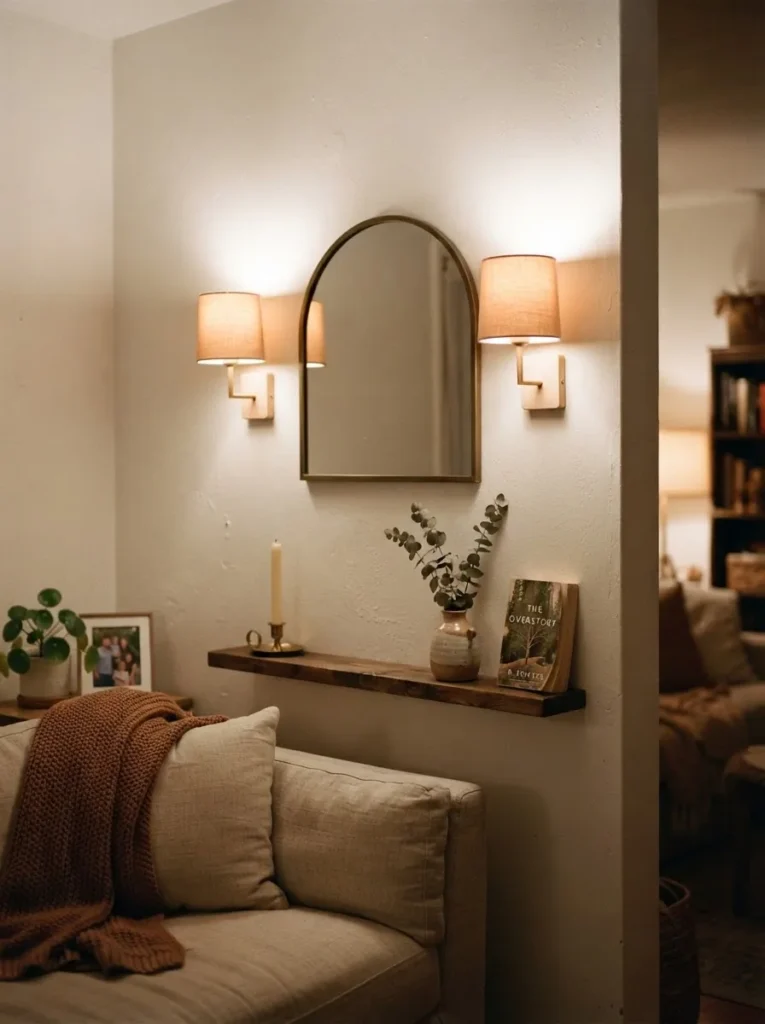
Park West Gallery’s guide to hanging and displaying art notes that lighting is one of the most overlooked elements of wall decor, even for artwork, and that the right lighting can make even a simple piece feel intentional and elevated.
A Note on Where to Start
If all 21 ideas feel like too much at once, pick one wall. The wall behind your sofa is almost always the right starting point in a small living room because it is the first thing you see when you walk in and the backdrop for most of the time you spend in that room. Choose one approach: a single large print hung at the right height, a small curated gallery cluster, or one bold peel-and-stick accent wall. Get that one wall right before you touch anything else.
A room that feels calm and finished usually has less on the walls, not more. The editing is the work. When you put something up and it does not feel quite right, take it down. You are not committed to anything until you decide you love it.
Make it yours. Not someday. Now.