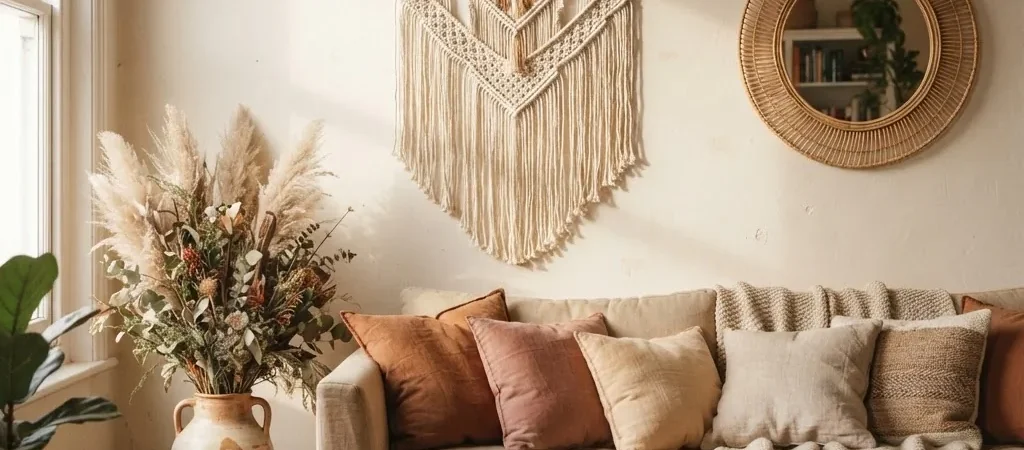
There is a version of boho wall decor that looks warm and layered and like it came together naturally over years of interesting living. And then there is the version that looks like a craft fair and a thrift store had an argument, and nobody won.
Most people searching for boho wall art ideas are hoping to land on the first version and terrified of accidentally ending up with the second. I have been there. I spent a long time decorating rentals where the walls were off-limits for real commitment, and figuring out how to make a space feel personal without looking chaotic is a skill that takes some actual thought. The good news is that “collected and cozy” is not a talent you are born with. It is just a handful of simple principles, applied with a little patience.
These 13 ideas are the ones I keep coming back to. Some are about specific pieces. A lot of them are about how you use those pieces. If your walls have felt bare or blah or like they belong to someone else, you are in the right place.
What Makes Boho Wall Art Feel Calm Instead of Busy:
Before we get into the specific ideas, it helps to understand the one thing that separates a boho space that feels intentional from one that feels overwhelming. It is not the amount of stuff. It is whether the eye knows where to rest.
Boho as a style is layered and eclectic by nature, which means you have permission to mix textures, finishes, and art styles in ways that a more formal or minimal style would not allow. But “layered” and “random” are not the same thing. A room that feels calm usually has a color anchor (meaning most of the art and objects share a tonal family), some variation in scale (not everything the same size), and at least one clear focal point the eye lands on first.
The boho color palette tends to live in warm, earthy, organic tones. Terracotta, sage green, dusty rose, rust orange, warm cream, honey gold, and muted warm beige all play well together. You can use this boho color palette guide as a starting point if you are not sure which shades work and which clash. Sticking within this family, even loosely, is what keeps a wall of mixed art from reading as noise.
With that in mind, here are 13 ideas.
1. Start With One Large Anchor Piece
The most common reason a boho gallery wall looks unfinished is that everything on it is small. Small pieces on a large wall float and look uncertain. A single large anchor, whether that is a big macrame piece, an oversized botanical print, or a wide woven tapestry, gives the eye a home base and makes everything else you add feel intentional by comparison.
For a living room wall behind a sofa, a good sizing guideline is to aim for your anchor piece (or the whole arrangement above it, treated as a unit) to span roughly two-thirds the width of the sofa below. A 72-inch sofa, for example, looks best with art or an arrangement roughly 48 inches wide. A piece that is too narrow will just look lost.
If you are working with a blank wall and no furniture anchor beneath it, a single large canvas or tapestry hung at the center can be more than enough on its own.
Worth it: Investing a bit more in your anchor piece makes everything else easier to build around. This is the spot to spend if there is one.
2. Layer in a Woven or Macrame Wall Hanging
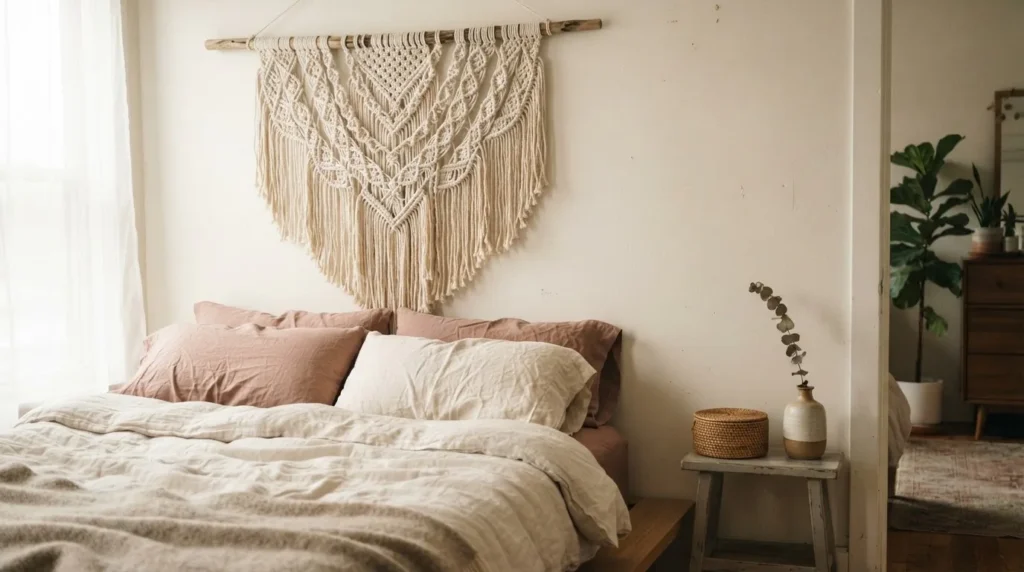
Texture is what separates a boho room from a generic apartment. Flat prints alone, even good ones, tend to look a little one-dimensional. A macrame wall hanging or a woven textile piece adds dimension, warmth, and something the eye can physically settle into in a way that a framed print simply cannot.
Woven tapestries have been staging a real comeback as wall art, and for good reason. As designers have noted, a tapestry can be “just as impactful as a giant fine art painting” and offers the added bonus of softening acoustics and adding warmth to walls that feel cold or sterile, as covered in this Apartment Therapy piece on the woven tapestry trend. For renters, a woven hanging is especially practical because most of them hang from a simple wooden dowel, which can go up on a single adhesive hook with no drilling required.
Care note: macrame and woven pieces are easier to maintain than most people think.
Spot clean with a damp cloth and lukewarm water when needed, and avoid soaking or machine washing, which can cause the fibers to stretch or unravel.
Skip it: Giant macrame wall hangings with a strong beach-shack vibe if your space leans earthy and minimal. Scale and style still matter even within the boho umbrella.
3. Build a Boho Gallery Wall (Without the Chaos)
A gallery wall is one of the most satisfying things you can put on a rental wall, because once it is done it completely transforms the space, and it is entirely removable. The trick to a boho gallery wall that feels curated rather than random is to treat the whole arrangement as a single unit, not a collection of individual decisions.
Start by choosing a tonal anchor. Pick a color that appears in at least two or three of your pieces, even if the pieces are otherwise different. Warm cream, terracotta, and sage green are easy starting points for a boho palette. From there, vary the formats: mix one or two framed prints with a small macrame piece, a woven element, and maybe a simple mirror. That variety of format and texture is what makes it feel boho rather than just a standard art wall.
For placement, the standard used by galleries and interior designers is to hang the center of the whole arrangement at 57 inches from the floor, which corresponds to average human eye level. Treat your gallery grouping as one large piece and aim for the visual center of the whole cluster to land at that 57-inch mark.
Spacing between pieces: aim for 3 to 6 inches between frames.
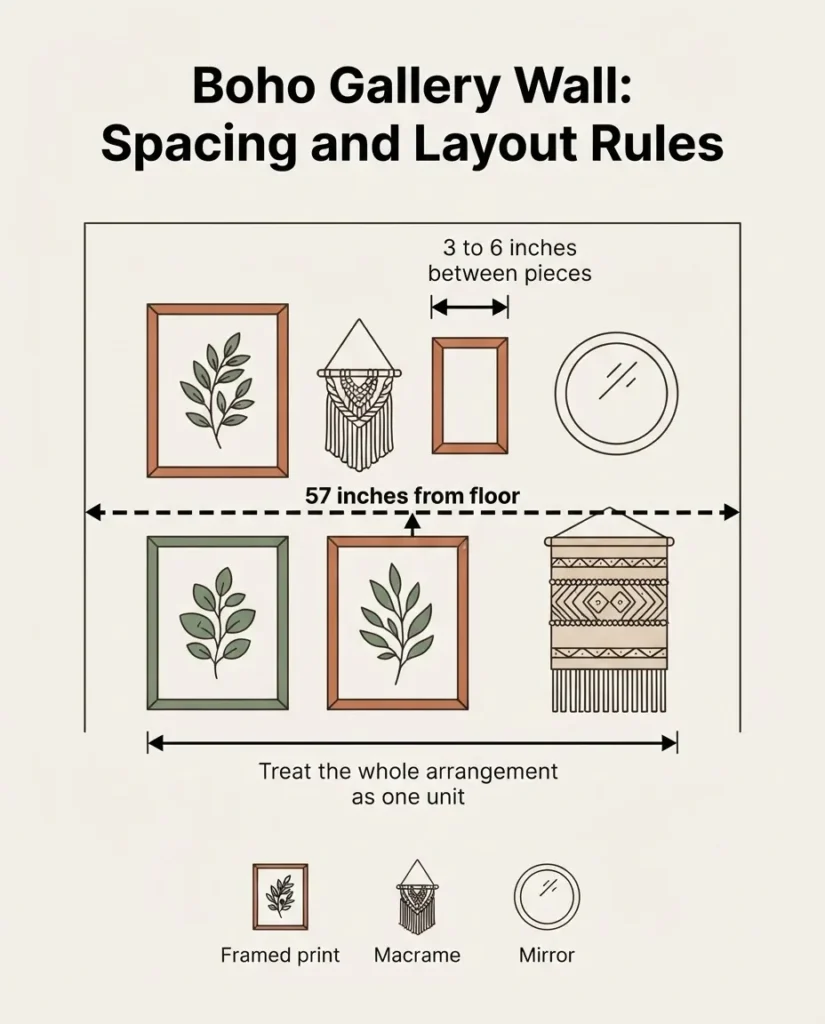
Less than 3 inches and things start to feel cramped and accidental. More than 6 to 8 inches and the pieces start to read as separate, unrelated objects instead of a cohesive grouping.
Renter note: Map out your arrangement on kraft paper or newspaper first, tape it to the wall, and live with the layout for a day before you commit to a single hook.
4. Use Earth-Tone Botanical Prints
Botanical prints are one of the easiest and most affordable entry points into boho wall art. A simple line-drawing of a monstera leaf, a fern, or a dried seedhead in a warm cream or sage green tone goes with almost any boho palette and adds that nature-connected, organic quality that is central to the style.
The easiest budget move here is to purchase a digital printable from Etsy (most run under $5 for a high-resolution file), print it at a local print shop or at home, and frame it in a simple wooden or natural-finish frame. You can get a set of coordinating botanical prints for well under $30 total, and they look genuinely beautiful when grouped in matching frames.
For anyone who has been on the fence about printable art: the print quality from a professional print shop is legitimately good, and most people cannot tell the difference between a printable and a more expensive framed print once they are matted and hung.
5. Hang Art Above Your Sofa or Headboard at the Right Height
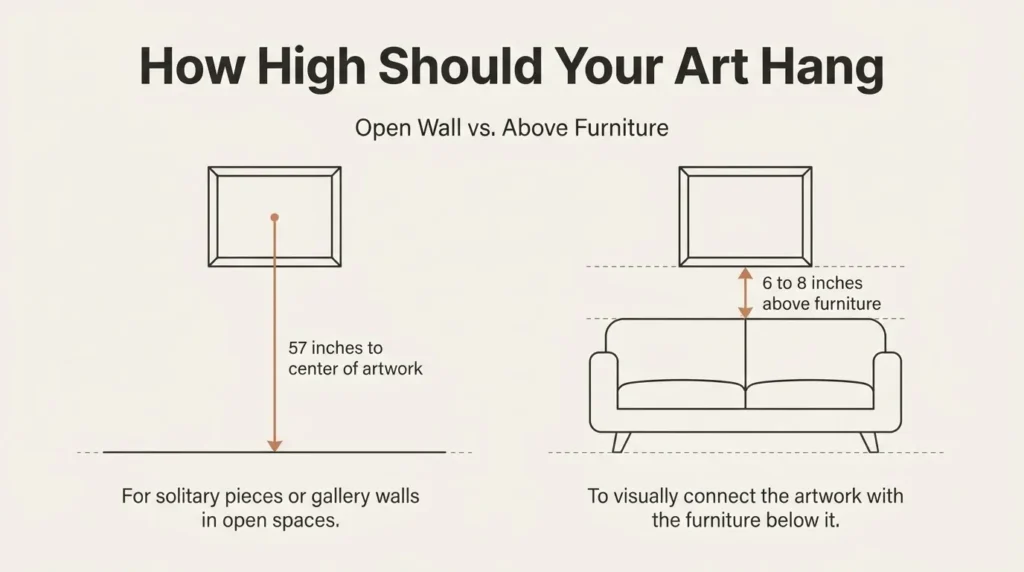
One of the most common mistakes I see in boho rooms, and honestly in any decorated room, is art hung too high. When art floats up near the ceiling, it breaks the visual connection with the furniture below it and makes the whole room feel slightly off without anyone being able to name exactly why.
The rule is simple: when hanging above a sofa, bed, or any piece of furniture, the bottom of the frame should sit 6 to 8 inches above the top of that furniture. Framebridge’s hanging guide explains this well, and the math holds up in almost every room size. For rooms with very high ceilings, resist the temptation to push art upward to “fill the space.” Hang it at the correct height and let the wall above breathe. The 57-inch center rule still applies for standalone pieces on empty walls, regardless of ceiling height.
Getting the height right costs nothing and makes more difference than almost any styling trick I know.
6. Add a Round Rattan or Wicker Wall Mirror
A round mirror in a rattan or wicker frame is one of the most practical pieces in a boho room. It reads as art, adds texture, reflects light (which is significant in a small or dark apartment), and makes a space feel larger without any renovation required. In a small apartment or studio, a well-placed mirror can genuinely change the feel of a room more than any print or hanging.
Rattan and wicker frame mirrors are widely available at a range of price points, and this is one of those pieces where budget versions often look identical to more expensive ones because the texture of the material itself does most of the visual work. This is a solid “cheap where it makes sense” category.
Hang a round rattan mirror alone as a statement, or use it within a gallery arrangement as one of the 3D or reflective elements that keeps the wall from reading flat.
7. Lean Art Instead of Hanging It
Not everything needs a hook. Leaning a large canvas or framed print against a wall, against a bookcase, or on a mantel is a completely valid styling choice and one of the most renter-friendly options there is because it leaves zero marks on the wall.
Leaned art works especially well in boho rooms because the casual, unstudied quality of it fits the aesthetic. It is the decor equivalent of tucking your hands in your pockets: it looks relaxed and unforced, which is very much the point.
For this to read as intentional rather than “I haven’t hung this yet,” the piece needs to be large enough to hold the wall on its own, generally at least 18 to 24 inches on the shorter side, and ideally propped with something in front of it at the base, like a small plant, a woven basket, or a stack of books. That grounding layer is what moves it from “leaning against the wall” to “styled against the wall.”
8. Mix Framed Prints With Unframed Tapestry Fabric
You do not have to frame everything. One of the hallmarks of a genuinely boho space is that not every piece of art is treated with the same level of formality. A printed fabric panel, a small vintage textile, or a length of batik or mudcloth can be hung directly on a dowel rod or pinned at the corners with small adhesive tacks, and it reads as intentional and layered in a way that an identical piece in a glass frame would not.
This is also one of the most affordable options on this list. A length of printed fabric or a vintage scarf from a thrift store can become a piece of wall art for a few dollars. The key is choosing fabric with a clear, interesting pattern and earthy tones that connect to the rest of the room.
For renter safety, keep fabric wall art away from heating vents and any open flame sources. This applies especially in apartments where vents are close to interior walls.
9. Try a Cluster of Small Woven Baskets
A grouping of small woven baskets hung on a wall is one of those ideas that sounds unusual until you see it done well, at which point it looks completely obvious and right. It adds serious texture to a wall, is extremely lightweight (which means adhesive hooks handle it easily), and gives that “collected over time” feeling that is central to boho at its best.
Woven wall baskets are widely available at craft stores, import home stores, and online, and they come in a range of earthy tones and weave patterns that layer beautifully together. An odd number, three, five, or seven baskets in varying sizes, tends to read as more organic and interesting than an even-numbered, symmetrical arrangement.
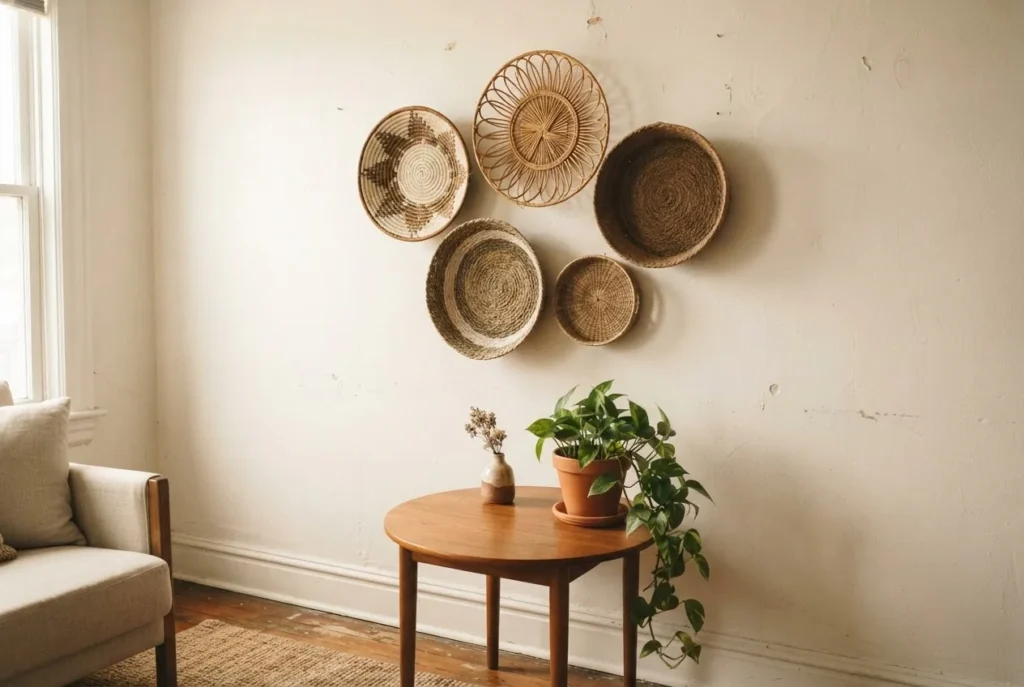
This is one of the most renter-friendly wall art ideas I know of, because most small woven baskets weigh under two pounds each, and Command’s large picture strips hold up to 16 pounds per set of four pairs, which gives you significant margin for a basket cluster without a single nail.
10. Use Pampas Grass or Dried Botanicals in Wall-Mounted Vases
This one sits on the line between art and decor, and that is exactly why it works so well in a boho space. A small bud vase or ceramic pocket mounted on the wall, holding a stem of dried pampas grass or eucalyptus, adds dimension and a natural, organic quality that no flat print can quite replicate.
Wall-mounted ceramic vases come in simple earthy finishes that pair well with any boho palette and are widely available at very accessible price points. If you want to try the look without committing to a purchase, a small standard vase set on a floating ledge shelf achieves nearly the same effect and gives you flexibility to rearrange.
Dried pampas grass specifically has had a real moment in boho decor and has earned it. The feathery texture, the warm cream and blush tones, and the way it moves slightly in air currents give a room a soft, lived-in quality that feels genuinely cozy without trying too hard.
11. Frame a Vintage Map or Old World Print
Vintage maps, botanical engravings, and old natural history illustrations are deeply boho in spirit, extremely budget-friendly (many are in the public domain and downloadable for free), and they add that “collected on my travels” quality even if you found them on your laptop at 11pm.
The Biodiversity Heritage Library and the Library of Congress digital collections both offer thousands of free, high-resolution botanical and natural history illustrations in the public domain that print beautifully at poster sizes. This is genuinely one of the best-kept secrets in budget wall art, and the quality of these old engravings is legitimately stunning when printed at size.
Frame in a simple warm-wood or matte black frame to let the illustration do the work.
Worth it: Spending a few extra dollars to get this printed at a full print shop rather than at home makes a noticeable difference in a vintage or art-focused piece.
12. Create a Floating Shelf Display With Art and Objects
A floating shelf is not wall art on its own, but it is one of the most useful tools for building a layered boho wall because it lets you mix flat art (leaned prints, a small framed photo) with three-dimensional objects like ceramics, trailing plants, crystals, or small baskets.
The key to a shelf that looks styled rather than cluttered is the same principle that applies everywhere in boho: odd numbers, variation in height, and something that trails or drapes (a small pothos or a hanging air plant works beautifully). A shelf with everything the same height and size just looks like storage. A shelf with a range of heights, a bit of negative space, and a mix of textures looks intentional.
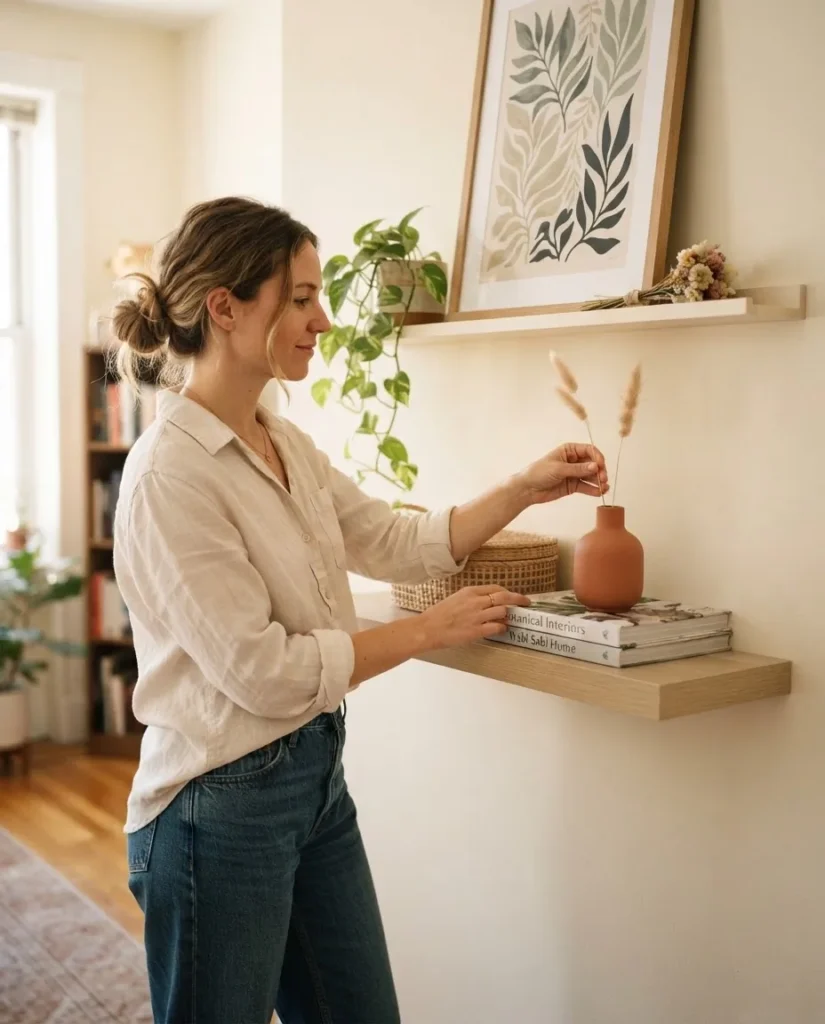
Floating shelf kits that use adhesive mounting hardware are available for lighter shelves, and many renter-friendly options hold up to 10 to 15 pounds when properly installed, making a small display shelf completely achievable without a drill.
13. Use Your Art to Tell a Story, Not Decorate a Wall
This one is less a specific item and more a mindset shift, and it might be the most useful thing on this list.
The boho rooms that feel the most alive are not the ones with the most art. They are the ones where you can sense that a real person chose each piece for a reason. A print of a plant you love. A woven hanging from a market you remember. A map of a place that matters to you. A piece of art a friend made. That sense of personal meaning is what makes a space feel collected rather than decorated.
You do not need to have traveled the world to build a wall that feels like it. You need to be a little deliberate about what you choose and resist the urge to fill every inch just because it is there. A few pieces you genuinely love will always look better than a full wall of things you bought because they were supposed to go together.
For all the practical guidance on how to actually hang a gallery arrangement and get the spacing and heights right, Park West Gallery’s three-rule guide to hanging art is one of the clearest, most straightforward references I have found.
Putting It Together: The One Principle Worth Remembering
Boho wall art earns its warmth through layering, and layering works because each thing adds something the others do not. A flat print, a textured hanging, a mirror, something living or dried. Once you have that mix, the room has depth. Once you have a shared color anchor, it has coherence. Once you stop trying to fill every inch, it has calm.
Your walls do not have to be expensive to feel like yours. They just have to be chosen. And for renters especially, the fact that all of this is removable means you can take your whole layered, collected, cozy corner with you when you go. That is the part I have always loved most about decorating this way.
Start with one piece. See how the room responds. Then add another. The wall will tell you when it is done.