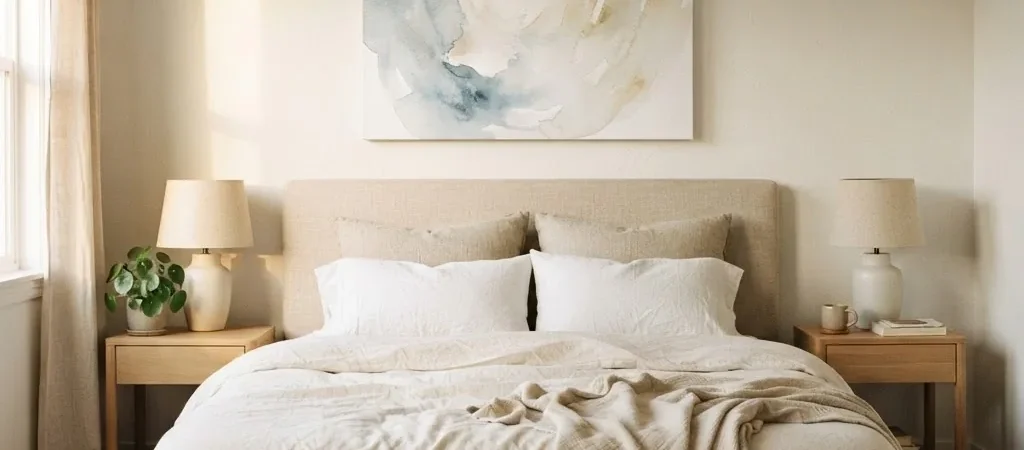
There is a particular kind of bedroom that I keep coming back to in my memory. No expensive furniture, no designer wallpaper, just a few well-chosen canvas prints hung at the right height, in the right proportion, over a bed that was made up with simple, layered bedding. The whole room felt considered. Calm. Like someone actually lived there and meant it.
That is what canvas prints can do for a bedroom, and it is also why getting it slightly wrong is so frustrating. Too small and the art floats awkwardly above the bed. Too high and it looks like an afterthought. Wrong subject matter and the room feels busy instead of restful. And if you are renting, there is the added anxiety of walls you cannot freely mess up.
This guide is built around those real concerns. Not just “here are 17 pretty canvas ideas” but here is what to get, how big it should be, where to hang it, how to hang it without wrecking your deposit, and what the art itself should look and feel like if you want your bedroom to be a place you actually want to spend time. Every idea here is renter-friendly, budget-aware, and doable in a real space.
Why Canvas Prints Make So Much Sense in a Bedroom
Before we get into the ideas, it helps to understand why canvas works so well in this particular room. Unlike framed prints, a gallery-wrapped canvas hangs without glass, which means no glare from your bedside lamp or morning light. The texture of the canvas surface catches light softly throughout the day, adding a quiet warmth that a flat paper print under glass simply cannot replicate. It also hangs flush to the wall and, because it does not require a frame, tends to look cleaner and less fussy in spaces that are already full of furniture.
From a practical standpoint, canvas prints are also among the more forgiving options for renters. Lighter canvas prints can be hung with damage-free adhesive strips, and the fact that canvas wraps around a wooden stretcher frame means the whole piece has a bit of structural integrity that helps it hang straight and stay put.
Research into bedroom art and sleep quality suggests that the imagery and color palette we choose for our bedroom walls genuinely influences how restful the space feels. According to About Wall Art’s guide on how bedroom wall art ideas can impact your quality of rest, the colors, subjects, and scale of wall art all shape whether a room feels restful or restless. That is worth thinking about when you are choosing what to hang in the one room that is supposed to help you decompress.
What “Gallery Wrapped” Actually Means (and Why It Matters)
Before the ideas, a quick note on canvas types, because this trips people up constantly. A gallery-wrapped canvas is a print that is stretched over a wooden frame, with the image continuing around the sides of the frame. The result is that it hangs with no visible border, no glass, and no additional frame required. It looks clean and modern on the wall.
A stretched canvas is similar but the image stops at the edge of the front face, with the sides typically painted in a solid color or left as raw canvas. This is the type you more commonly see sold as blank artist canvases. For bedroom decor purposes, gallery-wrapped is usually the better-looking option because those wrapped sides look intentional and finished, whereas plain raw sides can look a bit unfinished up close.
You can also find canvas prints sold in floating frames, which are thin wooden or metal frames that hold the canvas with a visible gap between the canvas edge and the frame. This looks intentional and adds visual weight, which can be nice for smaller prints that need a little more presence on the wall.
Sizing: The Rules That Will Save You From a Frustrating Return
Getting the size right matters more than almost any other decision. Too small is the single most common mistake, and it is heartbreaking because people buy something they actually love and then it just does not work in the space.
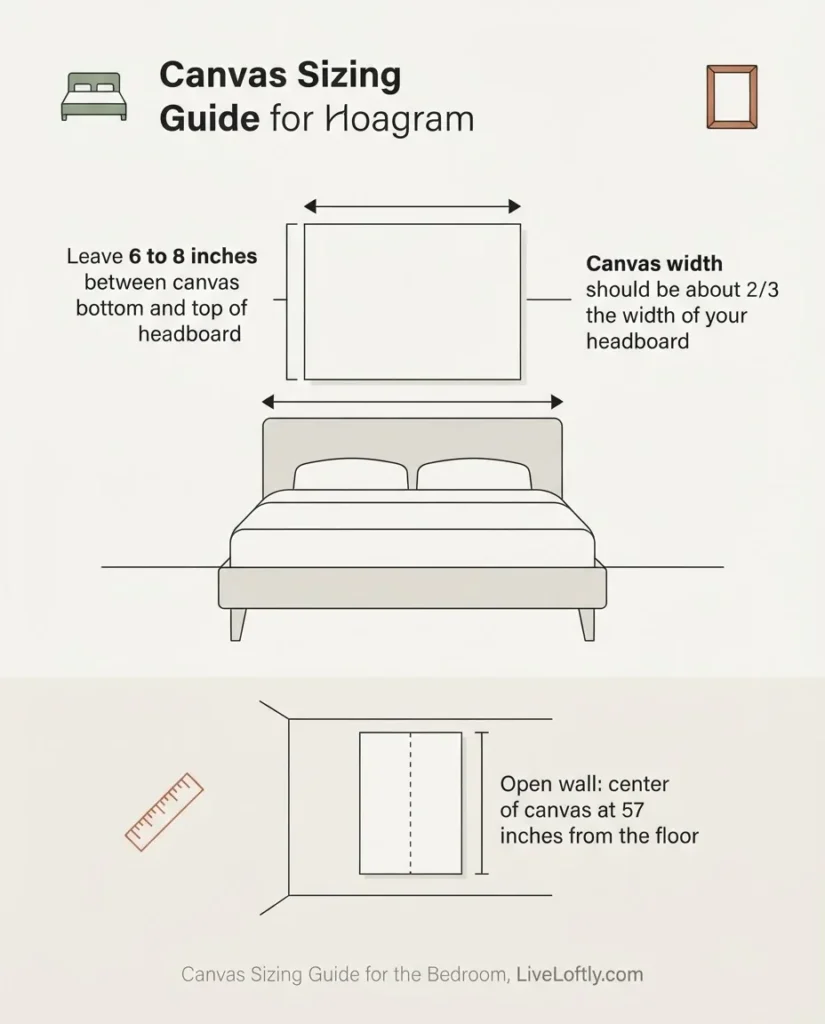
For a canvas above a bed, the most reliable proportional guide is the two-thirds rule: the width of the art or art arrangement should be roughly two-thirds the width of your headboard or bed frame. This keeps the piece visually anchored to the bed without overwhelming the wall. A king-size bed might call for a 48-inch or wider canvas, while a twin might be perfectly served by a 24-inch print.
If you are hanging a set of three prints as a triptych, the combined width of all three panels should still hit that two-thirds target.
Nations Photo Lab’s wall art size guide is a useful reference here. For smaller spaces and apartment bedrooms, standard sizes like 16×20 or 18×24 work well above a nightstand or a narrow dresser wall. For a statement piece above a queen bed, 24×36 is often a sweet spot that reads well from across the room without being overwhelming.
One note for small bedrooms specifically: you do not need to shrink the art to match the room size. A single slightly larger piece in a small room often reads better than several tiny ones. It draws the eye to one point and actually makes the room feel more settled, not more crowded.
17 Canvas Print Ideas for a Cozy Bedroom
1. One Large Statement Canvas Centered Above the Bed
This is the simplest move and still one of the best. A single wide canvas, hung centered over the headboard, immediately anchors the room. It gives the bed a focal point and makes the space feel intentional without requiring any arrangement decisions. Choose a horizontal canvas in a calm palette: think soft watercolor landscapes, abstract washes of blue and white, or a botanical study on a cream background. For a queen or king bed, aim for a canvas that is at least 40 inches wide so it reads as substantial from across the room.
2. A Triptych (Three-Panel Set) for Visual Width
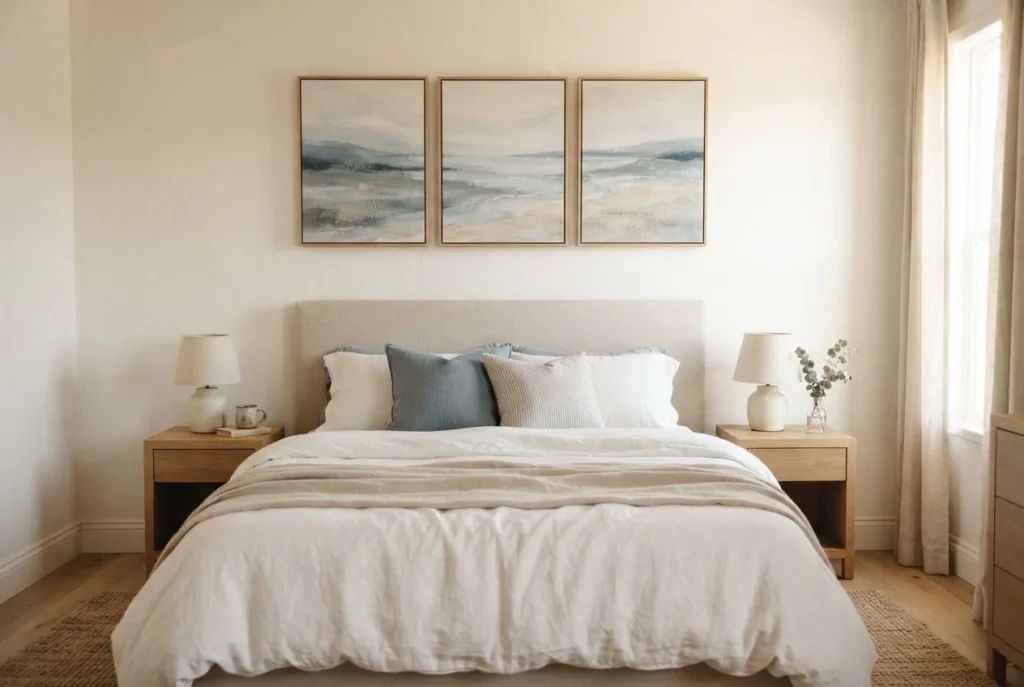
A triptych, which is three canvas panels hung as a group with small gaps between them, is a renter-favorite solution for creating the visual weight of a large piece without the cost or the challenge of moving one big canvas. The three panels together should hit that two-thirds width rule. Gaps between each panel are typically two to four inches, close enough that the eye reads them as one composition rather than three separate pieces. This format works especially well with landscape photography or abstract color-field art where the image flows naturally across all three panels.
3. Botanical Prints for an Instant Calm
If you tend to feel stressed in cluttered or visually busy spaces, botanical canvas prints are one of the most reliably calming choices for a bedroom. Ferns, tropical leaves, simple branch studies, and abstract botanical shapes in soft greens, creams, or sage tones bring in the visual language of nature without any maintenance. A set of two or three botanical prints in matching frames hung symmetrically above the bed creates a clean, almost spa-like feel that holds up across seasons.
4. Abstract Watercolor in Muted Tones
Abstract art gets a bad reputation in bedrooms because people associate it with loud, energetic canvases. The key word, though, is muted. A soft watercolor abstract in dusty blues, blush, taupe, or sage can be among the most calming things you put on a bedroom wall. The loose, organic movement of watercolor feels effortless and warm, and because the colors are gentle rather than saturated, the eye can rest on it comfortably. Look for abstract canvases with no hard edges and soft transitions between tones.
Sherwin-Williams’ color psychology guide is worth a read if you are uncertain about your palette. Their color expert notes that blue is soothing and relaxing and is one of the most recommended choices for bedroom walls and, by extension, bedroom art. Greens give a sense of familiarity and nature. If your bedroom walls are neutral, you have a lot of freedom to let the art carry the color story.
5. Black-and-White Photography for a Clean, Timeless Look
Black-and-white canvas prints are one of the most budget-friendly options because you are not worrying about whether a specific shade of teal in the art clashes with your comforter. The neutral palette coordinates with almost anything. A large black-and-white landscape, architectural photo, or abstract graphic print above the bed reads as sophisticated without being cold if the subject matter is soft. Foggy forests, ocean waves, rolling dunes, and mountain ridges all translate beautifully in black and white.
6. A Coastal or Seascape Canvas for a Breathy Feel
Coastal canvas prints remain popular for bedrooms because the ocean is one of the most universally relaxing visual subjects. Soft seascape photography, loose watercolor beach illustrations, or abstract ocean-inspired canvases in sea-glass blues, sandy taupes, and whites all work well. This style is especially good at making a small or low-ceilinged bedroom feel more open because the horizon line in the art pulls the eye outward.
7. A Single Oversized Canvas Leaning Against the Wall
For renters who are genuinely worried about holes or for anyone who wants maximum flexibility, consider skipping the hanging altogether. A large canvas print, propped and leaning against the wall behind the bed or atop a wide dresser, is a completely legitimate styling choice. It looks intentional when the canvas is at least 24×36 inches or larger (smaller canvases leaned against a wall just look like you forgot to hang them). You can layer a smaller framed piece leaned in front of it for depth.
8. Minimal Line Art for a Simple, Modern Bedroom
Single-line or minimal outline art has become a go-to for renters and first-time decorators because it is affordable, widely available, and works in almost any color scheme. A minimal line drawing of a face, a botanical shape, or a simple landscape on a cream or white canvas background is clean and unobtrusive, which is exactly right for a bedroom where you want calm rather than stimulation. Look for these on Etsy or print-on-demand sites, where they can often be bought as digital downloads you print yourself for a fraction of the cost.
9. A Warm Earth-Toned Abstract for a Cozy Boho Feel
If your bedroom leans warmer, think rust, terracotta, warm browns, and ochre rather than cool blues and greens. Earth-toned abstract canvas prints pair beautifully with linen bedding, wooden furniture, and woven textures, and they bring a grounded, cozy quality that is different from the airy calm of cool-toned art. This style suits cottagecore, boho, and Southwestern-influenced rooms particularly well.
10. A Sage Green Nature Scene for a Soft, Fresh Vibe
Sage green became a dominant bedroom color trend over the last several years because it reads simultaneously as natural, calming, and fresh. A canvas print in sage, soft olive, or dusty eucalyptus tones brings that same quality to any bedroom wall, regardless of your paint color. Botanical prints, abstract landscapes, and loose nature illustrations in the sage family are among the most easy-to-live-with choices for long-term decorating because the color never feels overdone.
11. A Set of Two Symmetrical Prints on Either Side of the Bed
Instead of one piece above the bed, try two matching or complementary canvases hung symmetrically on either side. This works especially well in rooms where the headboard wall is interrupted by a window, a sloped ceiling, or where there simply is not a good spot directly above the bed. Two small-to-medium canvases, around 12×16 or 16×20, hung at matching heights above the nightstands create a sense of balance that mirrors the natural symmetry of the bed itself.
12. A Large Canvas Above the Dresser
The wall above a dresser is one of the most underused real estate spots in a bedroom. A single canvas hung 6-8 inches above the dresser surface, proportional to the width of the dresser itself, creates a styled vignette that feels pulled together. You can reinforce the styling by placing a small tray, a plant, or a lamp on the dresser surface below.
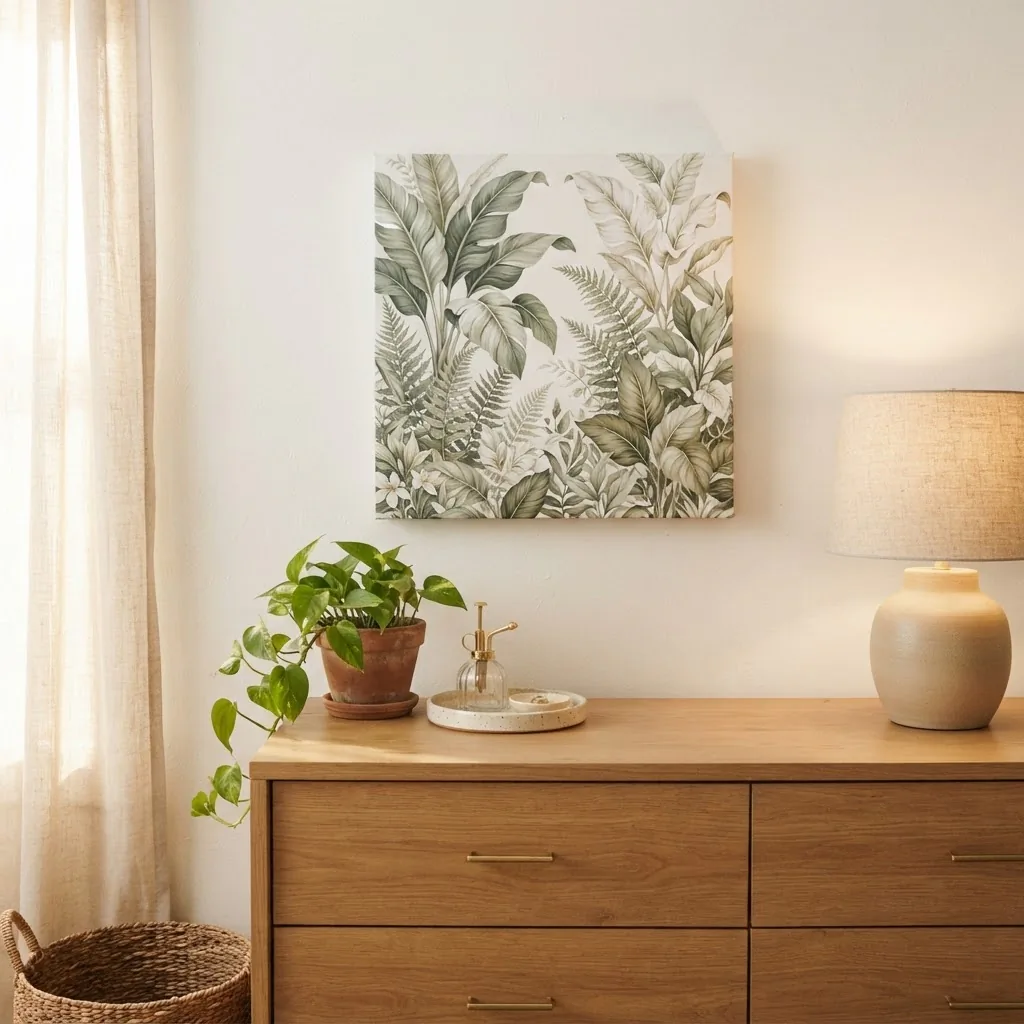
For a dresser that is around 48 inches wide, a canvas in the 24×30 or 24×36 range tends to look right without being too heavy.
13. A Canvas in a Reading Nook or Corner
If your bedroom has a small reading chair, a window seat, or just a corner you have carved out as a quiet spot, a canvas print on the wall beside or above it turns that corner into a real moment. A single vertical canvas with a subject that feels contemplative, a forest path, a stack of books, a simple floral study, reinforces the idea that this spot is intentional and meant for quiet. In small apartments where the bedroom is the only private space, this kind of corner can carry a lot of meaning.
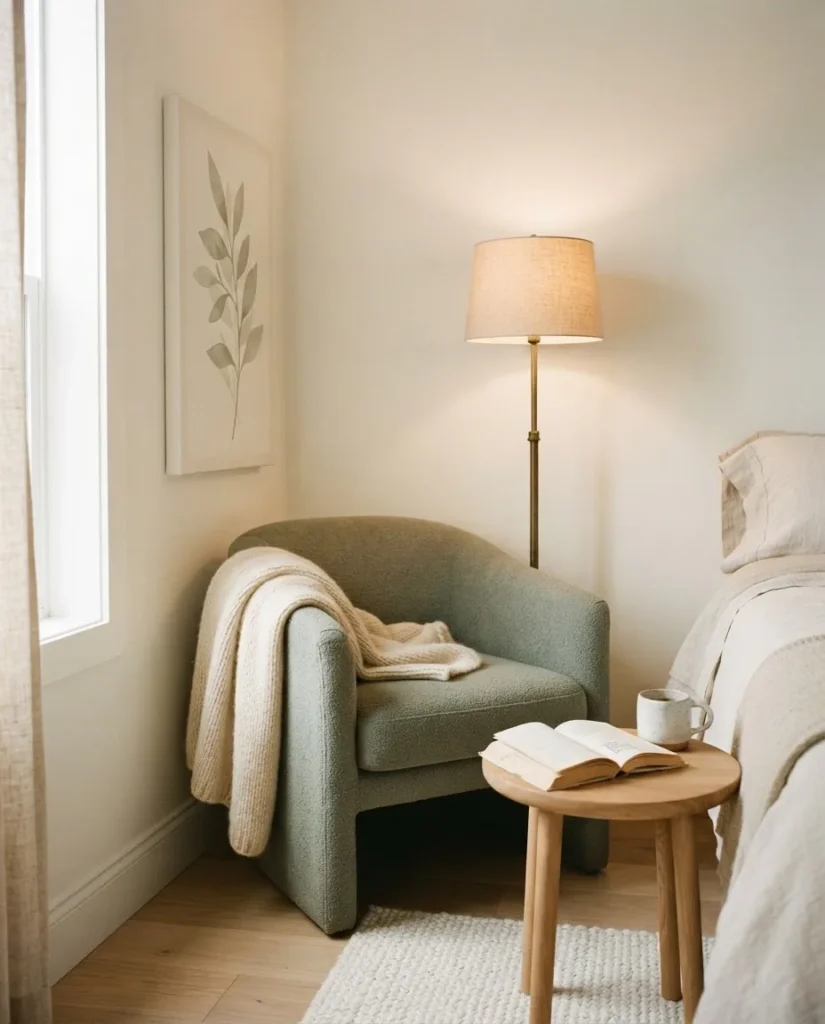
14. A Custom Photo Canvas for Something Personal
A photo canvas of a landscape, a place that matters to you, a trip you took, a view you love, adds something that no mass-produced print can: your actual story. Custom photo canvas printing is genuinely affordable now. Many print labs offer 11×14 canvases for under $25 during sales, and 16×20 or 20×24 sizes for $35-$65. The result is a piece that looks polished on the wall and is completely personal. For a bedroom specifically, that personalness matters. This is the room that is just for you.
15. A Minimalist Landscape for the Wall Opposite the Bed
The wall you look at when you are lying down and the wall above your head are different in one important way: the wall you face is what you see as you are falling asleep. A minimalist canvas on that wall, something spare and quiet, a single horizon line, a soft gradient, a simple moon or sky image, gives your eyes a place to rest that does not demand anything from you. That is a small thing and also not a small thing at all.
16. A Vintage or Retro-Toned Print for Warmth and Character
Vintage-style canvas prints, think faded maps, old botanical illustrations, antique-toned travel prints, or warm-sepia photographs, bring a sense of history and character that makes a room feel lived-in rather than freshly staged. These work especially well in rentals where the original character of the space has been stripped out by neutral paint and generic fixtures. A single vintage-toned canvas can make a room feel like it has been decorated over time, by a person with taste, rather than assembled in a hurry.
17. A Gallery Cluster of Mixed-Size Canvas Prints
A bedroom gallery wall made entirely of canvas prints, no frames required, has a softer, more organic quality than a traditional gallery wall of framed art. Because all the pieces share the same medium and depth, the wall reads as cohesive even if the sizes vary. Keep the color palette tied together, two or three anchoring tones across all the prints, and aim for that two-thirds width proportion over the bed as a whole.
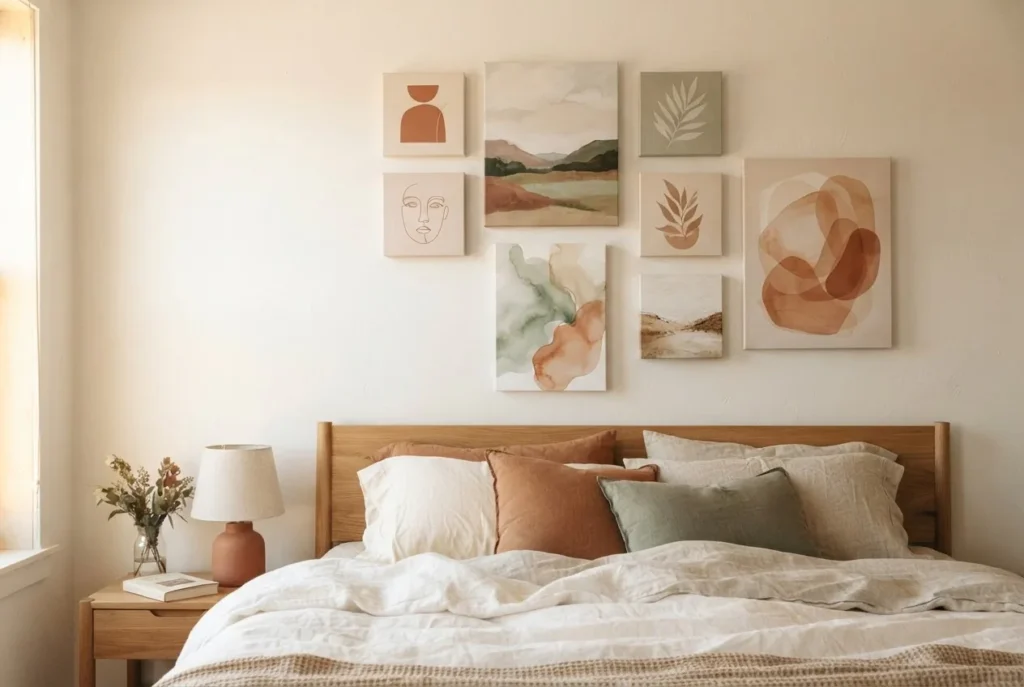
Start with your largest piece centered and build outward, keeping gaps between pieces consistent at two to three inches.
How High to Hang It: The Numbers That Actually Help
Getting the hanging height right is where a lot of otherwise good instincts fall apart. People tend to hang art too high. It is an almost universal tendency, and the result is that the art floats up toward the ceiling rather than relating to the furniture and the people in the room.
For an open bedroom wall, the standard guideline used by most galleries and museums places the center of the artwork at 57 inches from the floor. Apartment Therapy has a thorough breakdown of how to execute the 57-inch rule step by step, including how to calculate where the nail actually goes (which is almost never at 57 inches, because you are measuring to the center of the piece, not the hook).
Above a headboard, the rules shift. According to Spoak’s guide to the dos and don’ts of hanging art above a bed, the bottom edge of the canvas should sit about 6-8 inches above the top of the headboard. This keeps the art visually connected to the bed below it while leaving enough clearance that you will not accidentally knock it with a pillow. If you do not have a headboard, measure 6-8 inches above the top of your stacked pillows.
For the width calculation, Spoak confirms the two-thirds rule: your canvas or canvas arrangement should be at least two-thirds the width of your headboard. Wider is usually better than narrower. A piece that is slightly too wide looks bold and intentional. A piece that is notably too narrow looks like a mistake.
How to Hang Canvas Prints Without Ruining Your Walls
This is the section for renters, and it is also for anyone who has ever stood in front of a wall holding a hammer, felt vaguely anxious, and put the art back in the closet instead.
The honest truth is that for most canvas prints under about 10 lbs, damage-free adhesive hanging strips are a legitimate and deposit-safe solution. The official 3M Command picture hanging strips guide explains how they work and what each size holds. Large strips used in full sets of four can hold up to 16 lbs, which covers most standard canvas prints. A few important caveats from their own instructions: wait at least 7 days after painting before applying strips to any wall, and they do not recommend hanging over beds. That last one is worth noting. For canvases directly above the headboard, a single small nail at a slight upward angle is often the most secure and lowest-damage option, and a small nail hole is infinitely easier to fill with a tiny bit of spackling compound and touch-up paint when you move out.
For lighter prints going on side walls, near corners, or above a dresser rather than directly over your sleeping space, damage-free strips are genuinely excellent. They come off cleanly and leave walls intact as long as you follow the removal instructions carefully.
Another renter option worth knowing about is the picture rail system, which uses a thin rail installed near the ceiling with hanging wires or rods that reach down to hold the art. These leave only small screw holes at ceiling level (usually easier to patch) and allow you to move art endlessly without adding new holes. They are particularly useful if you like to rearrange often.
What Makes a Canvas Print Look Cheap (and How to Avoid It)
Before you hit purchase, a few honest notes on quality, because not all canvas prints are created equal and the gap between a canvas that looks like a considered art purchase and one that reads as a novelty item is real.
Pixelation is the most immediate giveaway. A canvas print that was made from a low-resolution image will show obvious blurring or a grid-like pixel pattern up close. If you are ordering a custom photo canvas, most reputable labs will have minimum resolution requirements. For a print at 16×20 inches, you generally want a source image that is at least 2400 x 3000 pixels. Anything less and you are taking a risk.
Thin stretcher bars are the next issue. A canvas print on cheap, thin wooden bars often has a slight bow to it, and when it hangs on the wall there are visible gaps at the corners where the canvas is not taut. Good quality canvas prints use thick kiln-dried wood stretcher bars (typically 1.5 inches deep) that keep the canvas flat and taut even as humidity fluctuates.
Color saturation and UV resistance matter for longevity. A canvas print in a sunny bedroom can fade noticeably over a few years if the inks are not UV-resistant. Better-quality print labs use archival inks that resist fading significantly longer. It is worth paying a bit more for this if the print is going on a wall that gets direct morning or afternoon sun.
Color, Mood, and What Your Bedroom Art Is Actually Saying
The subject matter and color palette of your bedroom art do real work in the room, even when you are not consciously looking at it. Colors and imagery set a baseline tone for how a space feels.
Cool tones, particularly soft blues, muted sage greens, misty grays, and warm whites, are the most reliably restful choices for bedroom art because they are associated with calm and reduce visual tension. Highly saturated versions of even cool colors can feel stimulating rather than restful, so look for desaturated, muted versions: dusty blue rather than cobalt, sage rather than bright kelly green.
Subject matter matters too. Landscapes, nature scenes, botanical subjects, and soft abstracts all give the eye somewhere restful to land. Figurative art with strong, direct gazes or portraits can sometimes feel subtly alert-making in a bedroom, which is worth considering if you are sensitive to that kind of thing. Busy geometric patterns and high-contrast graphic prints can feel activating rather than calming, which makes them better choices for a reading nook or side wall you look at when you are awake and engaged, rather than the wall directly in your sightline from the bed.
If you want to go deeper into the color-mood connection, Artacademi has a thoughtful breakdown of the 57-inch museum rule and eye-level ergonomics that also touches on how viewing position shapes the emotional experience of art in a room, which is worth a read if you are a detail person who wants to understand why these placement rules work rather than just following them.
A Few Final Thoughts on Building a Bedroom You Actually Love
The bedroom is the room in your home where you start every day and end every day. It is the last thing you see before you close your eyes and the first thing your brain registers in the morning. It deserves to feel like yours, even if you are renting it, even if you share it, even if your budget is modest.
Canvas prints are one of the most accessible ways to make that happen because they are affordable, lightweight, flexible, and genuinely beautiful when you choose them with a little intention. You do not need to buy everything at once. Start with one piece above the bed that makes you feel calm when you look at it, get the sizing and the height right, and see how the room shifts. You might be surprised how much one well-placed canvas can change the way a space feels.
That is the thing about decorating I keep coming back to: it is almost never about spending more. It is about a little knowledge, a little patience, and making one decision at a time.