There’s a specific kind of frustration that comes from a hallway wall. You walk past it every single day, it’s perfectly blank, and every time you think about doing something with it, you get stuck. It’s too narrow for most of the advice out there. It’s too short, or too long, or too dark, or it turns a weird corner. And if you’re renting, there’s that extra layer of hesitation: you want it to feel like home, but you also want your deposit back at the end of the lease.
I’ve decorated more hallways in more rentals than I can count, and I’ll tell you what I wish someone had told me at the start. A hallway wall is actually one of the most satisfying things to get right, precisely because it’s small, contained, and doesn’t cost much to change. The ideas below are organized the way I’d actually think through a real hallway, from the quick fixes you can do this weekend to the slightly more involved ideas that still stay renter-safe. Every single one of these is doable without a designer, without drilling into walls you aren’t allowed to touch, and without spending money you don’t have.
Start With What the Wall Is Actually Asking For
Before you buy anything, stand in your hallway for a minute. I know that sounds overly simple, but it genuinely changes what you’ll reach for. Ask yourself three things: Is this hallway short or long? Is it narrow or a little more generous? And is it dark or does it get some natural light?
A long, narrow hallway with no windows is a completely different styling problem than a short entry corridor with a window at the end. Long hallways benefit from something that draws the eye along the wall and gives it a rhythm, whether that’s a series of small framed prints, a runner rug on the floor below, or a repeating element like identical hooks or sconces. Short hallways do better with one or two intentional pieces rather than a collection, because there isn’t enough wall length to give a gallery wall breathing room without it feeling cramped.
Dark hallways call for light-reflective ideas first: a mirror, warm-toned art, or a light source on the wall. Bright hallways give you more options and can handle deeper colors and busier patterns without swallowing the space.
Once you have a clear picture of what you’re working with, the ideas below will make a lot more sense.
The Hanging Height Rule That Solves Half Your Problems
One of the most common hallway decorating mistakes I see is art hung too high. People hang it at the top of the frame rather than the center of the piece, and the result is a wall that looks strangely tall and the art looks like it’s floating up near the ceiling. It feels disconnected from the space.
The rule that actually works is this: the center of your art should sit at roughly 57 inches from the floor. That’s the guideline galleries and professional art installers use, and it works because it places the visual midpoint of the piece at average eye level, which is where it feels most natural to look. Park West Gallery’s art hanging guide explains the math simply: measure your art’s height, divide by two to find its center, then work backward from that 57-inch mark on the wall to find where your hook needs to go.
For narrow hallways specifically, this rule becomes even more important. When your corridor is only three or four feet wide, the walls feel closer and larger than they do in an open room. Art hung too high in that compressed space looks immediately wrong. Stick to 57 inches for single pieces. For a vertical series of two or three prints stacked on a tall narrow wall, center the entire group as a unit around that same 57-inch point.
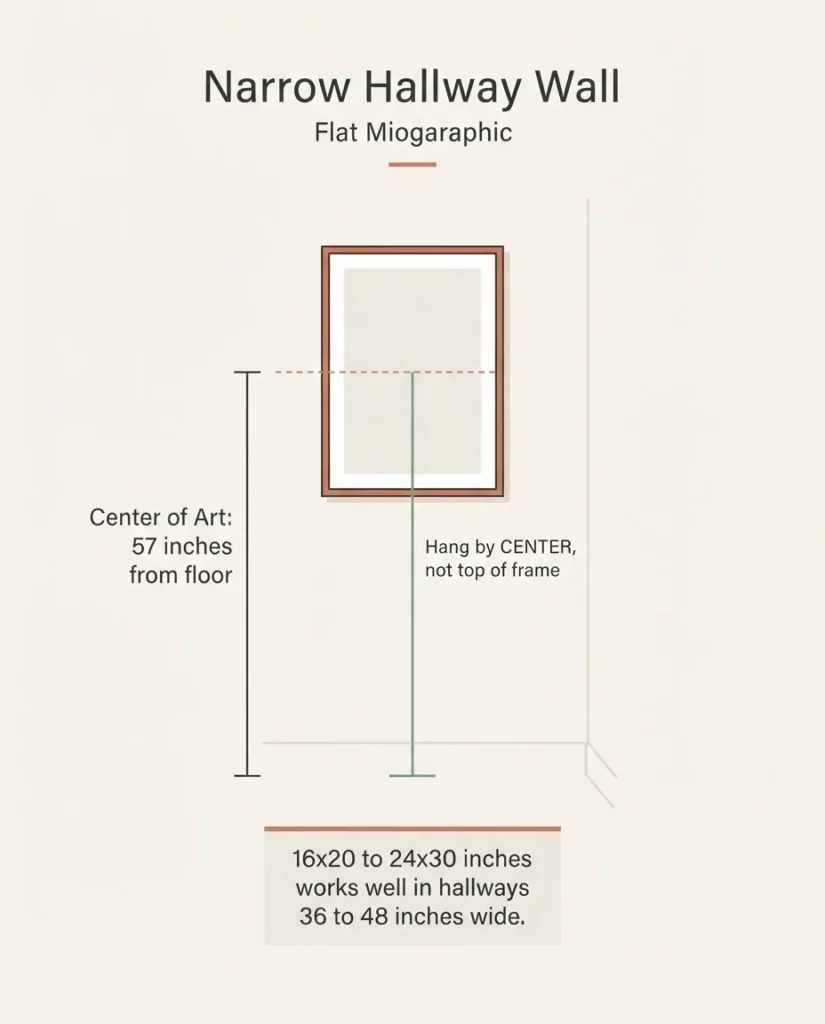
For sizing, a good starting point in a hallway that’s 36 to 48 inches wide is art in the 16×20 to 24×30 inch range. Smaller than that and pieces get lost; larger than that and they can feel like they’re reaching across the corridor at you.
18 Hallway Wall Decor Ideas for Awkward Narrow Spaces
1. A Single Oversized Print
Counterintuitively, one large piece of art often works better in a narrow hallway than a cluster of small ones. When you use one confident, well-proportioned piece, the eye has somewhere clear to land and the space feels intentional rather than busy. A single 18×24 or 20×28 inch print hung at center height reads as a deliberate design choice. Choose something with light tones or some white space in the composition if your hallway is dark, since lighter art bounces light back into the space.
2. A Vertical Gallery in a Tight Column
If you have a narrow wall but it’s tall, work with the vertical. Three or four prints stacked in a column with 3 to 4 inches of space between frames creates a sense of height and intention without spreading outward into the hallway’s width. Treat them as one unit when hanging, centering the entire column around eye level rather than centering each piece individually.
3. One Long Horizontal Print
For a long narrow hallway, a single horizontal print in a panoramic format, something in the 24×10 or 30×12 inch range, does something really useful: it reinforces the lengthwise flow of the space and gives the hall a sense of calm direction. Landscape photography, abstract horizontal compositions, or botanical panoramics work especially well here.
4. A Small Gallery Wall (Done Honestly)
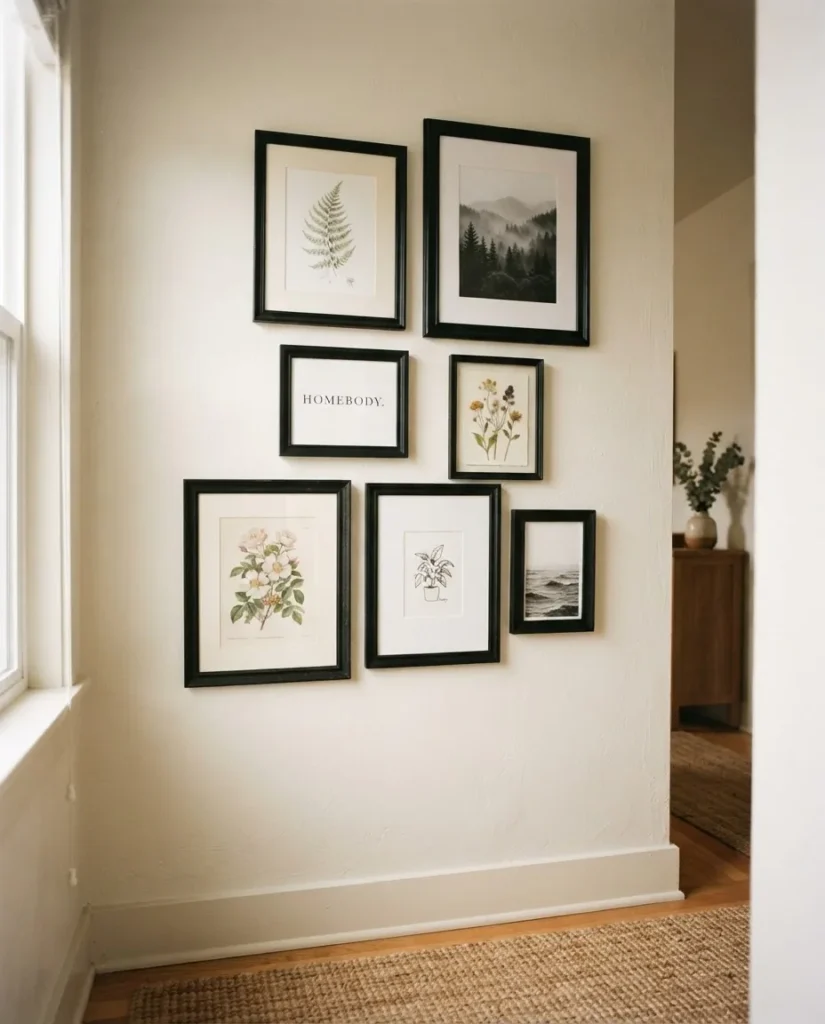
Gallery walls can absolutely work in a narrow hallway, but only if you resist the urge to pack in too many pieces. In a space this tight, three to five frames in a cohesive palette feel intentional. More than that, and it starts to look cluttered, which is the opposite of what a hallway needs. Use consistent frame finishes, wood-tone or black or white, and keep the spacing between frames to about 3 inches. Lay your arrangement out on the floor first to test it before hanging anything.
5. Damage-Free Hanging for Renters
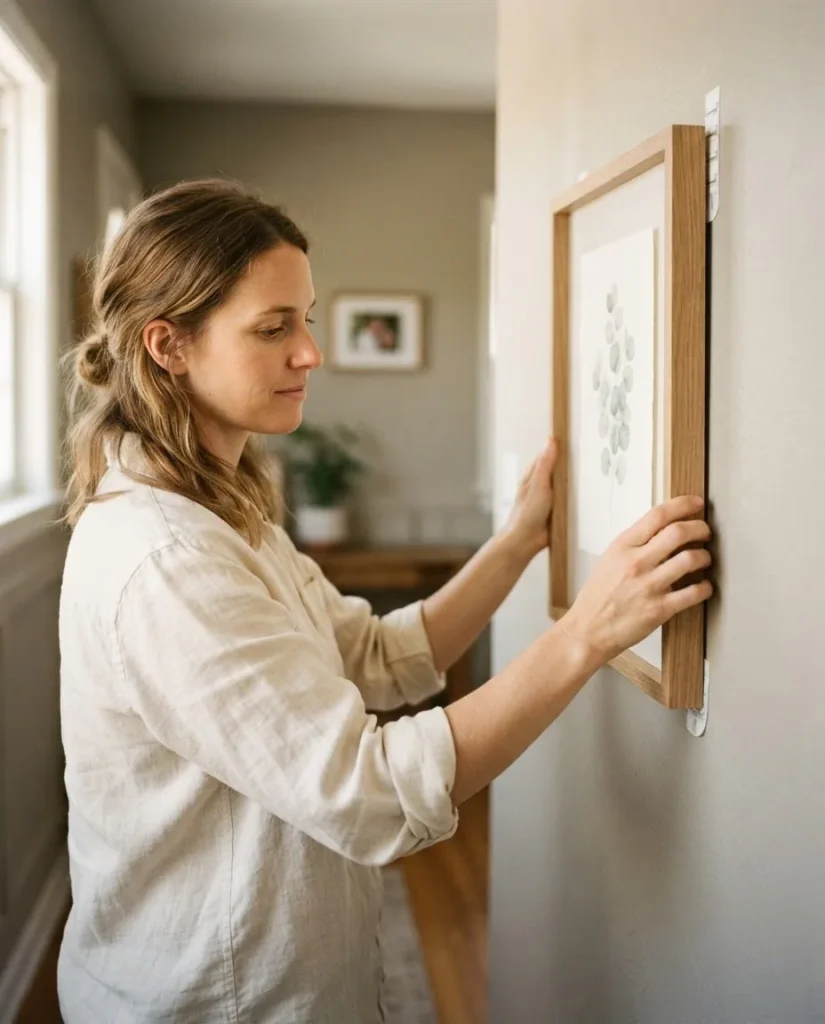
This is the part where most hallway decorating articles either gloss over the renter situation entirely or just say “use Command strips” without any useful detail. Here’s what you actually need to know. Command’s official weight limit guide shows that their large picture hanging strips support up to 16 pounds per set of four strips, which is enough for most lightweight to medium-weight framed prints. The catch is that strips work best on smooth painted walls with an eggshell or satin finish, not on heavily textured surfaces. Always press each strip firmly for 30 seconds and wait the full hour before hanging. For anything heavier than about 8 to 10 pounds, lean it on a shelf instead of hanging it on adhesive alone.
6. A Leaner Mirror
A mirror leaned against a wall instead of hung does two things at once: it makes the hallway feel wider and lighter, and it completely sidesteps the nail question. A full-length or three-quarter-length mirror leaned in a corner of the hallway or propped against the end wall bounces light back down the corridor and adds a sense of depth. Frames in antique gold, natural rattan, or simple black all work well. The renter-friendly bonus here is that leaning is genuinely stylish and not just a workaround.
7. A Hanging Textile or Woven Wall Art
Woven wall hangings and textile pieces have become popular in bohemian and cottagecore interiors, but they also work beautifully in any style hallway because they add texture without visual weight. A woven macramé piece, a tapestry, or a fabric print on a wooden dowel hangs from a single small adhesive hook and takes up very little depth. In a narrow hallway, this is a real advantage: unlike a framed print with glass, a textile sits nearly flush with the wall. They also add warmth to spaces that feel cold or echoey.
8. A Row of Matching Hooks
Functional decor is genuinely underrated in hallways. A row of three or four identical hooks in a matching finish, brass, matte black, brushed nickel, does double duty as wall decor and actual use. Coat hooks, bag hooks, or even just decorative hooks for hats and accessories look intentional when they’re evenly spaced and consistent in style. Space them 8 to 10 inches apart, keep them at a practical height of around 66 to 72 inches from the floor, and choose a style that fits your overall decor. This is one of the highest-value things you can do per dollar spent in a hallway.
9. Peel-and-Stick Wallpaper on One Wall
One accent wall of peel-and-stick wallpaper in a short hallway is one of the most dramatic changes you can make for under $60 to $100, and it’s fully renter-safe if you do it correctly. The key word there is correctly. Tempaper’s guide on what affects removability explains that peel-and-stick wallpaper works best on walls painted with eggshell or satin finish, not matte or flat paint, because matte paint can absorb the adhesive and pull away during removal. If your walls are matte, test a small sample in an inconspicuous spot and leave it for a few days before committing to the whole wall. Geometric patterns, grasscloth textures, and simple botanical prints are all excellent choices for a narrow space because they add interest without overwhelming the proportions.
10. A Runner Rug That Anchors the Wall Decor
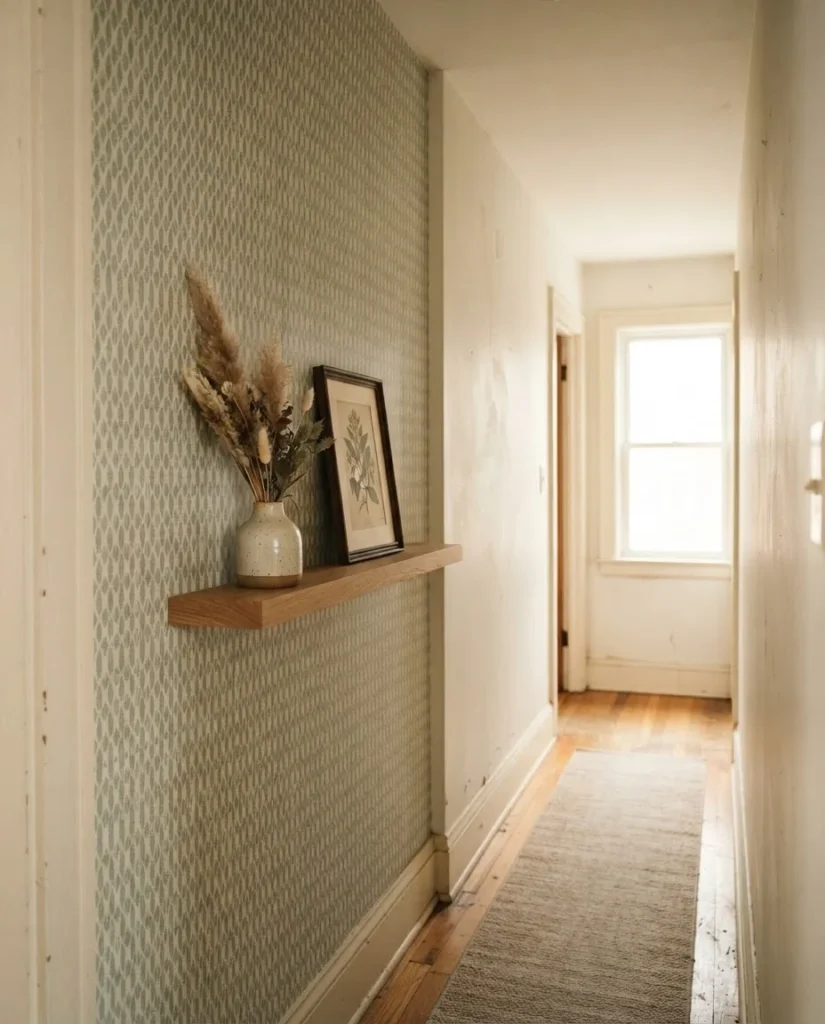
I know a runner rug is technically floor decor, not wall decor, but in a narrow hallway these two things are deeply connected. A runner grounds whatever is on the wall above it and makes the whole space feel like a room rather than just a passage.
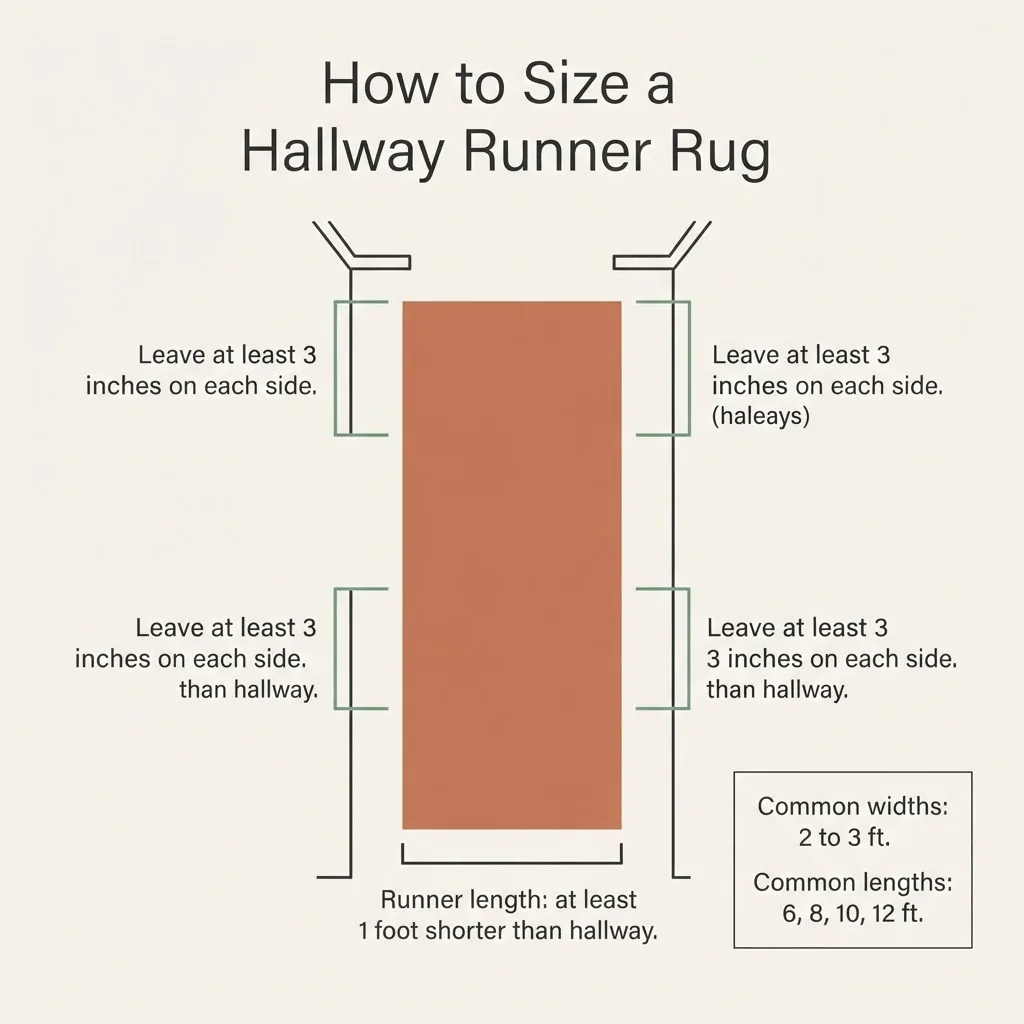
The measurement rule that matters here is that your runner should leave at least 3 inches of bare floor on each side, so if your hallway is 36 inches wide, you’d want a 24 to 30 inch wide runner. This hallway runner measuring guide from Sisal Rugs Direct confirms that standard runner widths run from 2 to 3 feet, and your runner length should be at least one foot shorter than the hallway so it sits centered with space at each end. A runner in a warm neutral or a low-contrast pattern makes the wall art above it feel more anchored and purposeful.
11. Framed Botanical Prints
Botanical illustrations are one of the most reliably good choices for hallways because they work in almost every style, from cottagecore to modern to coastal, they’re easy to find affordably as printable downloads or thrift store finds, and they tend to have a clean, calm quality that suits a transitional space. A set of three matching botanical prints in identical frames hung in a row at the same height creates a polished, intentional look without requiring any design skill beyond measuring. Black frames with white mats look clean and modern. Natural wood frames with no mat feel warmer and more relaxed.
12. Black-and-White Photography
A cohesive set of black-and-white prints, whether they’re family photos, landscapes, or abstract shots, has a timeless, editorial quality that works in narrow spaces because the monochromatic palette doesn’t compete with itself. Two to four prints in matching frames, hung in a horizontal line at eye level, is one of the simplest and most consistently good-looking things you can do with a long blank hallway wall.
13. A Small Floating Shelf With a Few Objects
If your hallway has a little depth to spare, a single slim floating shelf gives you the vertical dimension of wall decor while also creating a small landing spot for a vase, a framed photo, or a small plant. Keep the objects edited, three things maximum, and make sure the shelf doesn’t protrude more than 4 to 5 inches from the wall so it doesn’t become a navigation hazard in a tight corridor. Command Strips can support shelves in the 5 to 15 pound range depending on the product, so check the weight of your shelf and objects before mounting.
14. A Simple Arch or Shape Mirror
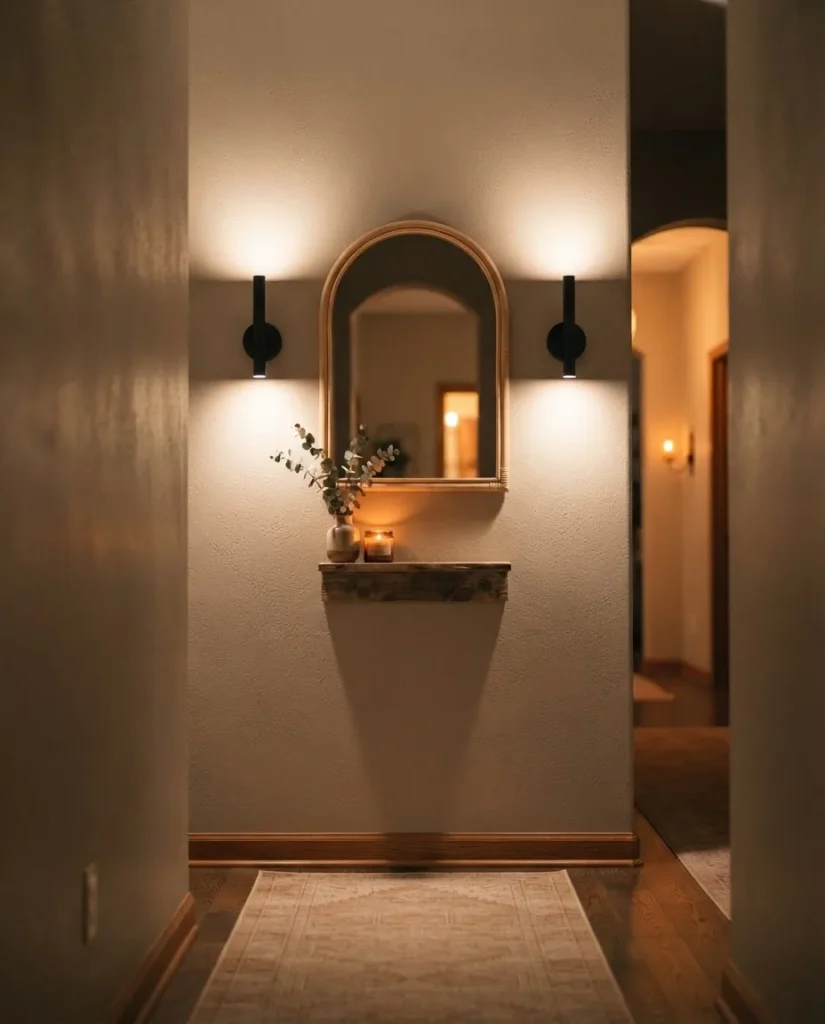
Arch mirrors, pill mirrors, and irregular organic-shaped mirrors have become easy to find at a wide range of price points, and they’re particularly well-suited to hallways because their shapes feel architectural without being heavy. A single arch mirror hung or leaned at the end of a hallway draws the eye forward and creates a sense of depth that makes the whole corridor feel longer and less claustrophobic. This is one of those hallway ideas that punches above its price point.
15. Cordless Wall Sconces for Mood Lighting
Overhead hallway lights are almost universally unflattering. They cast a harsh downward shadow and make the space feel utilitarian. A pair of cordless, rechargeable wall sconces placed on either side of a mirror or a piece of art does something genuinely transformative to a hallway. Wirecutter’s review of the best cordless rechargeable wall sconces specifically calls out their value for renters and dorm dwellers who can’t hardwire anything, and good options typically run from about $30 to $80 per sconce. Battery-operated sconces with a warm bulb temperature (look for 2700K to 3000K on the product listing) soften the whole hallway and make any art on the wall look better in the process.
16. A Thrifted Frame Collage on the Cheap
One of my favorite budget approaches for hallways is the thrift store frame collage. The idea is simple: buy any five to seven frames in a similar finish or color family, whether that’s all black, all wood-toned, or all cream, mix up the sizes, and fill them with things you actually love: a postcard, a fabric swatch, a printable, a page from an old book, a dried pressed leaf. The cost is usually under $20 for the frames if you’re patient, and the result has a personal, curated quality that no perfectly matched print set can replicate. Spray-paint mismatched frames in the same matte finish to unify them quickly.
17. Vertical Stripes With Removable Wallpaper or Washi Tape
Vertical lines visually raise a ceiling and make a narrow space feel taller. In a rental hallway where you can’t paint, you can create a simple vertical stripe effect using washi tape or cut strips of removable wallpaper in a single color. Even two or three evenly spaced vertical stripes framing a piece of art or a mirror give the wall structure and intentionality. This is a genuinely satisfying weekend project that costs almost nothing.
18. Seasonal Swap-Out Gallery
One underrated advantage of a hallway is that it’s a contained, low-commitment space to rotate decor seasonally. If you use a leaning mirror, a few removable hooks, and frames with glass fronts, you can swap out prints for under $10 whenever a season changes. Dried autumn branches framed in a simple clip frame, a single botanical print in spring, a calm abstract in winter. The hallway becomes a space that’s always fresh without ever requiring a full overhaul.
The Mistakes That Make Narrow Hallways Look Worse
It’s worth being honest about what doesn’t work, because a lot of hallway decorating advice skips this part.
Hanging art too high is the single most common problem, and it makes even nice art look wrong. Too many small pieces without enough breathing room between them creates visual noise instead of calm. Choosing frames that are too deep or art that protrudes significantly into the corridor creates a physical and visual obstacle, especially in a hallway under 40 inches wide. And using cool-toned or harsh overhead lighting without any warm supplementary light source makes every single piece of decor on the walls look flat and institutional.
The good news is that all of these are easy to fix. The hallway is a small canvas, and small canvases are forgiving. Getting one or two things right in this space is usually enough.
A Practical Note on Style
If you’re not sure which direction to go stylistically, the hallway is a great place to start small. A few black frames and botanical prints lands in a clean, calm modern space. Warm wood frames, woven hangings, and some dried botanicals lean cottagecore or boho without trying too hard. A mirror with a rattan or seagrass frame and some simple white linen-look art reads coastal. The style isn’t really the hard part. The hard part is editing down to a few things that work together, and then leaving it alone.
A calm hallway doesn’t need a lot. It needs intention. A wall that has one or two things on it that were chosen thoughtfully will always look better than a wall covered in things that were added gradually without a plan.
Where to Start This Weekend
If you’re looking at your hallway right now and feeling overwhelmed, here’s a simple starting point that works for almost any space. Hang one piece of art, a framed print you love, at 57 inches center height, centered on the longest wall. Add a runner rug below it if the floor allows, leaving at least 3 inches of floor on each side. Swap your overhead light for a warmer bulb if possible, or add one battery-powered sconce to the wall. That’s it. Three things. A hallway that felt like a corridor will start to feel like a room.
You don’t need to do everything on this list. You just need to do a few things thoughtfully, and a narrow awkward hallway becomes one of the most satisfying spots in your home to get right.