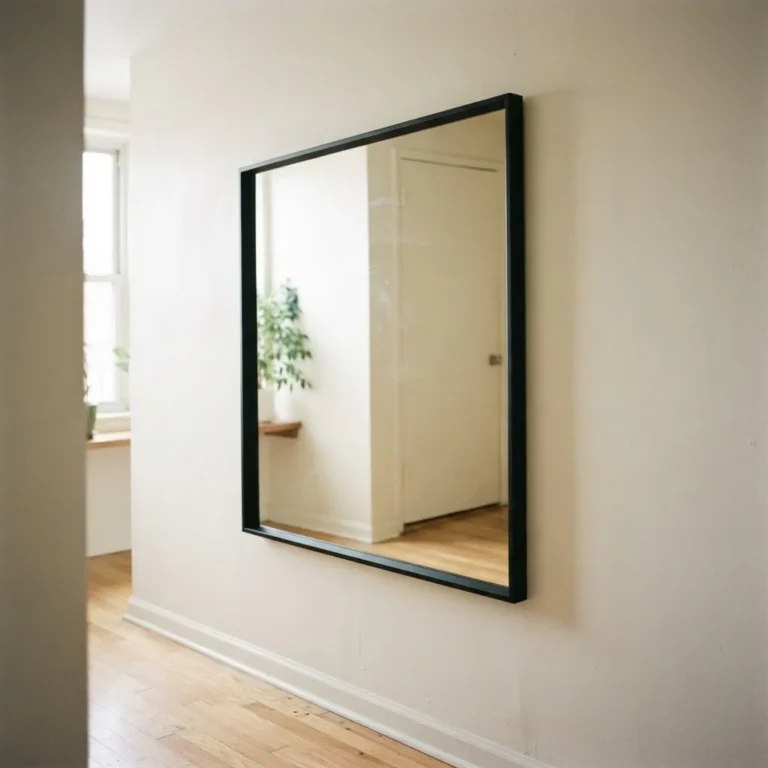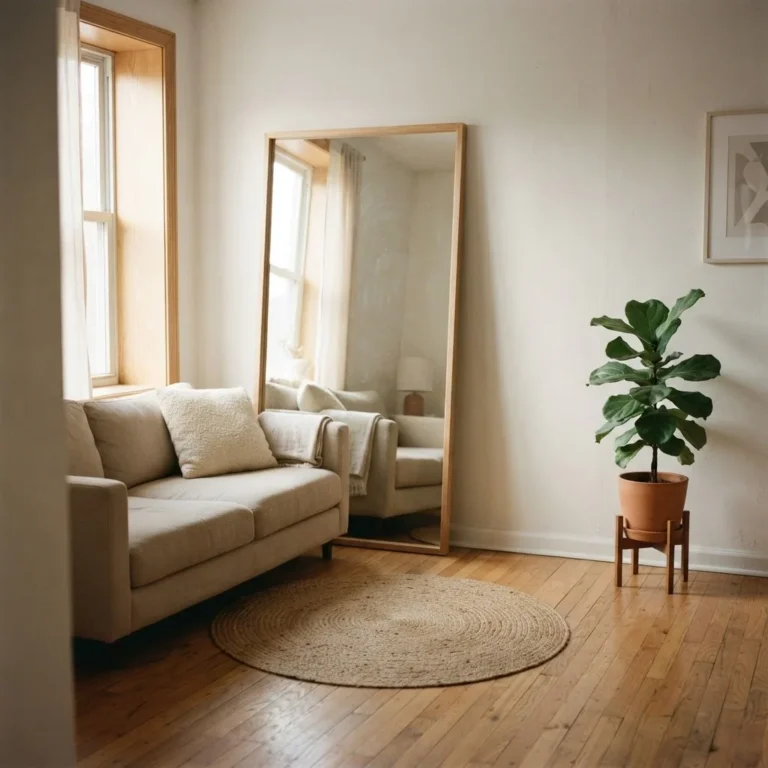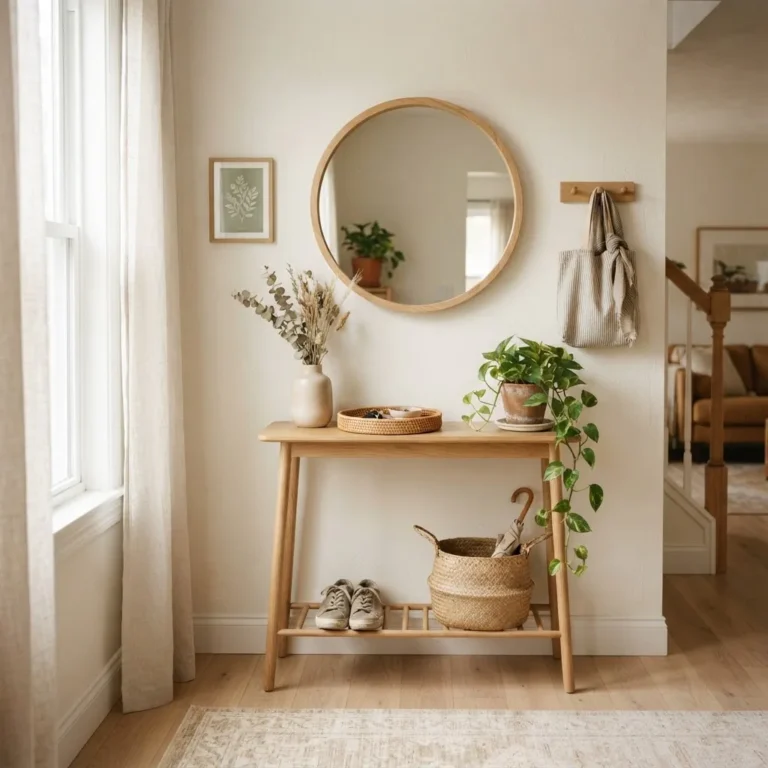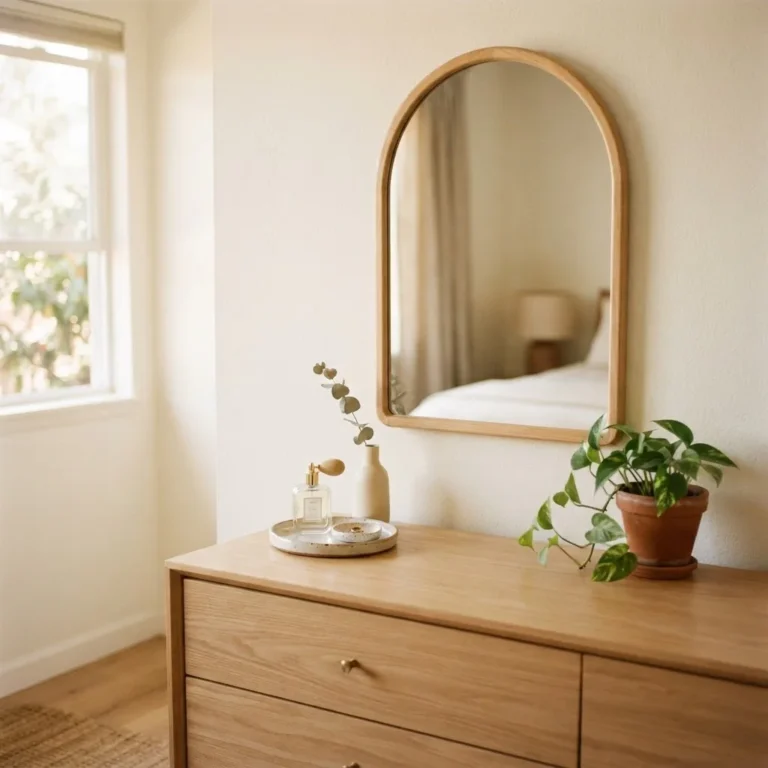
Round Mirror Wall Decor: Room-by-Room Ideas for Renters

There is a reason round mirrors keep showing up everywhere. They are one of those rare pieces of wall decor that actually does several jobs at once. They bounce light into dark corners. They soften the hard angles that most rental apartments are full of. They make a small room feel less like a box. And when you style one well, they have this way of making a whole wall look considered and calm, even if the rest of the room is still a work in progress.
I have been decorating rentals for most of my adult life, and a round mirror is almost always one of the first things I reach for when a space needs help. Not because it is trendy (though it is), but because it genuinely works. The question I hear most often is not “should I get one” but “what do I actually do with it?” So let’s go room by room, talk about sizing, placement, and hanging without destroying your walls, and I will be honest about what works and what wastes money.
Why Round Mirrors Work So Well (The Short Version)
Before we get into specific rooms, it helps to understand why the round shape keeps earning its place on walls. Most rental apartments are full of straight lines: rectangular windows, square doorframes, boxy furniture, right-angled baseboards. A round mirror cuts through all of that and introduces a softness the room is missing. Apartment Therapy has written about the science behind this, noting that research finds humans show a visual preference for curved lines over straight ones, associating them with calm and gentleness. That is not just interior design theory. You feel it when you walk into a room that has one.
Beyond the shape, mirrors are genuinely one of the most efficient tools a renter has. You are not allowed to knock out a wall to open up a room. You are not adding skylights or painting the ceiling. But you can hang a round mirror opposite your best window and essentially borrow that light and push it deeper into the space. In a small, dark apartment, that is worth more than almost any other single purchase you could make.
Getting the Sizing Right Before You Buy Anything
This is the step most people skip, and it is why mirrors sometimes look awkward. Sizing is not just about the wall, it is about the relationship between the mirror and whatever it is near.
The most useful rule of thumb I know is this: choose a mirror that is roughly two-thirds to three-quarters the width of the furniture piece directly below it. So if your console table is 48 inches wide, you want a round mirror in the 32-to-36-inch diameter range. If your dresser is 36 inches wide, something in the 24-to-27-inch range will look proportional.
For round mirrors specifically, here is a rough size guide by typical use:
- Small (12 to 18 inches): accent pieces, bathroom use, part of a cluster grouping, narrow walls
- Medium (18 to 30 inches): bedroom above a dresser, bathroom above a standard vanity, gallery wall anchor
- Large (30 to 40 inches): entryway statement, above a console table, above a sofa or mantel, living room focal point
- Oversized (40 inches and up): worth it if the wall can handle it, truly makes a room feel bigger
If you are doing a cluster of multiple smaller round mirrors, combinations of 12-16 inch, 18-24 inch, and 30-36 inch mirrors create natural visual variety without the grouping looking random.
How High to Hang It: The Number Most People Get Wrong
Hanging a mirror too high is the single most common mistake I see. People want it to feel “up on the wall” and overcorrect. The standard guidance from design professionals is that the center of the mirror should land at eye level, generally between 57 and 65 inches from the floor. For most rooms, 60 inches to center is a great default.
When the mirror is going above a piece of furniture, the height shifts.
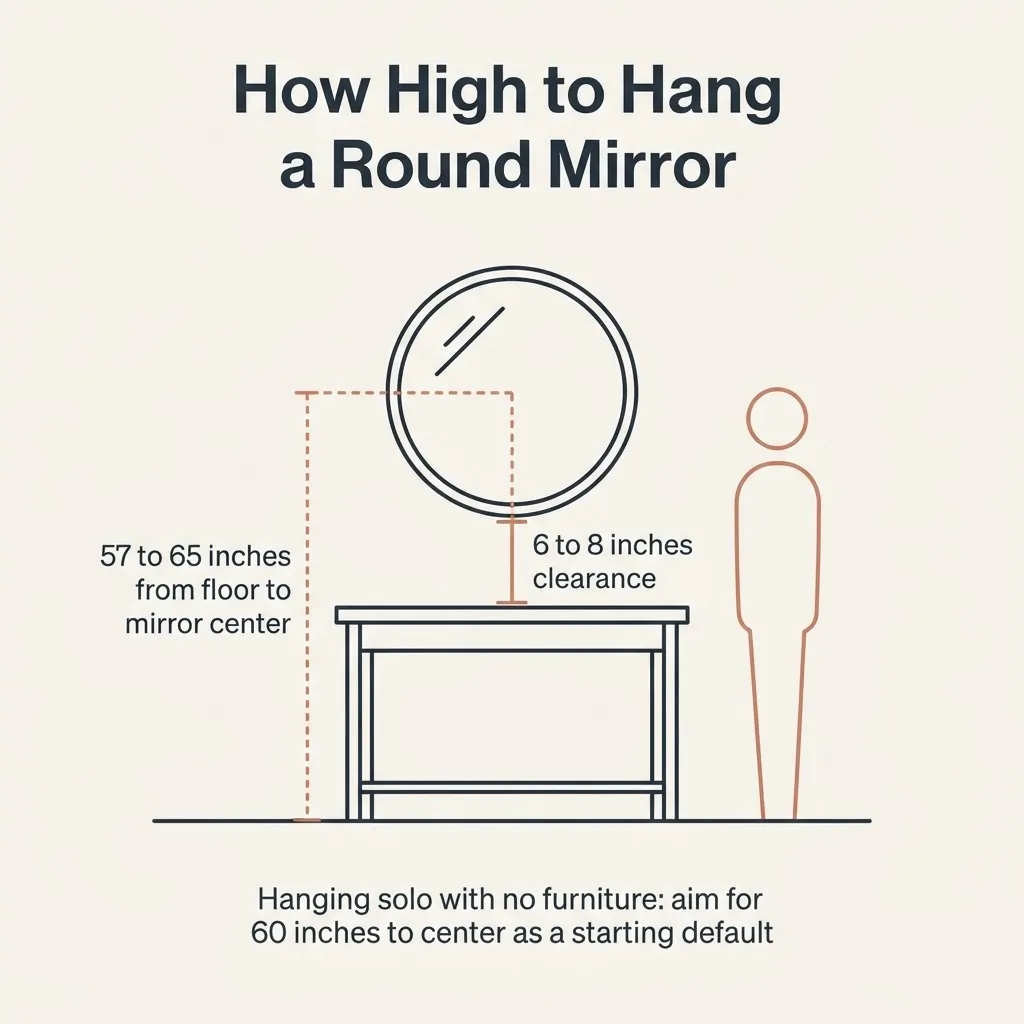
Frame My Mirror’s placement guide recommends leaving 6 to 8 inches of space between the top of the furniture and the bottom of the mirror. That gap prevents the mirror from feeling disconnected from the piece below it, while still leaving breathing room for any styling objects (a vase, a small plant, a candle) you want to place on the surface.
Above a console table, that 6-8 inch clearance still applies, but you can push it closer to 6 inches if the table is tall and the ceiling is standard height, or go up to 10 inches if you have a lot of vertical space to work with.
The Renter Rule: Hanging Without Wrecking Your Walls
This is the part I care most about, and it is the part most decor content completely ignores. You do not need to drive a nail into drywall to hang a round mirror safely.
For mirrors under about 20 pounds, Command Picture Hanging Strips are a legitimate solution. For heavier mirrors, 3M makes a product called the 3M CLAW Drywall Picture Hanger, which handles mirrors up to 65 pounds without tools, without studs, and without leaving large holes behind. The 3M heavy hanging guide walks through exactly which product to use based on your mirror’s weight. Before you buy any mirror, check the weight listed on the product page. A solid 30-inch wood-framed mirror can easily hit 15 to 20 pounds. A thin metal or frameless mirror of the same size might be 8 to 10 pounds. That difference matters for how you hang it.
A few honest notes on this:
Adhesive strips only hold as well as your wall paint. If you have old, flaking, or poorly bonded paint, the strip is only as strong as the weakest layer. In that case, you may want to find the stud and use a proper picture hook with a very small nail, which typically leaves a hole small enough to fill with a bit of white toothpaste or spackle at move-out.
Also worth knowing: there have been documented cases of budget mirrors with poorly made hanging hardware failing at the bracket. The CPSC issued a recall on Uttermost mirrors after hanging hardware broke on multiple pieces and caused them to fall. I am not saying budget mirrors are dangerous, I am saying check the back of any mirror before you hang it. Make sure the D-ring, wire, or sawtooth bracket looks solid and is properly secured. A cheap mirror with flimsy hardware is not worth the risk regardless of price.
The Question Everyone Forgets: What Is Your Mirror Going to Reflect?
Before you commit to a spot, stand where the mirror will hang and look at what is directly across from it. That is what will be visible in the mirror all day, every day.
The best case: your mirror reflects a window, which means it essentially doubles your natural light. Second best: it reflects a clean, styled corner, a nice lamp, a piece of art, something that adds depth and interest. The worst case: it reflects a television screen (which looks dim and blank during the day), a cluttered counter, or the ceiling. A mirror reflecting a ceiling fan is one of the most consistently distracting things you can do in a room. Take thirty seconds to check this before you commit to a nail hole or a strip of adhesive.
Placing a round mirror opposite a window is the single highest-return move in a small or dark apartment. It takes borrowed light and pushes it further into the room. If you only have one spot where this is possible, that is your spot.
Room by Room: Where and How to Use Round Mirror Wall Decor
Entryway and Foyer
The entryway is probably the most natural home for a round mirror, and with good reason. It serves a practical function (checking yourself before you leave), it greets you when you come home, and in a small foyer, it makes the space feel less like a closet you walk through.
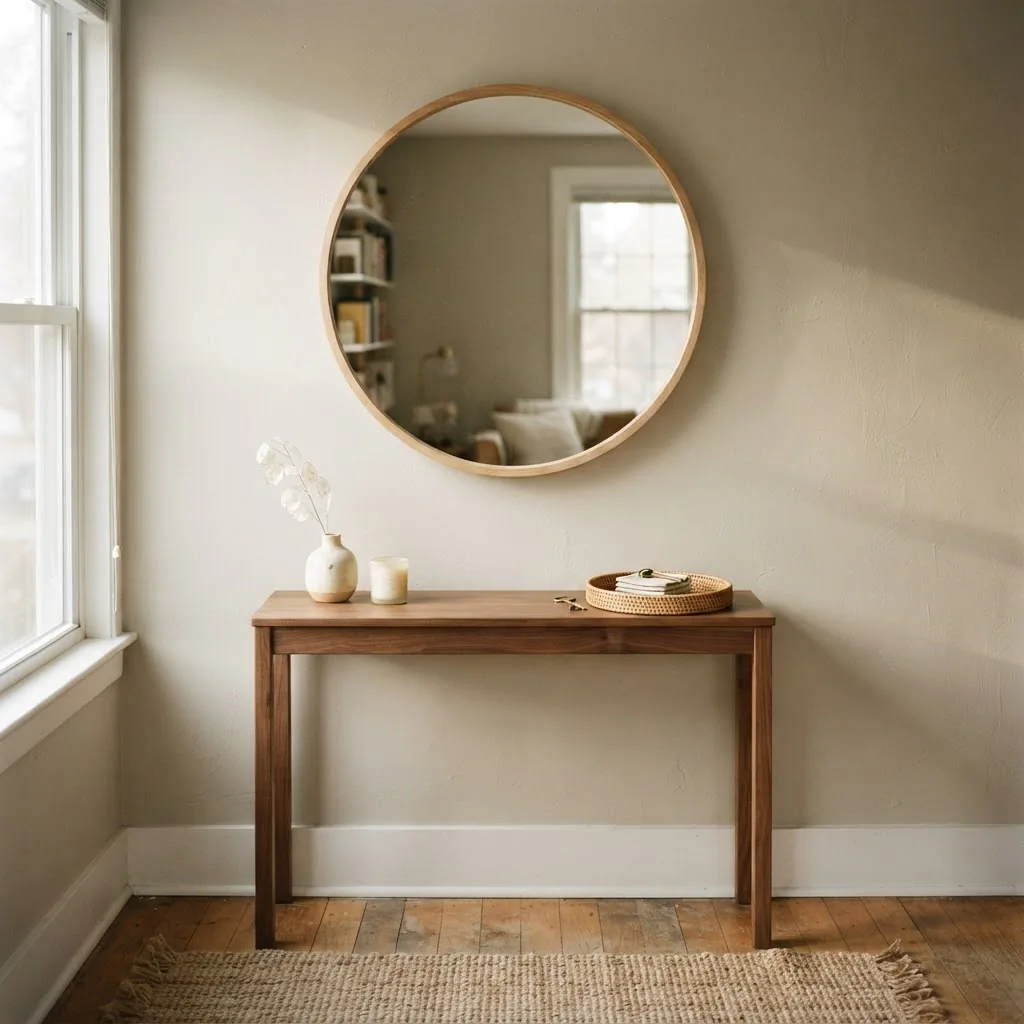
For a narrow entryway, a medium-to-large round mirror (24 to 36 inches) hung on the wall opposite the door or above a narrow console table is classic and genuinely effective. If the entryway is very small and there is no console table, a 20 to 24 inch mirror at eye level on the main wall works without overwhelming the space. Tribesigns’ guide on hanging mirrors over console tables notes that 6 to 10 inches above the table surface is the sweet spot, with the lower end of that range working better in tighter spaces.
For styling below: a small tray, one vase or a short plant, and one candle or small object. Three things maximum. Entryways get cluttered fast and a calm, minimal surface under a round mirror always photographs well and feels better to come home to.
Living Room
The living room gives round mirrors more options than any other room, which is also why people overthink it.
Above the sofa is one of the most popular placements, and it works well as long as the mirror is sized correctly. You want a mirror that spans roughly two-thirds the width of the sofa, which for a standard 84-inch sofa means a mirror in the 56-inch range. That is a large mirror, and it will likely need proper wall hardware rather than adhesive strips. If you want something lighter and cheaper, a cluster of three round mirrors in graduated sizes (say, 10, 16, and 22 inches) arranged in a loose triangle above the sofa achieves a similar visual weight with much lighter individual pieces.
A round mirror on the wall across from a window, even in a corner, is a small-space move that feels like cheating because it works so well. The room genuinely gets brighter, and it creates the impression of depth where there was none.
Bedroom Above the Dresser
This is one of my favorite uses of a round mirror because it solves two problems at once: the wall above a dresser often looks blank and unfinished, and a round mirror gives that space both a focal point and a practical function.
The sizing rule applies cleanly here: a mirror that is roughly two-thirds the width of your dresser. For a standard 60-inch dresser, that is a 36-to-40-inch mirror. For a narrow 36-inch dresser, something in the 24-inch range fits well.
Frame finish matters in a bedroom more than anywhere else because the bedroom needs to feel calm.
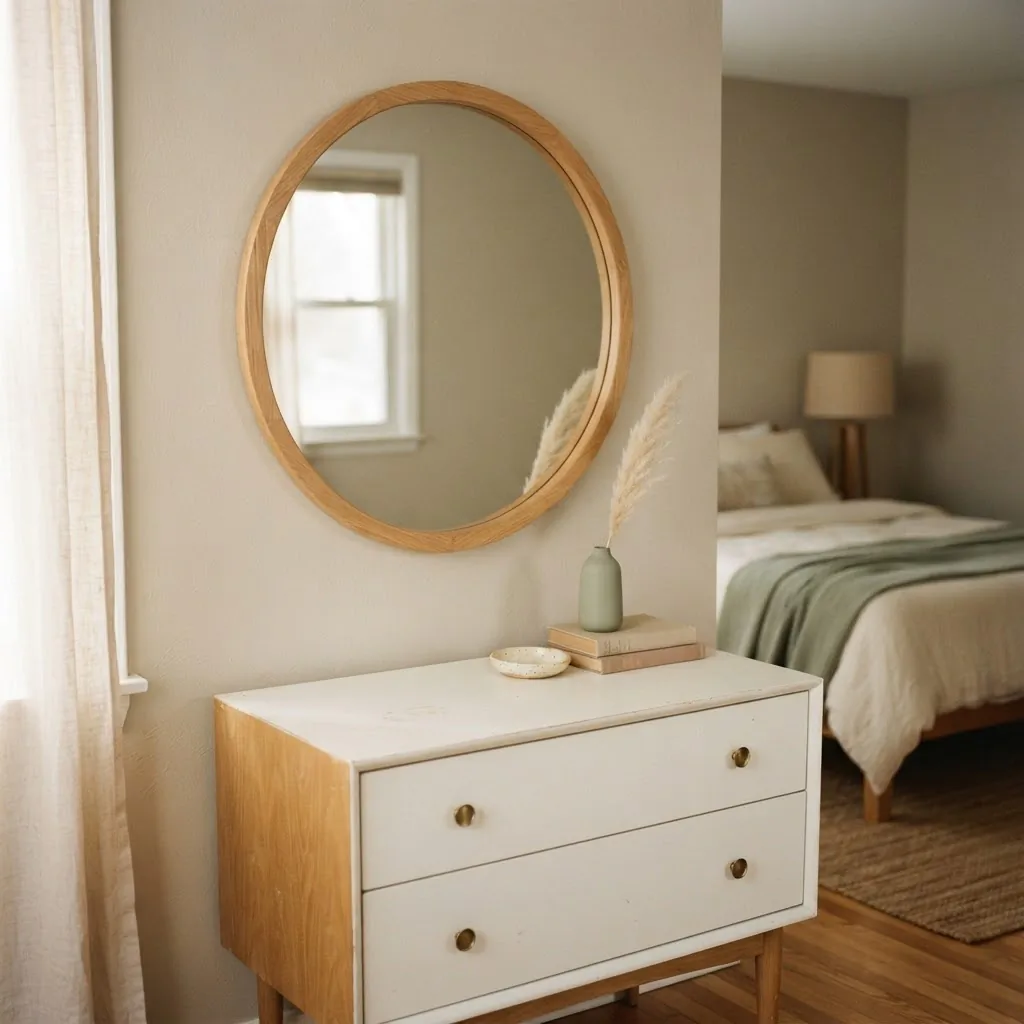
Natural wood frames or matte black work in most bedroom styles. Ornate gold works if you are leaning into a more maximalist or vintage look but can feel busy in an otherwise minimal room. When in doubt, wood frames warm the space without competing with anything.
Bathroom
Round mirrors in bathrooms have become essentially the standard, and there is a good reason for that: they soften the utilitarian feel of a bathroom and replace the generic builder-grade rectangular medicine cabinet look with something that actually has personality.
For a bathroom, the main practical consideration is moisture. Frameless glass or metal-framed round mirrors handle humidity much better than wood-framed mirrors, which can warp over time. If you love the look of a wood frame, sealed or painted wood holds up better than raw or lightly finished wood.
Above a single vanity, a round mirror in the 24-to-30-inch range is proportional for most standard bathroom sink setups. The center of the mirror should sit at roughly face height, which for most people lands around 60-65 inches from the floor.
Above the Fireplace Mantel
A round mirror above a fireplace mantel is a classic pairing that never really goes out of style. The rounded shape contrasts nicely with the strong horizontal line of the mantel shelf. The Spruce covers this placement in detail and The Spruce’s fireplace mirror design guide recommends positioning the bottom edge of the mirror 4 to 6 inches above the mantel surface for the most balanced look.
Size-wise, you want the mirror to feel dominant but not cramped. A mirror that spans about 50 to 70 percent of the mantel width reads as intentional. Go too small and it looks like an afterthought. Go too wide and it competes with the architectural frame of the fireplace.
One practical renter note: if the fireplace in your apartment is non-functional and the wall above it is just drywall, this is a completely normal hanging situation. If it is an active wood-burning fireplace, keep the mirror at a safe distance above the mantel and make sure no part of the frame is close enough to catch radiant heat.
Making a Cluster Wall: Multiple Round Mirrors Together
One of the more underused approaches to round mirror wall decor is the cluster or grouping arrangement. Instead of one large mirror, you hang three to five round mirrors of varying sizes together as a unit, and the result reads like intentional wall art rather than just a mirror.
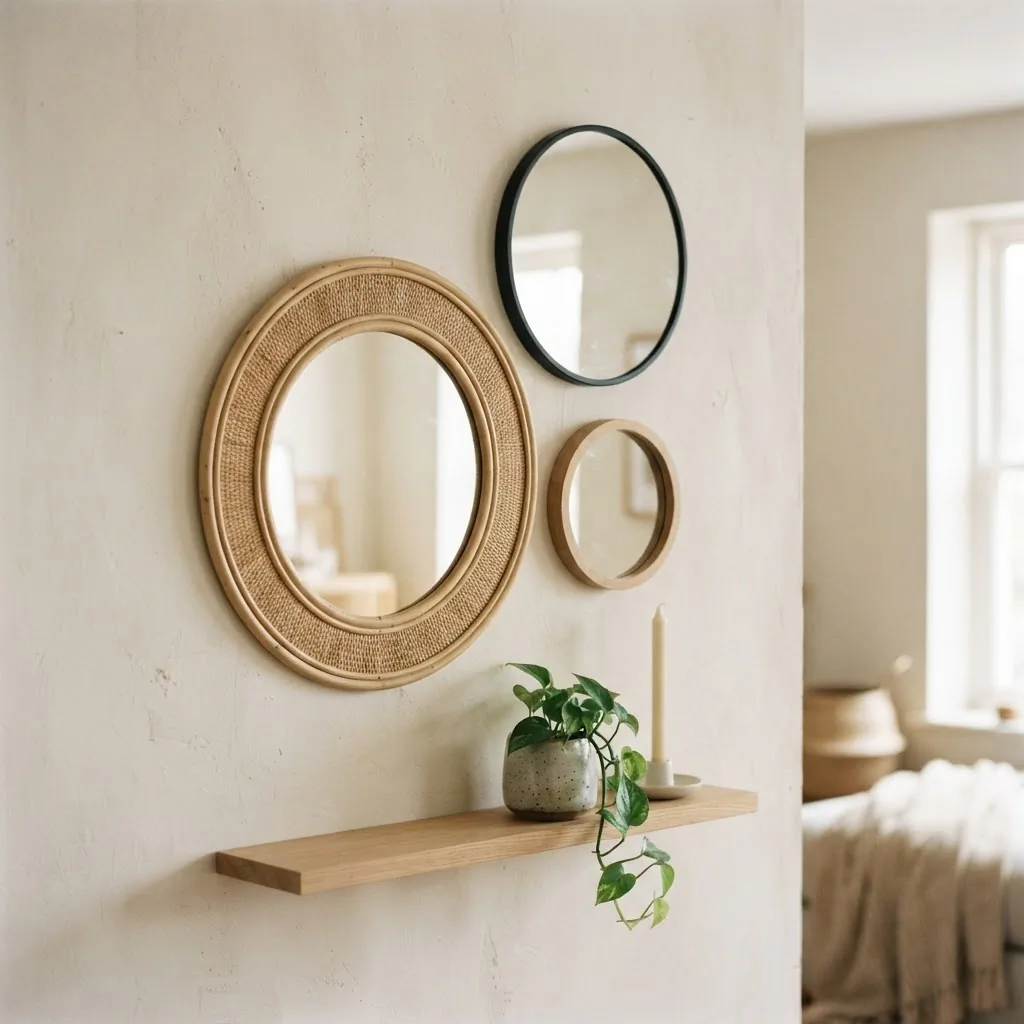
The key rules for making a cluster work: vary the sizes rather than using identical mirrors, keep 3 to 6 inches of spacing between pieces, and sketch out the arrangement on paper or lay it on the floor before you commit to any holes or strips. Mixtiles’ guide on gallery walls with mirrors suggests anchoring the arrangement with your largest piece slightly off-center and building outward asymmetrically for a more natural, less corporate look.
For renters, a cluster of small lightweight mirrors (each under 5 pounds) is actually one of the easiest hanging projects you can do with adhesive strips, because the individual weight of each piece is manageable and the total visual impact is large.
Frame Finish by Style: A Quick Match Guide
This is one of the most practical things I can tell you because the wrong frame finish is what makes a nice mirror look cheap or out of place.
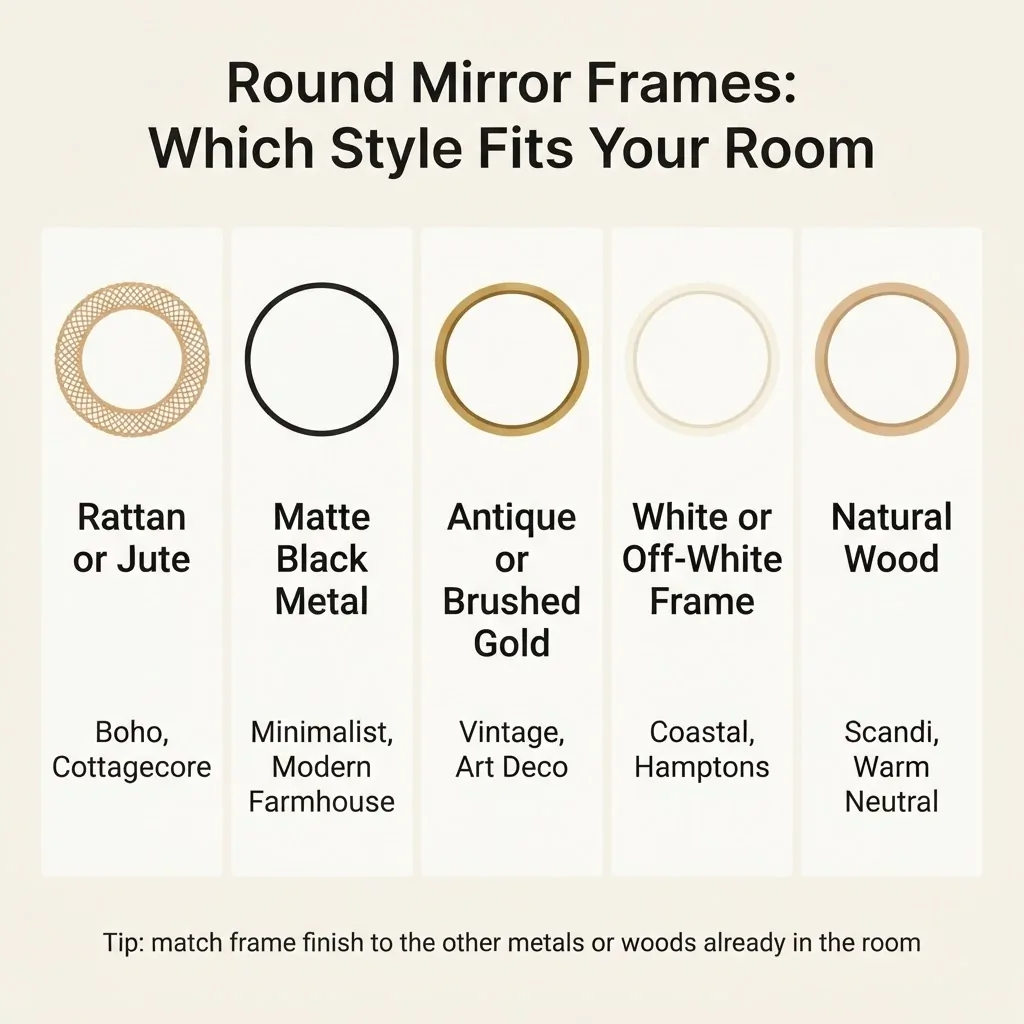
Natural rattan, jute, or woven frames are the clearest signal of a boho or cottagecore space and look beautiful paired with linen, macrame, and warm neutrals. Matte black metal frames are clean and flexible, working in minimalist, modern farmhouse, and Scandi-style spaces. Antique or brushed gold frames lean Art Deco or vintage, and look best in rooms with other warm metal accents. Simple white or off-white frames brighten a coastal or Hamptons-inspired room. Raw or light wood frames are the most universally neutral, pairing well with almost any style that leans warm rather than industrial.
The mistake is mixing a cold-finish frame (polished chrome, cool silver) into a room full of warm wood tones. It never quite settles. Likewise, a chunky ornate gold frame in an otherwise minimal room will read as restless rather than luxurious.
Budget Guide: Honest Tiers for Round Mirrors
Here is what you can actually expect to find at different price points, without the fake enthusiasm.
Under $30: You can find simple frameless round mirrors and thin metal-framed mirrors in the 18-24 inch range at this price. They work fine. The glass is often decent. The hanging hardware is where these tend to cut corners, so check the back before you hang it and use proper strips or hardware rather than relying on whatever came in the box.
$30 to $80: This is where round mirror wall decor starts to get genuinely good. You can find natural rattan and jute frames, solid wood frames, and well-made metal frames in the 24-to-30-inch range. This tier is the sweet spot for most renters and small-space decorators.
$80 to $150: Larger mirrors (30 to 40 inches), heavier frames, better hardware. Worth it if you are hanging in a prominent spot like an entryway or above a mantel where the mirror is a true focal point.
Over $150: Statement pieces, handmade frames, artisan rattan, sunburst designs. Not necessary to have a beautiful room, but if you find one you love and it fits the space, a good mirror lasts for years and moves with you through every rental.
The One Styling Mistake Worth Avoiding
I will end on this because it is the thing I see most often: people hang a round mirror and then leave the wall completely bare around it. The mirror floats there looking lonely, and the room still feels unfinished.
A round mirror works best when it anchors something. Even the simplest approach, a small shelf below it with two or three objects, a plant on one side, a sconce or wall-hung light on either side, gives the mirror a context and makes the whole arrangement read as intentional. You do not need much. One thing below, one thing beside, and the wall stops looking like you put something up and then ran out of ideas.
The goal is a calm wall, not a full wall. Editing matters as much as adding.