Yes, you can hang a heavy mirror on drywall without hitting a stud, as long as you use the right hardware and match it to the mirror’s actual weight. A bare screw into drywall holds almost nothing, but a quality toggle bolt or a modern no-stud hanger can hold a mirror that weighs well over 50 lbs safely and with a hole you can patch before you move out. The key is knowing what you have, what it weighs, and which hardware is actually built for the job.
I have been in the situation where the mirror is sitting on the floor for two weeks because nobody wants to be the one to put a hole in the wrong place. So here is everything you need to know to get it on the wall safely, without panic, and without gambling your security deposit.
Step One: Figure Out How Much Your Mirror Actually Weighs
This is the step almost everyone skips, and it’s the reason mirrors fall.
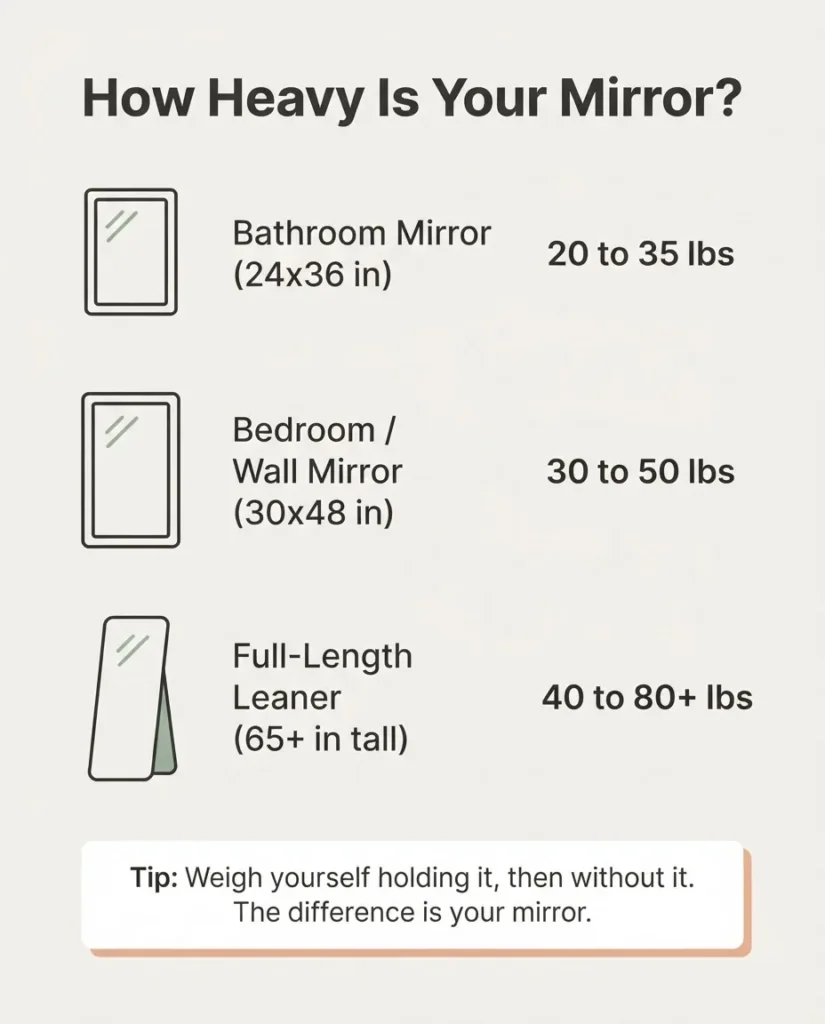
Most people have no idea how much their mirror weighs, and manufacturers do not always make it easy to find out. As a rough guide, standard mirror glass weighs about 1.5 lbs per square foot for every 1/8 inch of thickness. A typical framed bathroom mirror around 24 by 36 inches usually runs somewhere between 20 and 35 lbs once you add the frame. A full-length bedroom mirror or a large leaner can easily reach 40 to 60 lbs, and a heavy ornate frame can push that higher.
The simplest way to check is to weigh yourself on a bathroom scale holding the mirror, then weigh yourself without it. The difference is your mirror’s weight. Write it down. That number is going to drive every hardware decision you make.
If you cannot weigh it before it ships, check the product listing under “Item Weight” in the specs tab.
If you are buying in a store, ask a staff member, or look for a tag on the back. Do not guess.
The Wall Type Question: Drywall or Plaster?
Before you pick any hardware, you need to know what kind of wall you have. Most homes built after the 1950s have drywall, which is gypsum board covered with paper. Homes built before that often have plaster over wood lath, which is a completely different animal.
Here is how to tell the difference quickly. Press a thumbtack into an inconspicuous spot on the wall. If it pushes in with light pressure and feels uniform and slightly chalky, you likely have drywall. If it is rock-hard or crumbles into a sandy, grainy dust, it’s plaster.
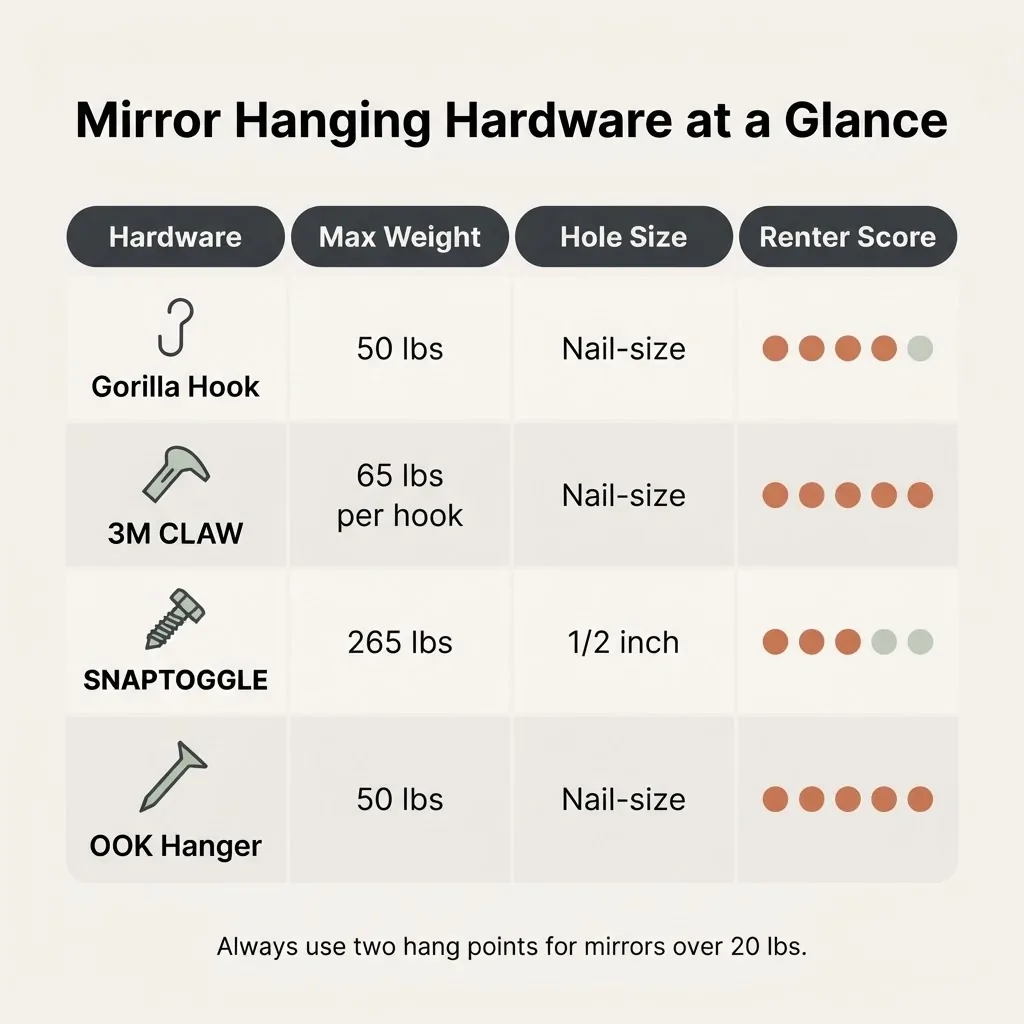
This matters because most no-stud drywall hangers like the 3M CLAW are designed specifically for drywall and will not perform the same way in plaster. If you have plaster walls, your best options are toggle bolts that work in hollow walls generally, or professional picture hangers like the OOK 50 lb hanger that use an angled nail and are rated for both drywall and plaster. Plaster can also be brittle around edges, so a slower, more careful drill at low speed makes a real difference.
What Hardware Actually Holds What: A Plain-English Breakdown
This is where I want to save you from the biggest beginner trap: buying picture-hanging hardware rated for a 15 lb painting and using it on a 40 lb mirror. The packaging looks the same on the shelf. The consequences are very different.
Here is how the main options stack up, written plainly.
No-Tool Push Hooks (Gorilla Hook style, up to 50 lbs)
The Hillman Gorilla Hook is one of the most renter-friendly hangers you can buy. It’s a bent spring-steel hook with a self-boring tip. You push the tip into the drywall and twist it in by hand, no drill, no stud, no tools. It holds up to 50 lbs per hook in drywall and leaves a hole roughly the size of a finishing nail. Easily patchable with a dab of spackle.
The honest limit: 50 lbs per hook is the rated limit, not the breaking point, but I would not push a single hook past 40 lbs in practice. For any mirror over 30 lbs, I’d use two of them. For mirrors over 50 lbs, step up to a different solution.

- TOOL-FREE INSTALLATION: Product requires no tools to mount. Simply poke hole in drywall and slide hook through until onl…
- DRYWALL/PLASTER USE: For use in drywall or plaster walls for best results
- REMOVABLE AND REUSABLE: Hooks can be slid out of drywall without causing damage to wall, making hanger reusable in anoth…
No-Stud Steel Claw Hangers (3M CLAW style, up to 65 lbs per hook)
The 3M CLAW is a step up from the push hook. It uses engineered hardened steel claws that dig into the drywall at multiple points, spreading the load across a wider area rather than concentrating it in one spot. It comes in 15, 25, 45, and 65 lb capacities, and critically, it requires no stud and no drill. According to 3M’s own product specifications, the CLAW leaves a hole small enough to patch cleanly, which is a genuine renter advantage over toggle bolts.
For most bedroom or hallway mirrors in the 30 to 55 lb range, two 45 lb CLAWs is a solid, safe, renter-friendly install. For mirrors in the 55 to 65 lb range, two 65 lb CLAWs gives you an effective combined rated capacity of 130 lbs, well above what you need.
This is the hardware I’d recommend to most people reading this article who have a standard drywall wall, a mirror under about 55 lbs, and a security deposit to protect.

- Command HANGER PICTURE DRYWL 45LB 1CT 3PH45M-1ES
Toggle Bolts for Heavy Mirrors (Over 50 lbs, or When You Need Maximum Confidence)
For a large mirror, an ornate framed mirror, or a bathroom vanity mirror that is pushing 50 to 80 lbs, toggle bolts are the serious answer. The TOGGLER SNAPTOGGLE is one of the best toggle bolts made. It uses a metal channel that stays put behind the wall even if you remove the bolt, meaning it’s also reusable. According to TOGGLER’s own specification data, the SNAPTOGGLE is rated for up to 265 lbs in 1/2-inch drywall. That is serious holding power for a mirror.
The honest tradeoff for renters: installation requires drilling a 1/2-inch hole, which is larger and harder to patch invisibly than a small nail hole. It is still patchable with spackle and paint, but it takes a bit more care. If the mirror is 60 lbs or more and will live in one spot permanently, the toggle bolt is absolutely the right call. If the mirror is under 50 lbs and you want maximum move-out ease, the CLAW or Gorilla Hook is a cleaner choice.

- 🔩 Hang with Confidence: When it comes to hanging heavy objects securely on walls, finding the right anchor is crucial. T…
- 🔩 Robust, Reliable, Resilient: Our heavy-duty wall anchors are expertly designed with high quality materials, including …
- 🔩 Stronghold for Thick Walls: Our flip toggle drywall anchor is a sturdy anchor designed for use in a variety of base ma…
Quick Comparison: Which Hardware for Which Mirror?
- TOOL-FREE INSTALLATION: Product requires no tools to mount. Simply poke hole in drywall and slide hook through until onl…
- DRYWALL/PLASTER USE: For use in drywall or plaster walls for best results
- REMOVABLE AND REUSABLE: Hooks can be slid out of drywall without causing damage to wall, making hanger reusable in anoth…
- Command HANGER PICTURE DRYWL 45LB 1CT 3PH45M-1ES
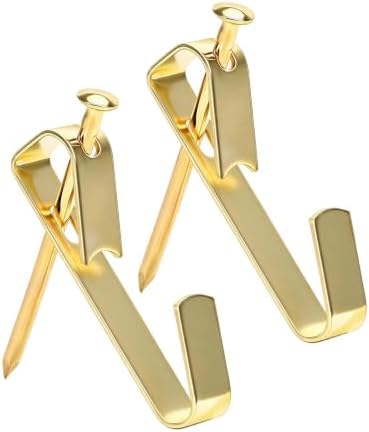
- 【Strong & Sturdy Hanging Support】These picture frame hooks are crafted from premium metal with gold and silver finishes,…
- 【Versatile Multi-Style Design】The assortment includes multiple hook styles to fit different frame types and sizes, makin…
- 【Quick & Hassle-Free Installation 】Each hook is designed for easy attachment to the back of frames, requiring minimal to…
Here is a side-by-side summary to make the decision fast.
How to Actually Find a Stud (Without Panicking)
Here is the truth about studs: you don’t always need one for a mirror. But when your mirror is pushing 50 lbs or more, hitting at least one stud for one of your two hang points is the most secure option you have, and worth spending five minutes to find.
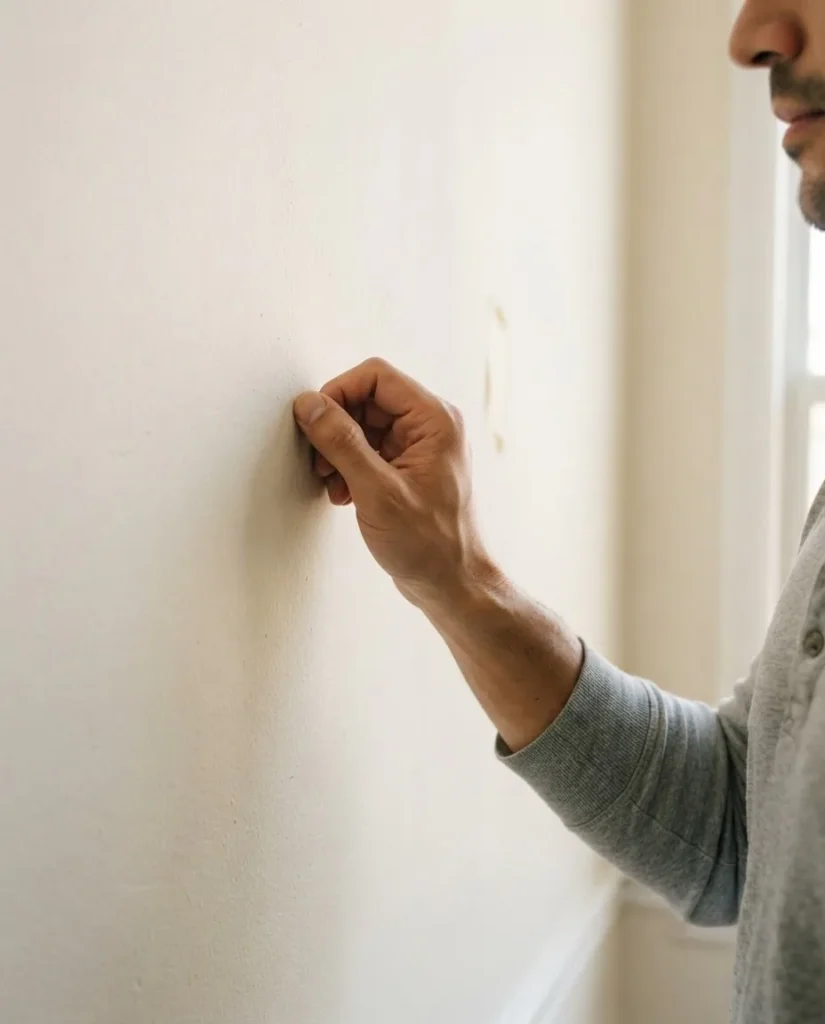
Most stud finders work fine for this job, but you don’t even need one. The knocking method works well enough for a quick check. Close your fist and knock firmly on the wall as you slowly drag it horizontally. A hollow sound means you’re between studs. A noticeably duller, flatter thud means you’ve likely found one. Mark that spot with a small piece of painter’s tape. For a step-by-step walkthrough of using an electronic stud finder, Bob Vila’s guide is beginner-friendly and covers both the electronic finder method and the no-tool backup methods.
In standard US construction, studs are spaced either 16 or 24 inches apart on center. Once you find one, you can measure across to predict where the next ones are.
If you cannot hit a stud for both hang points and your mirror is over 50 lbs, use the TOGGLER SNAPTOGGLE for the non-stud hole. Two solid attachment points, even if one is a toggle bolt and one is a stud screw, beats two weak points every time.
The Two-Point Rule: Why One Hook Is Never Enough for a Heavy Mirror
A heavy mirror hung from a single central point will swing, rotate, and put enormous stress on one small area of wall. Over time, the hole widens, the anchor loosens, and the mirror eventually comes down, usually when no one is watching for it. This is especially true with wire-hung mirrors because the V-shape of the wire focuses leverage on a single central point.
The right way to hang any mirror over about 20 lbs is to use two hang points, spread roughly equal to the width of the frame or at least 12 to 16 inches apart. This distributes the weight, keeps the mirror stable and level, and dramatically reduces the risk of it shifting or falling.
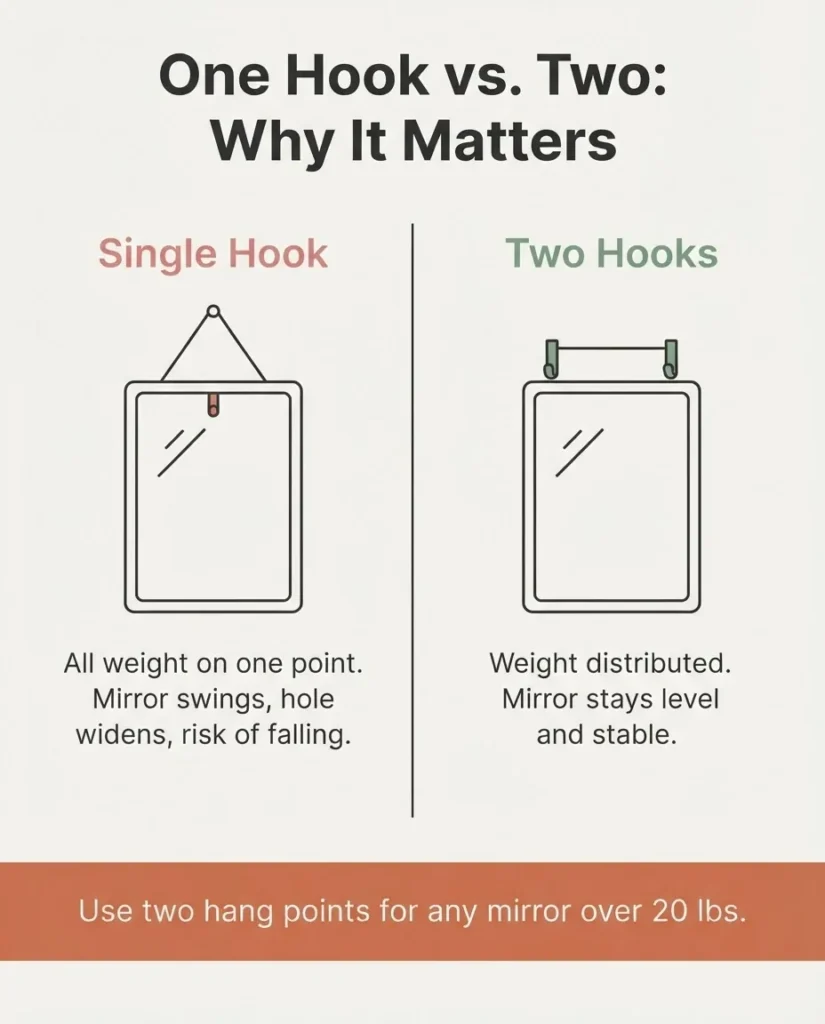
For reference, if a mirror has a wire across the back, you want to hang the wire on two hooks set at the same height rather than one. If it has two D-rings or strap hangers, those two mounting points should drive where your two wall hardware pieces go. The detailed practical guidance on Home Depot’s mirror hanging guide covers the two-hook wire method clearly if you want a step-by-step visual reference.
The Renter’s Real Question: What Will This Cost Me on Move-Out?
This comes up in every renter conversation about hanging things, and the answer is more reassuring than most people expect.
Small nail holes from picture hangers are generally considered normal wear and tear by most landlords. A hole from a Gorilla Hook or a 3M CLAW is roughly the size of a finishing nail and typically falls into that category. A toggle bolt hole is larger, around 3/8 to 1/2 inch, and depending on your landlord, may need to be patched. Patching a toggle bolt hole with spackle, letting it dry, and touching up with paint is a straightforward 20-minute job and costs very little at the hardware store.
The things that do cause deposit problems: multiple large holes in the same area, tears in the drywall paper from adhesive strips pulled off aggressively, or unpainted patches that stand out. The solution to all three is to hang thoughtfully, patch small holes with spackle before you leave, and use hardware designed to leave a manageable hole in the first place.
Command strips fall apart here for heavy mirrors, and I want to be direct about that. According to 3M’s own weight limit specifications, Command Picture Hanging Strips are rated for mirrors up to about 20 lbs. Many people use them on heavier mirrors because they’re no-hole and feel safer for the deposit, but a Command strip failure on a 40 lb mirror is not a small problem. Stick to their actual rated weight. For anything heavier, the Gorilla Hook or 3M CLAW gives you a much more honest hold with a much smaller hole than what a ripped-off adhesive strip leaves behind.
A Note on Leaning Mirrors: They’re Not Off the Hook
If you have a large leaner-style floor mirror, you might think hanging hardware is not your problem. It still is. An unsecured leaning mirror can tip forward under its own weight or from a bump, vibration, or a curious cat, and a large mirror falling on a person or a child is a real safety hazard.
The CPSC’s AnchorIt.gov safety campaign focuses on furniture tip-over safety, but the principle applies directly here: any large, heavy item leaning against a wall should be anchored to it. Anti-tip furniture straps designed for leaning mirrors are a smart, renter-friendly solution.

They attach to the back of the mirror frame and anchor to the wall with a small screw, limiting how far the mirror can tip without requiring you to fully mount it.

- 🔩【30 Pack Furniture Anchors】: Furniture anchors for baby proofing that come with 30 pack,including 30 Adhesive anchors +…
- 💪【Secure 168 Pound Furniture】: Upgraded furniure anchors with strong adhesive and 9.8 inch long nylon strap, can secure …
- 🔐【Prevent Falling and Anti Tip Straps】: Create a safe enviroment for your baby and pets, this furniture anchor for baby …
Step-by-Step: How to Hang a Heavy Mirror Safely
Here is the process, kept simple.
- Weigh the mirror. Use the bathroom scale method or check the product specs. Write it down.
- Check your wall. Drywall or plaster? Knock to confirm the general texture, or use the thumbtack test.
- Pick your hardware. Match the hardware’s rated capacity to at least 1.5 times the mirror’s weight. If the mirror is 40 lbs, use hardware rated for at least 60 lbs total across both hang points.
- Check the back of the mirror. Does it have a hanging wire, two D-rings, a French cleat, or a keyhole slot? That determines where your wall hardware needs to go and how far apart.
- Mark your hang points. For a two-point hang, hold the mirror against the wall (have a second person help), note the height, and mark both hardware positions with a pencil. For wired mirrors, measure where the wire sits when taut and hang both hooks at that height.
- Install the hardware. For Gorilla Hooks and 3M CLAWs, follow the push-in or tap-in instructions exactly. For toggle bolts, drill the correct hole size per the package, insert the toggle, and tighten until snug, not overtightened.
- Hang the mirror on both points and check for level. A small bubble level placed on top of the frame is faster than eyeballing it.
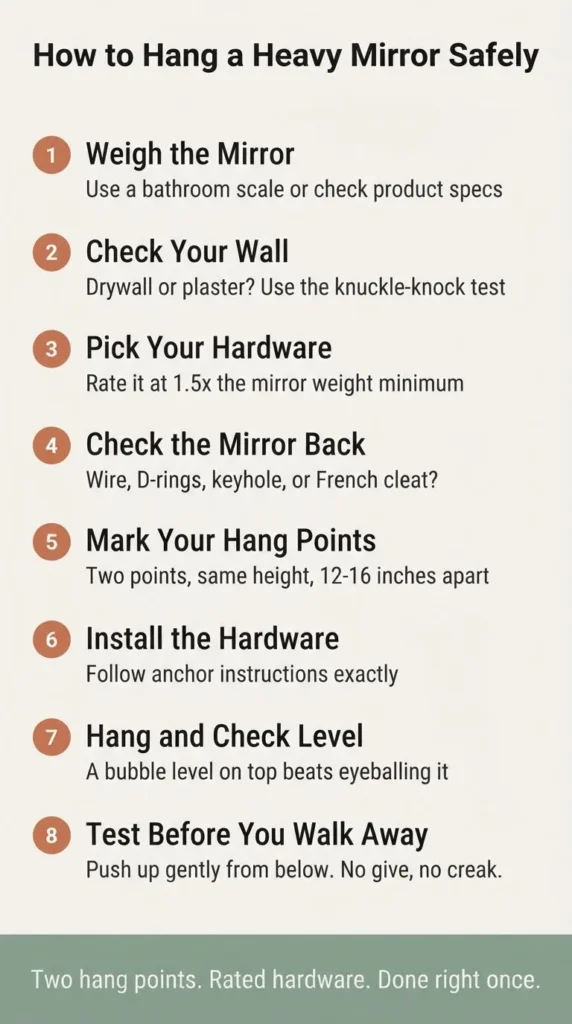
- Test it before you walk away. With both hands, push slightly upward on the frame from below. It should feel completely solid. If there is any creaking, shifting, or give, remove it and check the anchor seats before you trust it to stay.
FAQ
Can a heavy mirror fall off the wall with the right hardware installed?
Any hanging system can fail if the hardware is undersized for the weight, if only a single hook is used on a heavy mirror, or if the anchor is installed in damaged or wet drywall. Use hardware rated well above the mirror’s weight, always use two hang points for mirrors over 20 lbs, and confirm the anchor feels solid before you walk away.
What is the maximum weight you can hang on drywall without a stud?
With the right anchor, quite a bit. Toggle bolt anchors like the TOGGLER SNAPTOGGLE are rated for up to 265 lbs in standard 1/2-inch drywall, and drywall anchor testing by Family Handyman found most anchors exceed their rated weights. The weak point is usually not the anchor itself but the surrounding drywall, so spreading weight across two hang points is always smarter than relying on one.
Are Command strips safe for heavy mirrors?
Command Picture Hanging Strips are rated for mirrors up to about 20 lbs per 3M’s specifications. For anything heavier, they are not the right tool. The failure risk is real, and the damage a failed adhesive strip leaves on painted drywall is often worse for a security deposit than a small nail hole from a proper hanger.
Do I need permission from my landlord to hang a heavy mirror?
Most standard leases allow small picture-hanger holes as normal wear and tear, but if you are making larger holes for toggle bolts or your lease is strict, a quick note to your landlord takes 30 seconds and removes any ambiguity. A 3M CLAW or Gorilla Hook that leaves a tiny hole is unlikely to be a lease issue anywhere.
How do I hang a heavy mirror on a plaster wall?
Plaster walls are harder and more brittle than drywall, which means standard no-stud push hooks and drywall CLAWs may not work correctly. For plaster, use angled-nail professional picture hangers like the OOK 50 lb hanger that are rated for plaster, or use toggle bolts that work in any hollow wall. Drill at a slow speed to avoid crumbling the plaster around the hole.