Entryway Mirror Decor Ideas for Renters and Small Spaces

There is a reason the entryway is the one room most people put off decorating. It is usually tiny, often awkward, and it does not feel like a room at all. It is just the place where you drop your keys, wrestle off your shoes, and mentally clock out from whatever the day threw at you. Most rentals make it worse. A blank white wall, a closet door, and about three feet of space between the entrance and the rest of your life.
Here is the thing, though. The entryway is the first thing you see when you come home, and the last thing you see before you walk out into your day. That matters more than people give it credit for. And of all the things you can put in that narrow, overlooked strip of space, a mirror does the most work for the least effort and money. It bounces light, opens up the space visually, gives you a place to check your reflection before you head out, and just makes the whole entry feel like someone actually lives there on purpose.
I spent years decorating rental entryways, which basically means I got good at making a small, boring stretch of wall feel intentional without ever putting a single nail in a place I would regret. What follows is everything I have learned about picking, sizing, placing, and styling an entryway mirror, with real numbers and honest takes on what is worth spending on and what is not.
Why a Mirror Is the Single Best Thing You Can Add to a Small Entryway
This is not a decorating opinion, it is a function argument. When Apartment Therapy surveyed six interior designers about what a small entryway needs most, they all landed on the same answer: a mirror. Over a console table, over hooks, over baskets, over a bench. A mirror came first every time. The reasons are practical. In a small space, a mirror reflects whatever natural light is coming in from windows or doors and makes the space feel significantly larger and brighter without changing a single wall. It also does something quieter and more psychological. A wall that has a mirror on it looks like a deliberate choice. It looks like a room that belongs to someone.
For renters especially, this is a big deal. You cannot paint, you often cannot wallpaper (or at least not without sweating through the entire peel-off process), and you cannot do anything structural. A mirror is one of the few moves that can completely change the feeling of a wall without touching it in any permanent way.
The Sizing Question: How Big Should Your Entryway Mirror Actually Be?
This is where most people either overthink it or just grab whatever they see first and regret it when they get home. Here is what to think about before you buy.
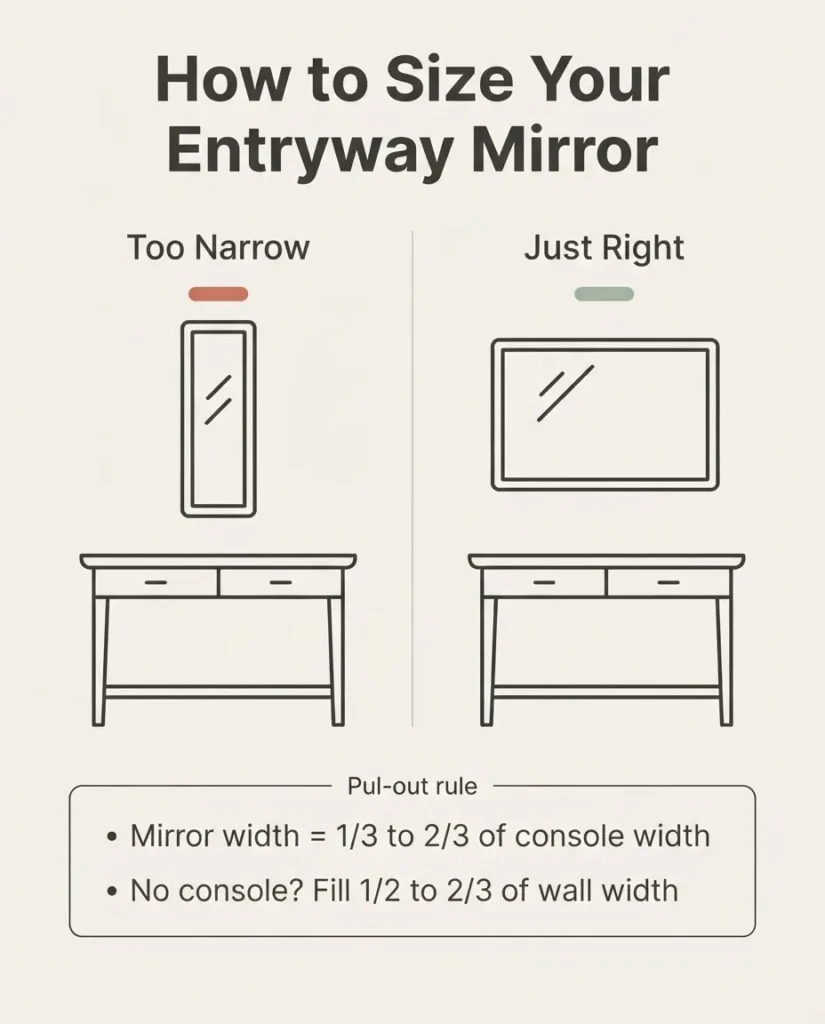
If your mirror is going above a console table, the proportions matter a lot more than people realize. The classic rule is that the mirror should be roughly two-thirds the width of the console beneath it, and no narrower than about one-third. Tom Faulkner’s illustrated pairing guide explains it well: a mirror that is too wide for its console makes the whole arrangement feel top-heavy and unstable, while a mirror that is too narrow looks lost and disconnected from the furniture below it. If your console is 48 inches wide, your mirror sweet spot is roughly 24 to 32 inches wide.
If you are working with no console at all, which is a completely valid and often better choice in a very narrow entryway, scale the mirror to the wall instead. A mirror that takes up about half to two-thirds of the available wall width tends to read as intentional rather than random. When in doubt, go a little bigger. Small mirrors in large or medium spaces almost always look like an afterthought.
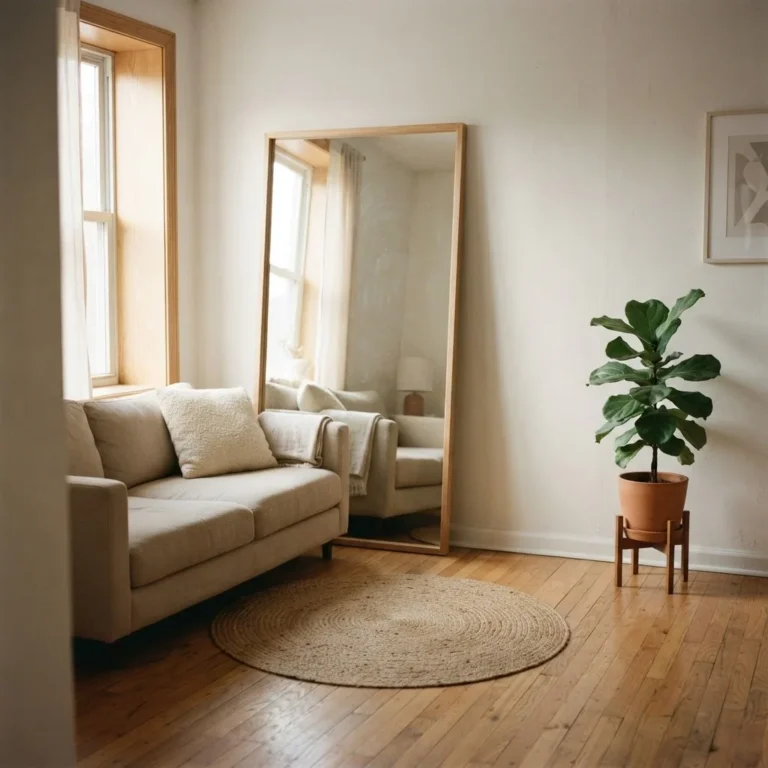
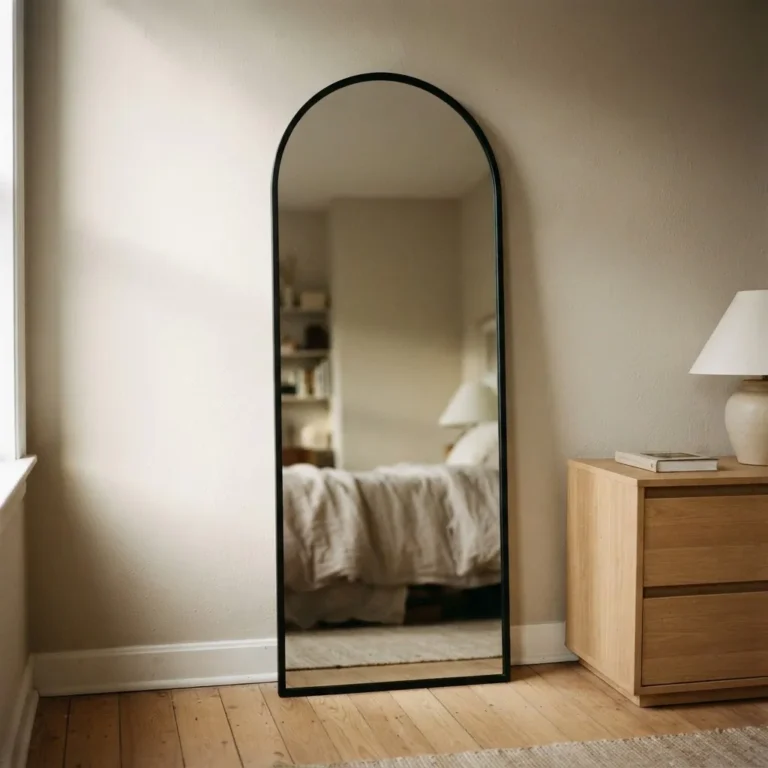
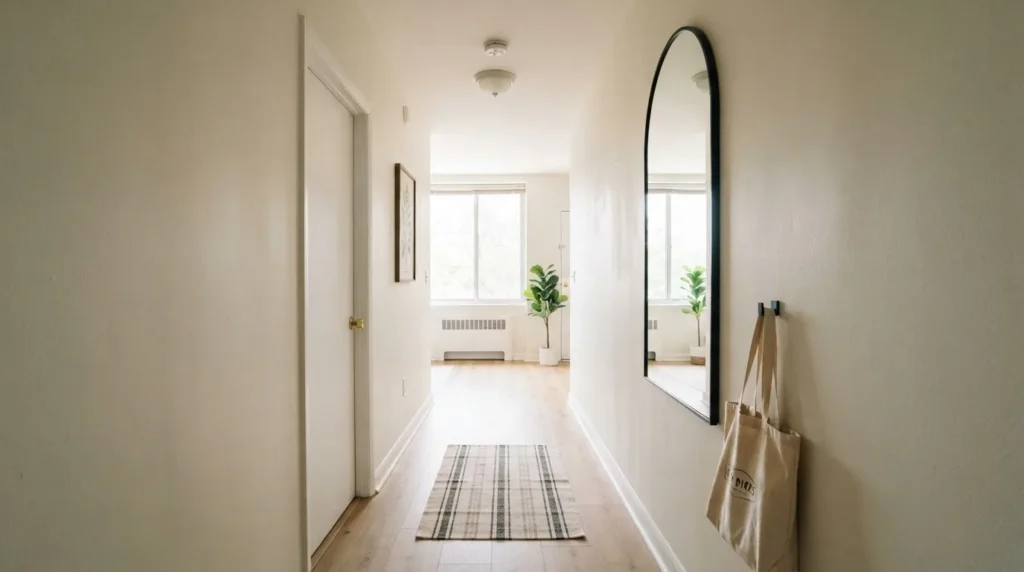
Full-length mirrors deserve their own mention here. A tall, floor-length mirror leaning against or hung on an entryway wall does dramatic work in a small space. It reflects more of the room and more of the incoming light than a smaller hung piece. If you have a narrow hallway rather than a proper foyer, a full-length mirror running vertically along one wall can make the whole corridor feel twice as wide. More on hanging versus leaning in a moment.
The Height Question: Where Does the Mirror Actually Go on the Wall?
The standard advice is to hang the center of the mirror at eye level, which for most adults falls between 57 and 60 inches from the floor. That is a useful starting point and it is the number most designers default to. If you are hanging the mirror on its own with no furniture beneath it, that center-at-eye-level rule gives you the most functional, finished result.
When the mirror sits above a console table, the calculation shifts slightly. The goal is a visual relationship between the two pieces, not just a mirror floating in space. Most designers recommend leaving 6 to 8 inches between the top of the console and the bottom of the mirror. This hanging height guide from HTGT Furniture notes that mirrors hung too high often feel disconnected from the furniture below, and that a clean 6-inch gap is what creates the sense that the two pieces belong together. If your ceiling is unusually high, you can push that gap to 10 or 12 inches, but keep it consistent so the arrangement still reads as a cohesive grouping.
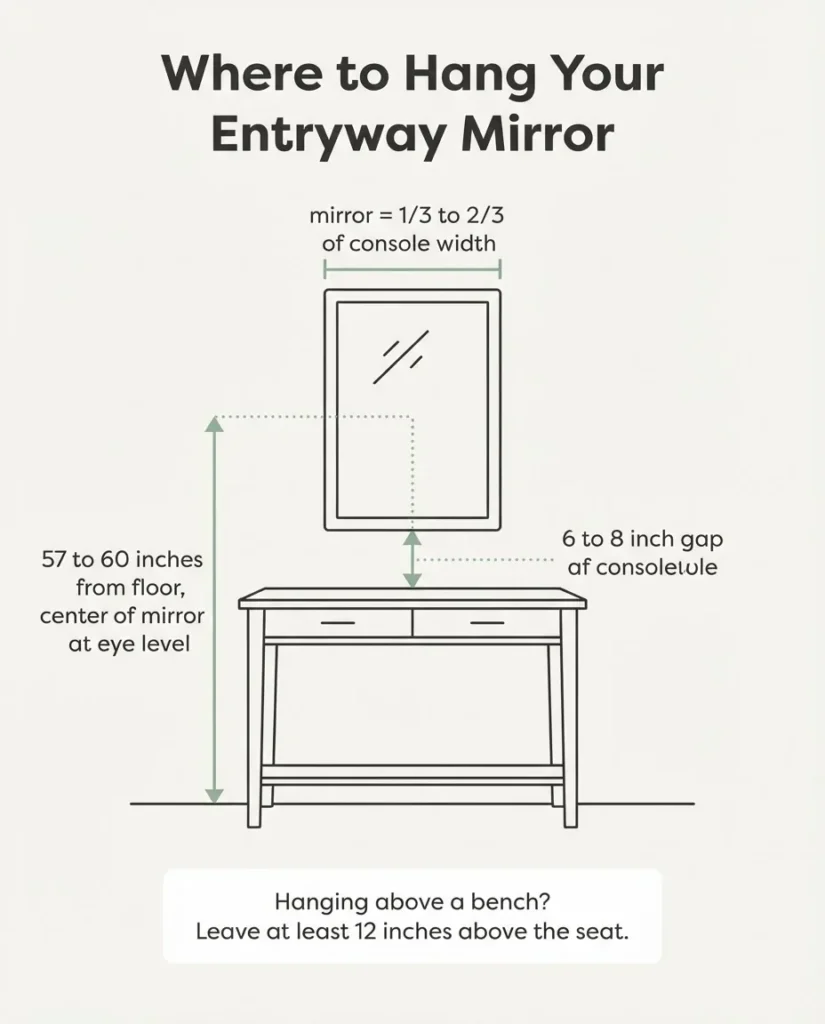
One detail that gets missed: if you have a bench rather than a console table beneath the mirror, make sure the bottom of the mirror sits high enough that a seated person cannot hit it when they lean back. A clearance of at least 12 to 14 inches above the seat level of the bench is a good safety buffer.
Mirror Shapes and What They Actually Do in a Small Space
Shape is not just aesthetic preference, it changes how a mirror feels in the room and what it does to the space around it.
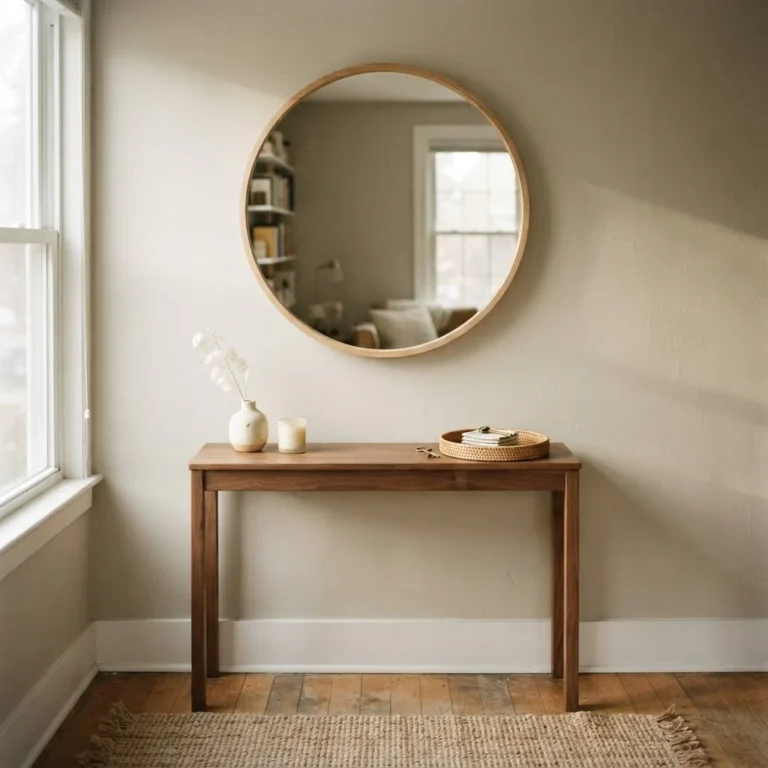
Round mirrors are the most forgiving choice for small or awkward entryways. A round mirror softens a space full of hard architectural lines: door frames, baseboards, light switches, and wall edges. It adds a sense of warmth that rectangles do not naturally have. According to Edward Martin’s entryway mirror shape guide, round and oval shapes add softness and work especially well in smaller spaces. They are also widely available at lower price points than ornate shaped mirrors, which makes them a good budget starting point.
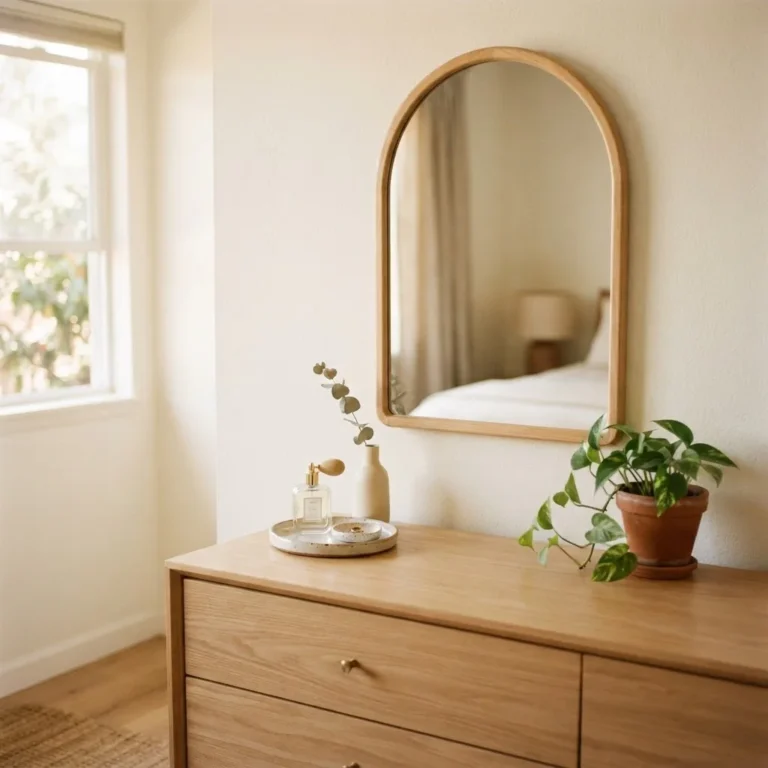
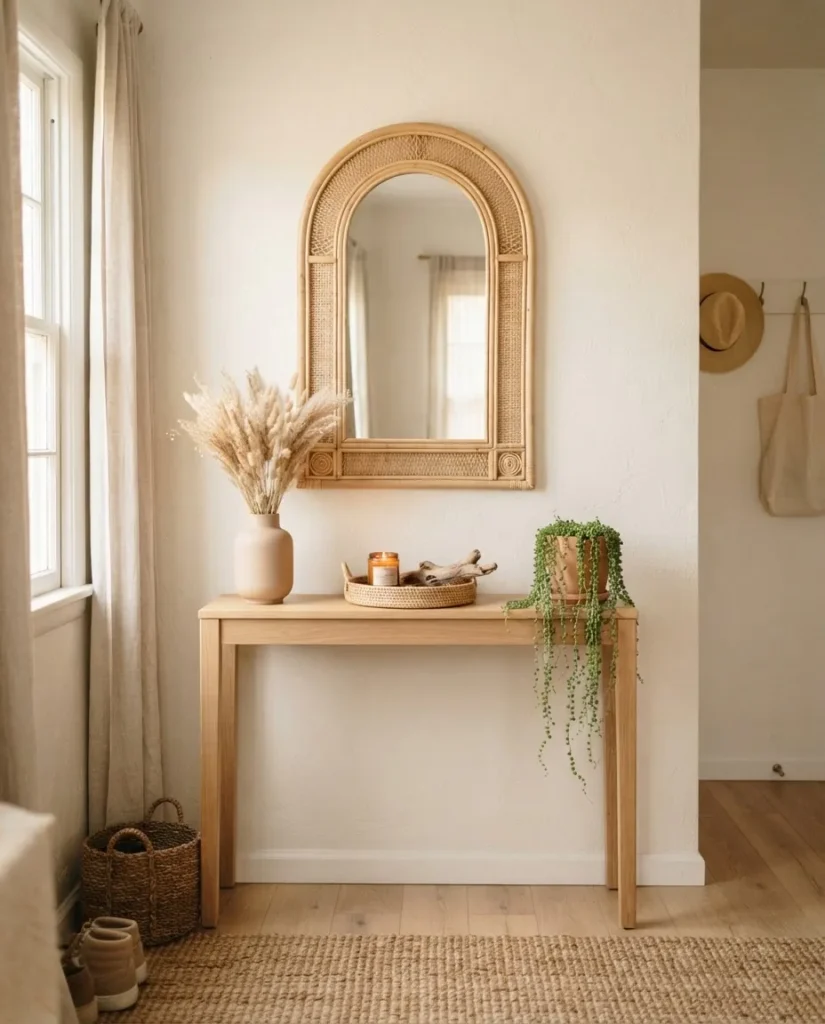
Arched mirrors have become one of the most searched mirror shapes for a reason. The soft arch at the top adds a subtle architectural quality that a plain rectangle does not have, and it works across styles from boho to modern to cottagecore without committing fully to any of them. If you want one mirror that will look good across multiple apartments and multiple style phases of your life, a simple arched mirror in a warm wood or black metal frame is a very reliable pick.
Rectangular and vertical mirrors are the best shape for amplifying light and making a ceiling feel taller. Hung vertically, they draw the eye upward and create a sense of height in low-ceilinged spaces.
Full-length and floor mirrors are the most dramatic option and, for renters, sometimes the easiest because leaning is a valid placement strategy. A leaned mirror also means no hanging decision at all. Just be sure to secure it with furniture straps if you have kids, pets, or a particularly enthusiastic front door.
Sunburst and statement-frame mirrors function more like wall art than functional mirrors. They are a great choice if you want personality over practicality, and they are especially good in very tiny entryways where you would not be checking your full reflection anyway.
The Renter Reality: How to Hang a Mirror Without Wrecking Your Walls
This is the part most decor articles skip completely, and it is the part renters need most. Let me be straightforward about the options.
For mirrors under 20 pounds and no larger than 24 by 36 inches, Command Picture Hanging Strips from 3M are a legitimate option. The key word is “under 20 pounds.” The 3M official guidance page confirms the weight cap clearly: Command strips up to 20 lbs for picture-size mirrors, and 3M CLAW Drywall Hangers up to 65 lbs without requiring tools or studs. The CLAW hangers leave only a tiny pinhole, which spackles invisibly when you move out. They are a genuinely good middle-ground solution for heavier mirrors in a rental.
A few practical rules to follow with no-nail hanging:
- Always check the actual weight of your specific mirror, not just the size. Some framed mirrors are heavier than they look.
- Clean the wall surface before applying strips. Even a slightly dusty wall reduces adhesive performance significantly.
- For Command strips, follow the pressing time and cure time instructions exactly. The strips need a full hour of pressure and then 24 to 48 hours before you hang anything.
- Do not use Command strips in a space with high humidity or direct sunlight on the wall surface, as heat degrades the adhesive.
For leaning mirrors, the look is casual and easy, but safe only when it is actually secured. A leaning mirror that is not anchored is a real hazard, especially around children and pets. A set of inexpensive anti-tip furniture straps can anchor a leaning mirror discreetly to the wall through a single small hook, which spackles out cleanly at move-out. This is genuinely worth the five minutes it takes.
17 Entryway Mirror Decor Ideas, by Problem and Style
Here is where the ideas come together. I have organized these by the actual situation you might be in, which felt more useful than another list of shapes.
When your entryway has no real space for furniture:
- A single round mirror, high and centered on the wall. No console, no shelf, no table. Just the mirror, hung at eye level. Lean into the simplicity. Add a small removable hook below it for your keys and you have everything you need.
- A sunburst or woven rattan mirror as wall art. In a tiny entryway where function is not the priority (you have a different spot for keys), a decorative mirror does the work of a piece of art while still bouncing light.
- A narrow vertical rectangle hung on a side wall. Side walls in entryways are underused. If your main wall is the door, try the adjacent wall for a vertical mirror that catches the light as you pass.
When you have a console table:
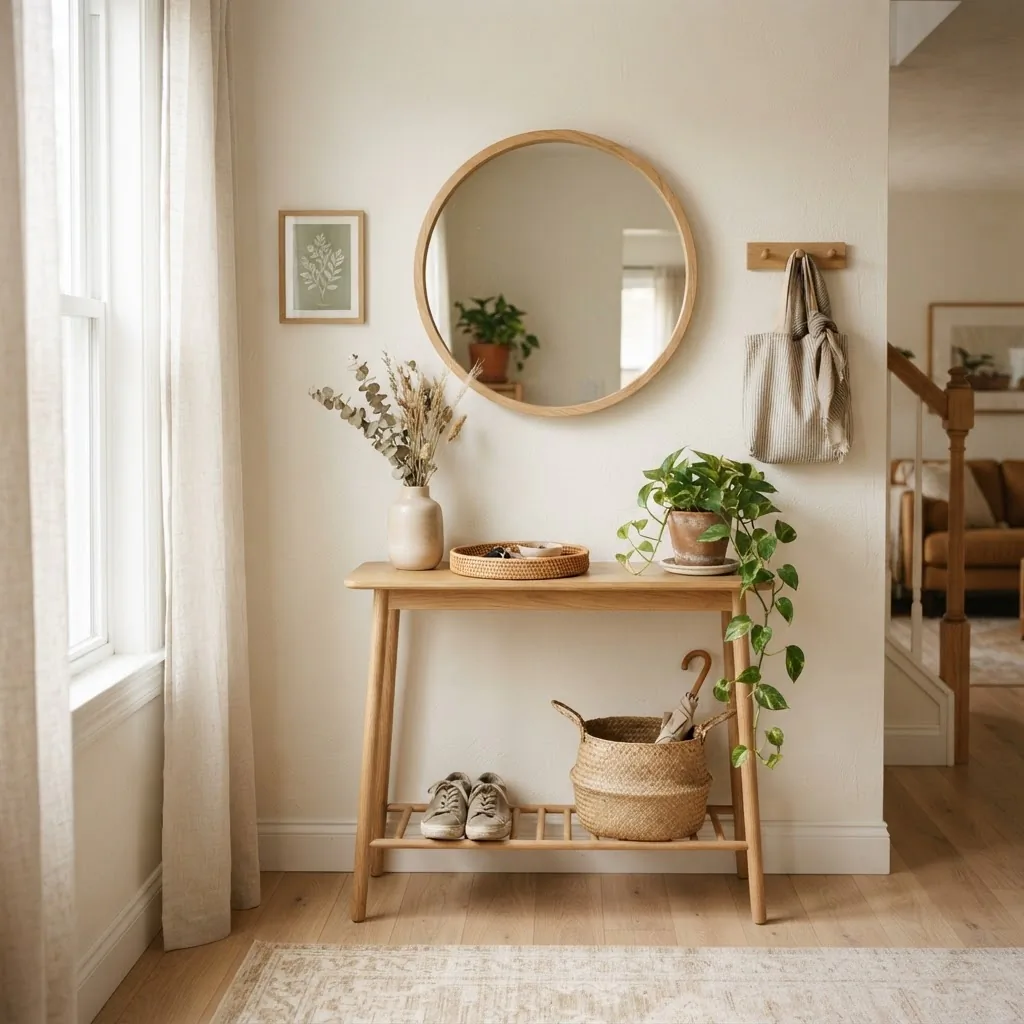
- Round mirror above a slim console. The contrast between the soft circle and the straight-lined table is one of the most reliably good-looking combinations in home decor. Keep the table accessories simple: a small lamp, a tray, one plant.
- Arched mirror in a warm frame above a dark console. The arch adds architecture, and pairing a warm wood or brass-toned frame with a darker table creates depth and warmth. This is a good one for renters who want their entryway to feel substantial.
- Oversized mirror that’s slightly larger than expected. There is a version of the two-thirds proportion rule that says when your mirror extends closer to the full width of the console, it creates a bolder, more intentional statement. If the room needs more visual weight, this is the move.
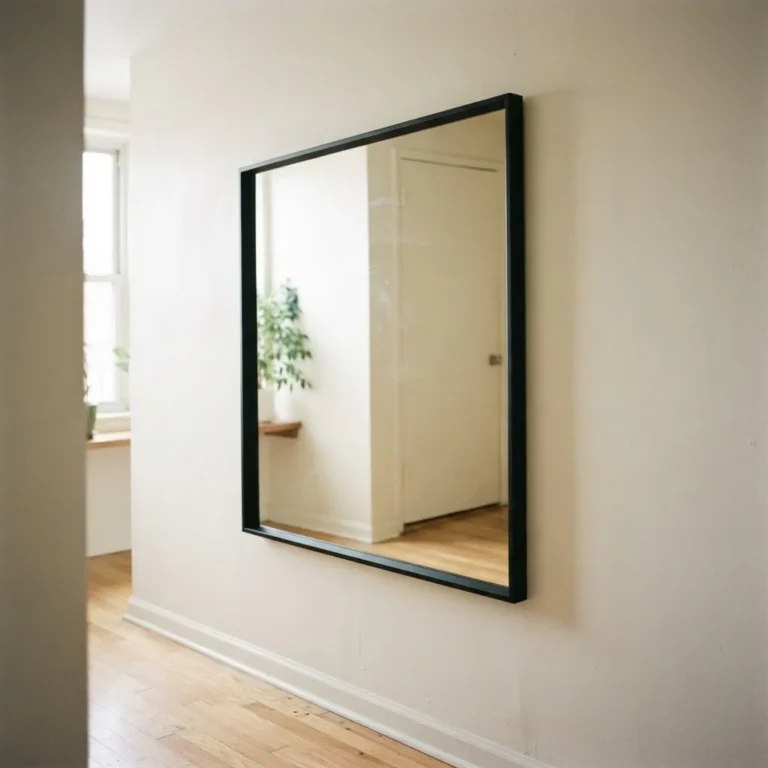
- Frameless or simple black-metal-framed mirror for minimalists. A frameless mirror or one with a very thin black or brushed metal frame above a clean, unfussy console is one of the easiest looks to pull off and one of the easiest to find at a good price. This is the combination that photographs cleanly and never feels cluttered.
- Leaned mirror on a console. Not hung on the wall at all. Just resting against it. This is a genuinely good no-commitment option for renters. It reads as intentionally casual and editorial, and it is easy to move and adjust.
When your entryway is just a hallway:
- A tall, vertical mirror on the long wall. This does more visual work for a narrow hallway than almost anything else. It makes the corridor feel like it has a destination.
- Two smaller mirrors, staggered. If one large mirror feels like too much of a commitment, two smaller mirrors arranged asymmetrically on a long wall create the same light-bouncing effect with a more curated, gallery feel.
- A mirror with a built-in shelf or hook rail. This is the most functional option for a hallway. You get the mirror effect plus actual storage: hooks for bags or leashes, a small shelf for keys or mail. These combination pieces are widely available and start at a very reasonable price point.
When you want a specific style:
- Boho: A woven rattan or jute-wrapped mirror. Pair with a small ceramic vase, dried pampas grass or dried flowers in a slim vessel, and a natural wood tray.
- Minimalist: A frameless mirror or a very thin-profile arched mirror in brushed gold or black. One small plant. Nothing else.
- Coastal: A whitewashed wood frame or a rope-wrapped mirror. Pair with white ceramic accessories and a small piece of driftwood or a stone.
- Cottagecore: An ornate vintage-style mirror with a painted or gilded frame. Thrift stores and Facebook Marketplace are genuinely excellent for these and you will often find better pieces there than at any retailer, for a fraction of the price.
- Modern farmhouse: A simple black metal grid or windowpane-style mirror above a shiplap-inspired or reclaimed wood console.
- Gallery wall including a mirror. Hang your mirror as part of a cluster arrangement with a few small framed prints or photos. Use a mix of sizes and keep the spacing consistent (about 2 to 3 inches between each piece). This is a good way to fill a larger wall without buying a single large statement mirror.
Styling the Space Around Your Mirror: The Console Vignette
A mirror hung on a bare wall with nothing below it or around it reads as unfinished. The goal is to build a small arrangement that makes the whole entry feel like it was put together with intention, not just assembled.
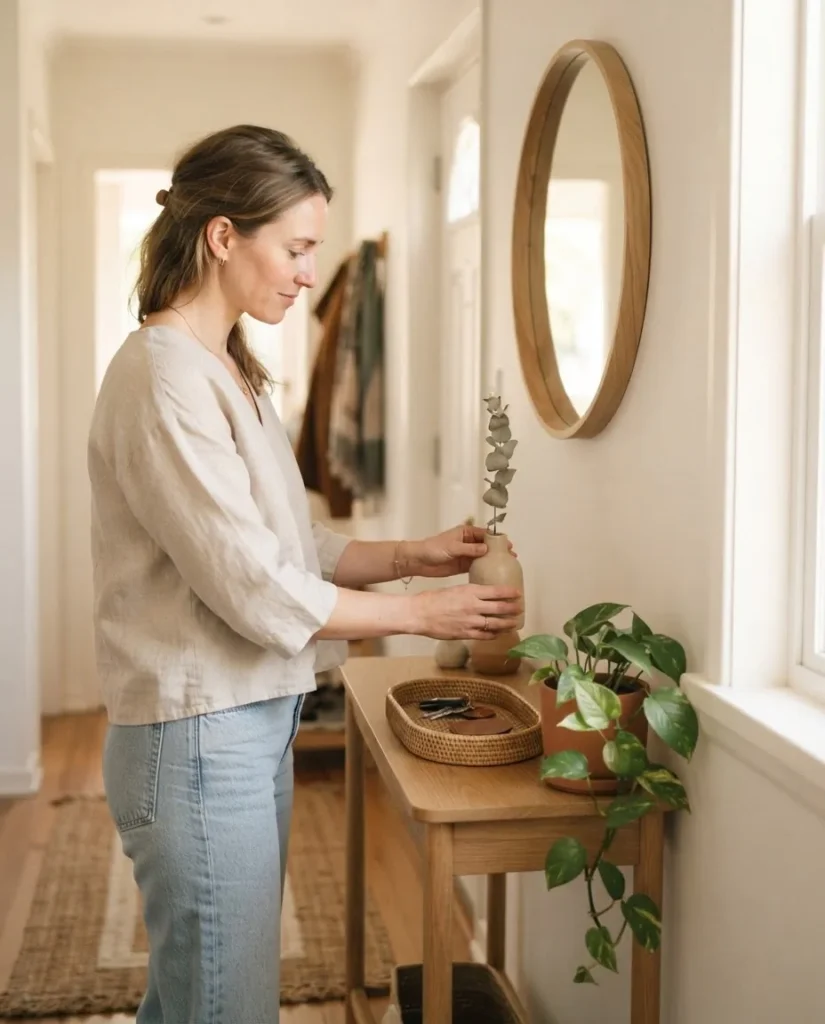
The classic console vignette formula is: one tall element, one medium element, and one low element. That might look like a slim table lamp (tall), a small plant or ceramic vase (medium), and a tray with a few small objects or a candle (low). You do not need all of these. You need enough variety in height that the eye travels rather than flatlines. Three things done well beats ten things done carelessly every time.
A few styling principles that hold up across every budget and style:
Odd numbers group better than even numbers. Three objects on a shelf read as a deliberate collection. Four objects read as a line.
Vary the texture, not just the color. A smooth ceramic next to a woven element next to a matte metal tray creates visual richness without visual noise.
Seasonal swaps keep the space feeling fresh without requiring a new mirror. Swap out a candle for a small branch or a few stems in autumn, or a small trailing plant in spring. The mirror stays the same for years. The accessories around it do the seasonal work.
Worth It vs. Skip It: Honest Budget Notes
From renters and budget decorators consistently finding the same results: a nice mirror frame is worth spending a little more on. The mirror itself is the anchor of the whole arrangement, and a cheap-looking frame undermines everything around it. You do not need to spend a lot, but a mirror with an actual wood frame, a woven detail, or a clean metal finish will look significantly better than a frameless plastic-framed version at the same size.
Where you absolutely do not need to spend more: the accessories around it. The tray for keys can be a thrift store find. The small ceramic can be a two-dollar piece from a local estate sale. The plant can be a propagated cutting in a simple glass jar. The mirror is the piece that lasts. The styling around it can come from anywhere.
Thrift stores and Facebook Marketplace are genuinely some of the best places to find mirrors with interesting frames, especially the ornate vintage-style pieces that would cost $150 or more at a retailer. An old gold-toned mirror with a carved frame, found for $12, cleaned up and hung in a minimal white entryway, will look like a deliberate, thoughtful choice. Because it is.
One Last Thing Before You Buy
Measure the wall before you look at a single product listing. Take a piece of painter’s tape and mark out the rough dimensions of what you are considering on the actual wall. Step back and live with it for ten minutes. It is the single best thing you can do to avoid that moment of “this mirror looked so much smaller in the photo” when you unpack the box.
A mirror is a small, returnable, damage-light piece of decor that can completely change how your entryway feels. You do not need a decorator, a big budget, or a landlord’s permission for most of the ideas here. You just need a little time, a tape measure, and a willingness to hang something on the wall and see what it does to the light.