A good arched mirror under $100 is entirely possible. The key is knowing what to look for: an aluminum alloy frame, at least 4mm float glass, and a shatterproof backing. Those three things separate a mirror that reflects cleanly and stands up over time from one that warps your reflection and wobbles the moment you breathe on it. Most people searching this keyword are not sure whether under $100 is even worth it. This guide gives you a straight answer, walks you through what the specs actually mean, and recommends specific picks you can buy with confidence.
Why Arched Mirrors Get Confusing to Buy Online
Mirrors are one of the trickiest things to buy without seeing in person. Every listing photo looks sharp and clean, and the price differences between a $40 mirror and a $300 mirror are not always obvious from a thumbnail. I’ve been through the frustration of buying something that looked great in the photo and arrived with a slightly wavy reflection, or a frame that had a noticeable flex to it. Once you know what the listing is actually telling you, and what it’s quietly leaving out, the shopping process gets a lot easier.
The good news: this category has genuinely improved. The floor is higher than it used to be. Aluminum alloy frames, HD float glass, and shatterproof film are no longer premium-tier features. They’re now common on the bestselling options in this price range. The less-good news: not everything at this price is built the same way, and knowing which spec lines to read (and which are just marketing noise) is the whole job here.
What Actually Matters in a Budget Arched Mirror
Frame Material: Why Aluminum Alloy Is the Right Answer Here
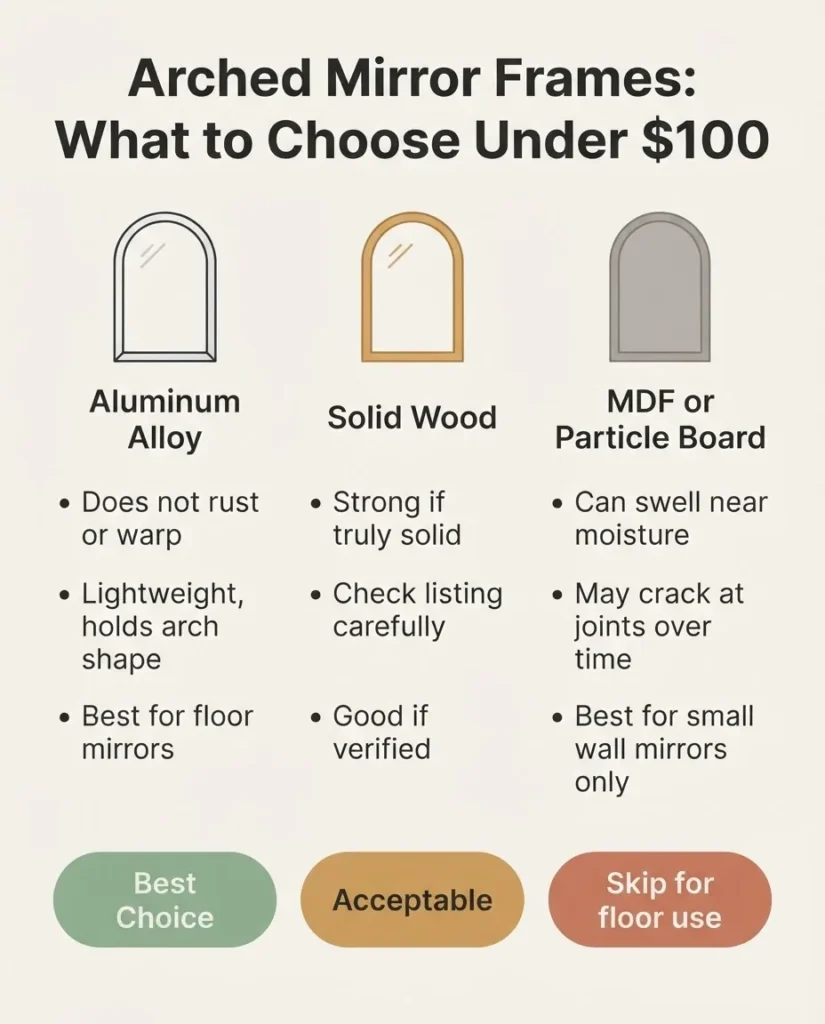
At the sub-$100 price point, you’ll see three frame materials showing up: aluminum alloy, solid wood, and MDF (medium-density fiberboard, the stuff that looks like wood but is pressed particle material). Each has a different story in this price range.
Aluminum alloy is the clear winner for floor mirrors at this budget. It’s lightweight, won’t rust, doesn’t warp or swell near humidity, and holds its shape over time. It’s also how manufacturers achieve the clean, thin-framed look that makes arched mirrors appealing in the first place. A 65″ mirror with an aluminum alloy frame is something one person can handle and reposition without help. That matters if you’re a renter moving between apartments or just someone who decides the mirror looks better two feet to the left.
Solid wood frames do exist in this price range and aren’t automatically bad. Real wood has good structural integrity. The catch is that at under $100, the “wood” framing on some listings is actually a wood veneer over an MDF core, or just MDF with a wood-tone finish. MDF is fine for a wall-mounted accent mirror that stays put, but in a large floor mirror that flexes and shifts when leaned, MDF can crack at joints over time, and it absorbs moisture if you’re putting it anywhere near a bathroom. Read the listing carefully. If it says “solid wood frame” and means it, that’s usable. If it says “wood frame” and the material breakdown in the details says MDF or “fiberboard,” treat it like MDF.
Plastic frames exist in this category too, mostly at the very bottom of the price range. Skip them on any mirror over about 36 inches tall.
Glass Quality: The Spec That Separates a Mirror from a Funhouse
This is the thing that matters most and gets explained least on most product pages. There are two things to look for in the listing: glass type and glass thickness.
For glass type, you want float glass. Float glass is made by pouring molten glass over a bath of molten tin, which creates an exceptionally flat, even surface. The result is a distortion-free reflection. According to Guardian Glass, one of the major manufacturers of float glass, float glass offers higher light transmission, better color neutrality, and a smoother surface than standard drawn or rolled glass. You’ll see this called “HD float glass” in most listings. That’s not just a marketing term — it’s a real and meaningful spec.
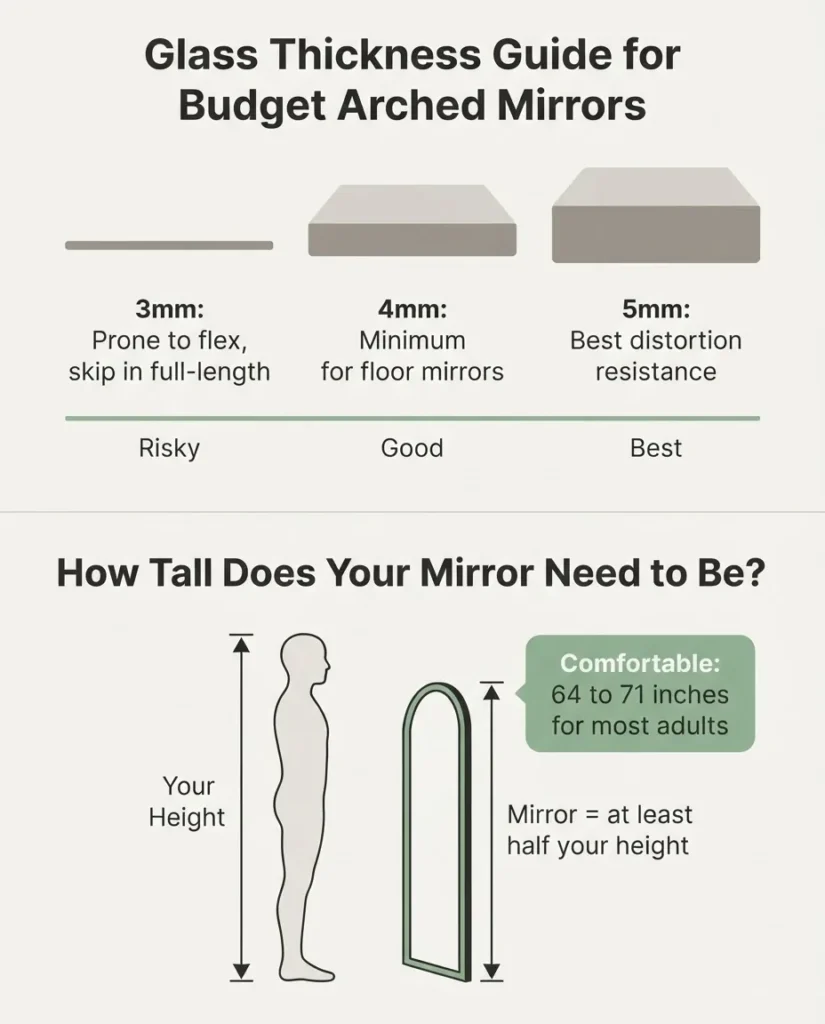
For glass thickness, the sweet spot for a full-length floor mirror is 4mm to 5mm. According to Noble Custom Glass’s mirror thickness guide, glass under 3mm is prone to flexing under its own weight in larger formats, which creates the wavy reflection that causes buyer regret. At 4mm to 5mm with a rigid aluminum frame, you get adequate stiffness for a mirror in the 56″ to 71″ tall range. Most listings in this price band don’t advertise the exact glass thickness, but the ones that do, and list 4mm or 5mm, are telling you something worth knowing.
If the listing only says “glass” with no thickness spec and no float glass mention, that’s a yellow flag.
The distortion-check you can do from a listing: look at product photos that show the mirror reflecting a room. If the straight lines in the reflection (a doorframe, a countertop edge, a shelf) look slightly curved or wavy, that’s a real quality tell. Edward Martin’s guide to evaluating mirror quality puts it well: a quality mirror should reflect straight lines as straight lines, and standing at an angle to look at known-straight elements in the reflection is how you test it in person or catch problems in unboxing.
Shatterproof and Tempered Glass: What Those Terms Mean Here
You’ll see both “shatterproof” and “tempered glass” in listings at this price. They’re not quite the same thing, and it’s worth knowing the difference.
True tempered glass is heat-treated to be significantly stronger than regular glass. If it does break, it breaks into small, blunt pebbles rather than sharp shards. Tempered glass is a genuine safety upgrade. Some listings in this range do use it, though it’s more common in mid-range and higher-priced mirrors.
“Shatterproof” in the budget category most often means a shatterproof safety film has been laminated to the back of the glass. This film doesn’t prevent the glass from cracking under impact, but it holds the fragments together so they don’t scatter. It’s still a meaningful safety feature, especially in a home with kids or pets.
Either is fine for most households. If you have young children or active pets and are buying a free-standing leaning mirror, prioritize the ones that explicitly mention one or the other. More on leaning safety in a moment.
Sizing: How Tall, How Wide, and Will It Fit Your Space
This is where a lot of returns happen. Not because the mirror was bad, but because someone bought a 71″ mirror for a room with 8-foot ceilings and then realized it dominated the entire wall, or they bought a 56″ mirror and it didn’t show their full body. Here’s what actually matters.
For a full-body reflection, the physics are simple: a mirror needs to be at least half your height to show you from head to toe. That’s because of how light angle works, with the angle of incidence equaling the angle of reflection. A 5’8″ person (68 inches) technically needs only a 34-inch-tall mirror for a full-body view. But that calculation assumes the mirror is positioned perfectly. In practice, floor mirrors lean slightly, which shifts the viewing angle, so going taller is always safer. For a full-length arched floor mirror, look for at least 56 inches tall, and 64″ to 71″ is more comfortable for most adults.
For a full-body reflection in an arched floor mirror, look for at least 56 inches of height, but 64 to 71 inches gives you better coverage for most adults and allows for the slight backward lean of a free-standing mirror. According to the Castlery mirror sizing guide, a good sizing rule for a wall or floor mirror is to choose a width that matches roughly two-thirds to three-quarters of the furniture width below it if you’re placing it above a console. The Ferguson Home buying guide seconds that rule: mirror width should be about two-thirds to three-quarters the width of any furniture it sits above, and for standalone floor mirrors the width is largely personal preference, but narrower (18″–22″) suits tighter rooms better.
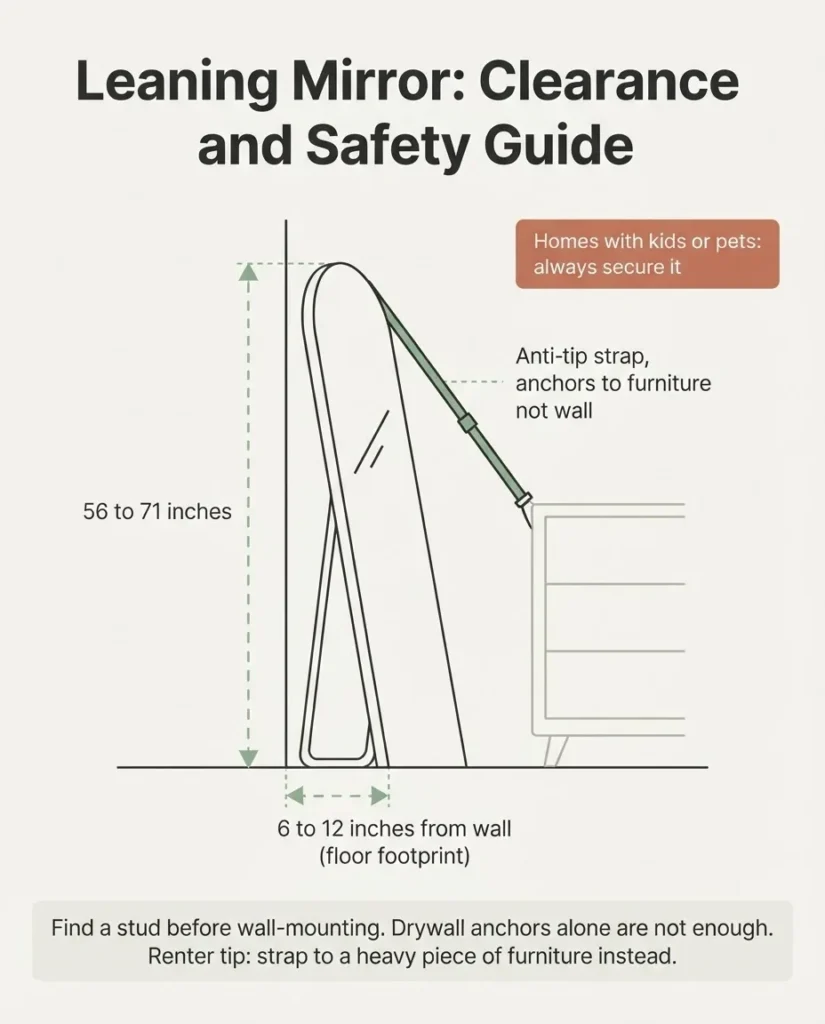
Width in this category typically runs from 18 to 28 inches. An 18″–22″ width is enough for an outfit check and has a narrower physical footprint, which matters in smaller bedrooms. A 24″–28″ width feels more proportional on an open wall. Keep in mind that a leaning mirror’s footprint extends out from the wall: most arched floor mirrors lean at roughly 5 to 10 degrees, which means the base sits 6 to 12 inches out from the wall depending on height. Measure that floor space before ordering.
Leaning vs. Wall-Mounted: A Real Decision, Not Just a Preference
Most under-$100 arched floor mirrors advertise “free-standing, leaning, or wall-mounted,” and that flexibility is genuinely useful. But there’s a safety dimension here that most guides quietly skip.
A leaning mirror is not inherently unsafe for adults. It becomes a concern when kids or pets are around, or when the floor surface is slick (hardwood or tile with no grip). The base of a leaning floor mirror has very little resistance to being bumped or tugged, and a 65-inch mirror weighing 15 to 20 pounds coming down on a small child is a serious risk. The CPSC’s Anchor It campaign specifically recommends securing free-standing mirrors and large furniture to walls in homes with children.
If you’re a renter and can’t or don’t want to drill into a wall, there’s still a practical path: anti-tip furniture straps (the same straps used to anchor bookshelves) can be attached to a heavy piece of furniture directly behind the mirror rather than the wall, giving the mirror a tether point without putting holes in drywall.
The DIY Playbook has a solid walkthrough on securing a leaning mirror without permanent wall damage. It’s a 15-minute job with about $15 worth of anti-tip straps. Worth doing.
For renters who want a true wall-mount, most of these mirrors include mounting hardware for that use. Find a stud with a stud finder and use the included hardware. Drywall anchors alone are not reliable for a mirror this size and weight.
What You Give Up Under $100 (Honest)
There’s no point pretending the under-$100 tier is the same as a $300 mirror. Here’s what typically gets compressed at this price:
The frame finish is thinner. Scratch resistance is lower. The hardware (hinges, stand brackets) is functional but not premium. Color accuracy in the finish can vary slightly between units if you order two. The backing paint on the mirror glass is thinner than what you’d find in higher-price ranges, which means these mirrors are more susceptible to edge blackening over time if placed in a bathroom or near a steam source. If you’re putting this mirror in a bathroom, keep it away from the shower splash zone.
What you do not give up under $100, if you buy the right ones: float glass quality, adequate glass thickness, decent frame rigidity, functional safety film, and overall size. The best options in this range look genuinely clean and reflect accurately. The gap between a well-chosen $70 mirror and a $250 mirror is narrower than the price difference suggests.
The Picks: Best Arched Mirrors Under $100
These are the options I’d point you toward. All are aluminum alloy frame, all advertise HD float glass or shatterproof glass, all free-standing or wall-mountable, and all priced in the budget range at time of research.
The Roundup

- 🌞【Designed for PS5 Disc Edition】This is a Faceplates for PS5. It can completely replace the original white faceplates. T…
- 🌞【Durability& Shockproof Material】The FacePlates for PS5 are made of impact-resistant hard ABS material, which is durabi…
- 🌞【Easy installation and Removal】The precision cutting clip matches your current faceplates for PS5 . Simply press the cl…

- 【ARCHED DESIGN】Modern & Contemporary Full Length Mirror with metal frame is suitable for the design style of your family…
- 【EXCELLENT QUALITY】It use Aluminum Alloy frame, the glass thickness is 0.2″(5mm), HD reflection effect. The back is cove…
- 【SIMPLE INSTALLATION】 Freestanding /wall-mounted/Lean on the wall 3 ways. If you want to hang it on the wall, it’s very …

- 【Elegant Arch Design】 This 77″x38″ full-length mirror features a sleek arch design with a brushed metal frame, combining…
- 【Safety-First Design with Explosion-Proof Glass】 The mirror is equipped with a nano-explosion-proof HD glass that ensure…
- 【Versatile Installation Options】 Easy to install, the mirror comes with all necessary hardware. You can choose to hang i…

- Generous Size & Elegant Design: This full-length floor mirror offers a spacious reflection so you can easily view your e…
- Sleek & Durable Aluminum Frame: Crafted with a high-quality aluminum alloy frame, the mirror is both lightweight for eas…
- High-Definition & Safety Glass: Featuring premium custom glass with HD imaging for a crystal-clear, distortion-free refl…

- 【Mirror Full Length】This full-length mirror, measuring 56″ x 19″, provides ample coverage for you to view your entire fi…
- 【Gracefully Arched Design】The arched-top design adds a touch of sophistication and timeless elegance to any room, settin…
- 【High-quality & Safety Assurance】Crafted with premium-quality glass, this floor mirror ensures high-definition real refl…
My Top Pick for Most Buyers
If you just want one recommendation without reading the whole roundup: the OLIXIS 64″x21.5″ arched mirror is where I’d send most people. It’s sitting at Amazon’s Choice status with a 4.7-star rating from a solid review count, it uses shatterproof glass, and the 64″ height gives you a genuinely comfortable full-body reflection for most adults. It free-stands, leans, or wall-mounts, and the aluminum alloy frame is the real thing, not a painted plastic substitute.

- Full Size: Our OLIXIS large mirror full length is 64″ in length and 21″ in width, which is large enough to give you a vi…
- Unique Design: The floor mirror features a clean, right-angled top frame design, blending sharp geometry with practicali…
- High Definition Imaging Glass: Our standing mirror is made of 3mm high-definition glass. Upgraded sterling silver layer …
Assembly: What to Actually Expect
Most arched floor mirrors in this category require minimal assembly. You’re typically attaching a foot bracket or stand to the base of the mirror frame using two to four screws, a process that takes 10 to 20 minutes with a screwdriver. The instructions are usually a single sheet. If you’ve ever assembled anything from a flat-pack box, this is easier. A few things to know going in: check that all hardware is included before discarding the packaging, and lay the mirror face-down on a soft surface (a folded moving blanket or towel works) during assembly so you’re not scratching the glass on your floor.
Unboxing Tip (Return Risk)
Large mirrors are one of the higher-risk shipping categories. The box can look fine on the outside while the glass inside has taken a corner hit. Before you break down the box, stand the mirror upright and look at the reflection from an angle. If the reflection of a straight line (a doorframe, a table edge) looks wavy or bent, the glass may have flexed or cracked in transit. Check this before you assemble anything and before you dispose of packaging.

Amazon’s return process for large items is typically straightforward within the 30-day window, but you need the original box to ship it back. Don’t throw the box away until you’re satisfied with the mirror.
Cleaning and Care: What Not to Do
Silver-backed mirrors are sensitive to ammonia-based cleaners. Regular Windex contains ammonia and, used repeatedly along the edges of a mirror, it will eventually cause the silver backing to deteriorate and produce the black spotting along the edges that makes an older mirror look dingy. Use a diluted isopropyl alcohol solution or a dedicated glass cleaner without ammonia, applied to a microfiber cloth rather than sprayed directly on the mirror. Wipe from the center outward. Spray directly on the glass (not on the frame) to keep moisture away from the frame joints and the backing edges.
FAQ: Real Questions People Ask Before Buying
Is a $50 arched mirror actually worth buying?
For a floor mirror that free-stands or leans, yes, if it has an aluminum alloy frame, 4mm or 5mm float glass, and some form of shatterproof backing. Buyers in this range consistently report that the reflection is clear and the build is solid enough for everyday use. What you’re accepting is thinner hardware, a less durable frame finish, and less long-term corrosion resistance in the backing, but the actual functional performance is good for most households.
What size arched floor mirror do I need for a full-body reflection?
For a full-body reflection, look for a floor mirror at least 56 inches tall, but 64 to 71 inches is more comfortable, and a width of at least 20 inches, since the mirror needs to be roughly half your height to show your full reflection due to the way light angles work. Most budget arched mirrors exceed the minimum, but taller people (over 6 feet) should look for the 70″–71″ options in this range.
Can I mount a $60 arched mirror on the wall instead of leaning it?
Most under-$100 arched floor mirrors come with both mounting hardware for wall installation and a stand for free-standing use. Wall-mounting is the safer option in homes with kids or pets. Find a wall stud with a stud finder and use it. Drywall anchors alone are not reliable for a 15–20 lb mirror.
Will a cheap arched mirror distort my reflection?
It can, but it doesn’t have to. The key spec to look for is “HD float glass” in the listing. Float glass has a flatter surface than standard glass and is far less prone to distortion. Glass that is too thin (under 4mm) is more prone to flex and waviness in full-length formats. The best options in the sub-$100 range advertise both, and the buyer reviews will usually call out distortion immediately if it’s an issue.
What frame material is best for an arched mirror under $100?
Aluminum alloy is the best choice at this price. It’s lightweight, resistant to rust and humidity, doesn’t warp over time, and holds the arch shape without additional structural support. Solid wood is fine if the listing clearly specifies solid wood (not MDF). Avoid MDF-framed mirrors for free-standing use, as they can crack at joints over time.