
A quality LED vanity mirror is worth it for most buyers. The lighting is genuinely better for grooming and makeup than a ceiling fixture or a separate vanity light bar, the LEDs themselves last for decades, and the running cost is only a few dollars a year in electricity. That said, the market is flooded with cheap, poorly made versions that look identical in a listing photo but fail within a year or two, and a handful of models have even been caught using fake safety certification marks. So the real question isn’t “are LED mirrors worth it” in general. It’s “how do you find one that’s actually good?”
That’s what this guide is for. I’ll walk you through what actually matters in an LED vanity mirror, what’s an upsell you don’t need, how renters can use one without touching a single wire, and which specific models are worth your money right now.
What Is an LED Vanity Mirror, Actually?
A standard bathroom mirror is a reflective surface. That’s all it is. The light comes from somewhere else, usually a ceiling fixture or a separate light bar mounted above or beside the mirror. And that’s the problem: overhead light casts shadows downward across your face, right across the areas you’re most trying to see clearly. The tip of your nose, your jawline, under your eyes, all of it gets shadowed out just when you need even light the most.
An LED vanity mirror puts the light source directly at the mirror, so it reaches your face head-on and from the sides, the same way a makeup artist’s mirror works. The light is built into the mirror itself, either around the perimeter (front-lit), glowing behind a frosted edge or panel (backlit), or both. The result is more even, face-level lighting than a ceiling fixture can ever give you. For shaving, skincare, or applying makeup, this is a practical upgrade, not just an aesthetic one.
Most mid-range and up LED mirrors sold today also include a touch dimmer, a color temperature switch (more on this in a minute), and an anti-fog heating pad. Some add a clock display, a magnifying zone, or Bluetooth speakers. A few of those extras are genuinely useful. Some are just features on a spec sheet.
Does the Lighting Actually Make a Difference?
Yes, and this is where the real value is. Two specs determine whether an LED mirror’s light is actually good or just bright.
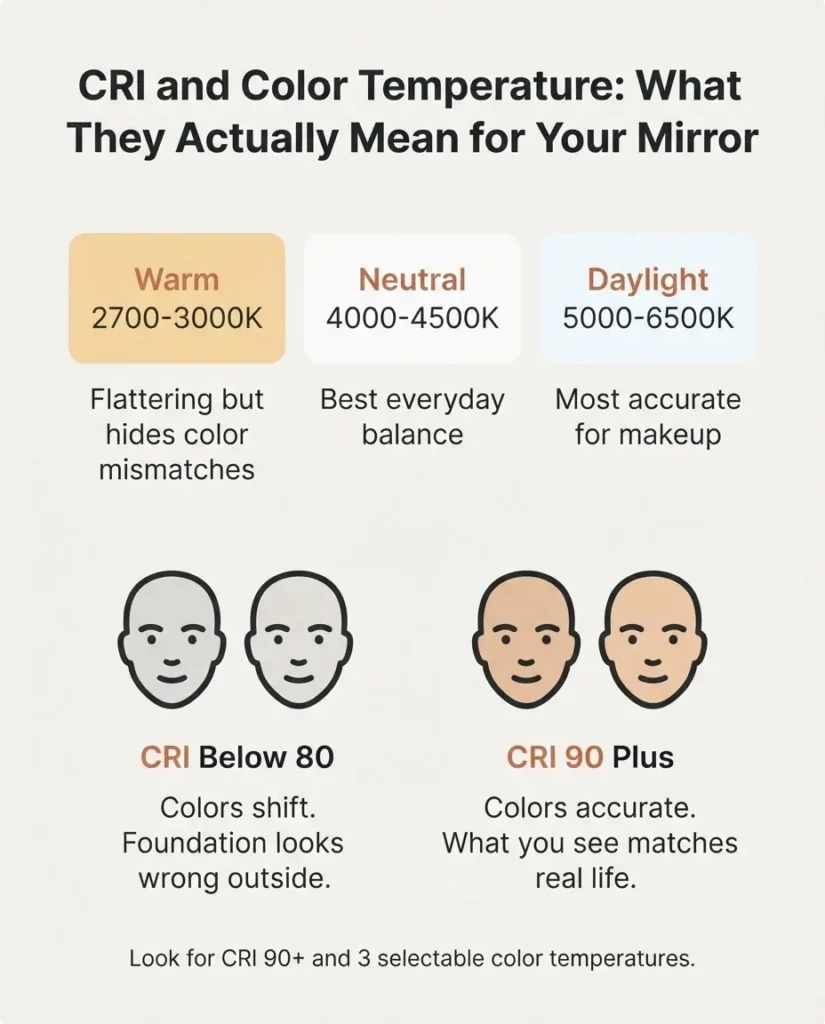
CRI: the one number most listings hide or downplay. CRI stands for Color Rendering Index. It measures how accurately a light source renders colors compared to natural daylight, on a scale of 0 to 100. A mirror with CRI 95 shows your skin tones and makeup colors close to how they look outside. A mirror with CRI 70 shifts reds and warm tones, grays out skin, and makes applying foundation a genuine guessing game.
For an LED vanity mirror to show your actual skin tones and makeup colors accurately, look for a CRI rating of 90 or higher. Below CRI 80, what you see in the mirror genuinely does not match what you look like in natural light. Most budget mirrors don’t list CRI at all, which usually means it’s below 80 and they’d rather not say. If you can’t find a CRI number on the listing, that’s a flag. As Golden Lighting’s breakdown of makeup lighting puts it directly: “Look for 90 CRI or higher anywhere you make color decisions about your own face.”
Color temperature: warm, neutral, or daylight. Color temperature is measured in Kelvins (K). Warm light (2700-3000K) looks golden, flatters skin, and feels relaxing, but it also hides foundation mismatches and makes blush read darker than it is. Daylight range (5000-6500K) is accurate but clinical. Neutral white (4000-4500K) sits in the middle and works well for both grooming accuracy and everyday bathroom use.
The honest sweet spot for most people: a mirror with three selectable color temperatures (usually labeled warm, neutral, and cool) so you can use warm light for winding down in the evening and switch to neutral or daylight for actual grooming. This feature is worth paying for. A fixed-temperature-only mirror locks you into one choice permanently.
The Safety Thing Nobody Talks About
This part matters, so I’m putting it early. LED mirrors go in bathrooms, which are wet environments. Any electrical product near water needs to be properly rated for it. The spec to look for is the IP (Ingress Protection) rating. For a bathroom vanity mirror, you want at minimum IP44. That means the mirror is protected against solid particles over 1mm and water splashing from any direction. IP54 adds more dust resistance and is a better choice for smaller, more humid bathrooms.
The second thing to check is electrical safety certification. In the U.S., UL listing and ETL certification both follow the same NRTL safety standards and both are valid. Look for either mark on the listing and in the product specs.
Here is the critical catch. In October 2024, UL Solutions issued a formal safety warning about a specific LED bathroom mirror model that was sold online bearing a fake, unauthorized UL certification mark. The mirror had not been evaluated to any actual safety standard. UL Solutions recommended it be removed from service. That warning is real, public, and checkable.
What this means practically: a UL logo on a listing photo or even printed on the mirror itself is not proof of real certification. Cross-check on the UL Product iQ database (ul.com/piq) or look for brand names with a verifiable track record.
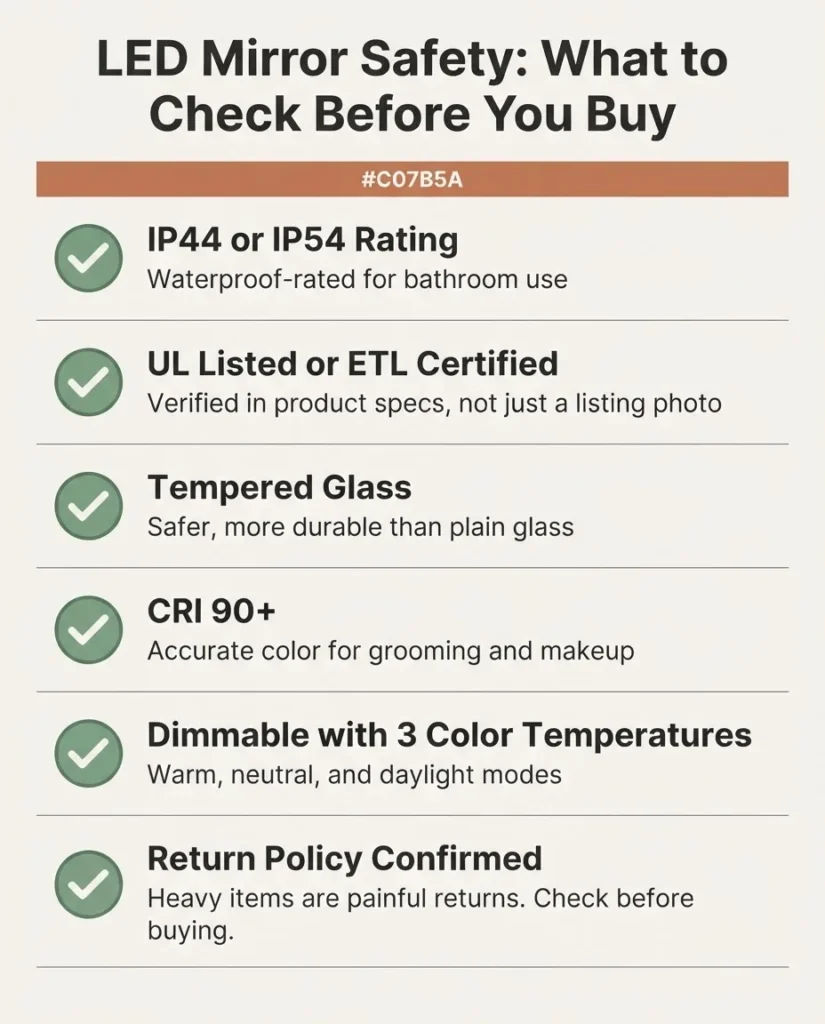
Stick to products from established brands with real certifications listed in their specs, not just in a listing photo. If a mirror at a very low price carries a certification mark but the brand has no presence, no reviews beyond a few weeks old, and no traceable manufacturer information, skip it.
Plug-In or Hardwired: The Renter Question
Renters can absolutely use an LED vanity mirror by choosing a plug-in model, which requires only a nearby GFCI outlet, no rewiring, and leaves no permanent changes when you move out. This is the version I’d tell any renter to start with.
Plug-in LED mirrors power from a standard GFCI outlet (the outlets with the test/reset buttons, required in bathrooms). The cord runs from the mirror to the outlet, which some people manage by tucking it behind the mirror or along the backsplash. The light looks identical to a hardwired version once the mirror is up. Plug-in LED mirrors are fully renter-friendly: mount the bracket (most use a French cleat or a simple keyhole bracket), hang the mirror, plug it in, done. No electrician, no lease violation, and the mirror comes with you when you move.
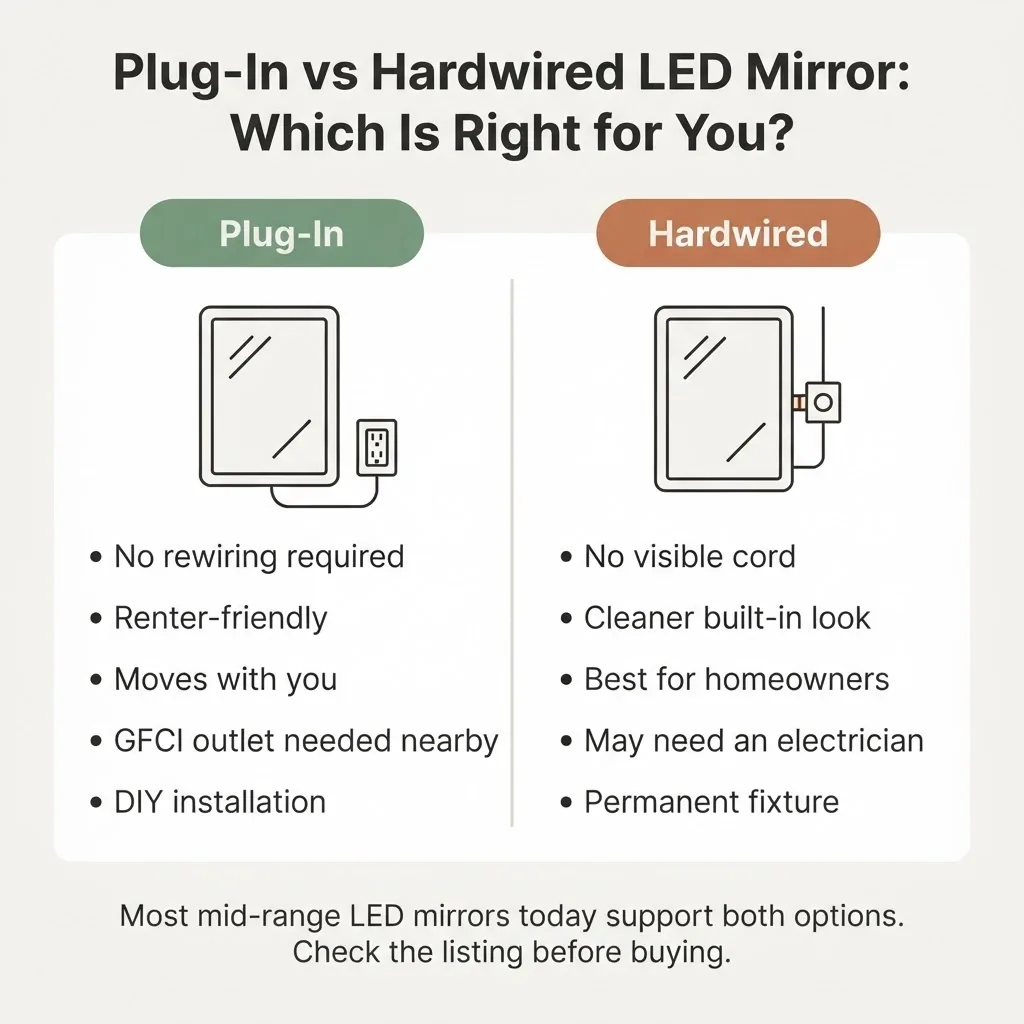
Hardwired mirrors connect directly into the existing bathroom wiring or junction box. They look cleaner because there’s no visible cord, and they’re the better choice if you own the space and want the most finished look. If you’re a homeowner and there’s already a junction box or wiring behind your existing mirror, the swap is straightforward. If no wiring is present, adding a circuit costs roughly $100-$300 for an electrician depending on your setup. For renters, hardwired is simply not the right category.
One practical note: most mid-range wall-mount LED mirrors today support both plug-in and hardwired connection. The Keonjinn 48″x30″ (B09VBS6T8N) is one example. Always confirm which power options a specific model includes before buying.
Wall-Mount vs. Tabletop: Which Type Should You Buy?
There are two completely different product categories people call “LED vanity mirrors,” and they serve different purposes.
Wall-mount LED mirrors (24″x32″, 30″x40″, 48″x30″, etc.) replace your existing bathroom mirror. They’re the ones with the built-in LED perimeter or backlight, the anti-fog pad, and the touch controls on the glass. They are permanent or semi-permanent fixtures. These are the right choice if you want to upgrade your bathroom’s actual lighting situation, not just add a makeup mirror to a dresser.
Tabletop LED vanity mirrors sit on a dresser, vanity table, or bathroom counter. They’re smaller (typically 8-18″ wide), portable or rechargeable, and designed specifically for makeup or skincare up close. Most have a magnifying zone on one side. These don’t replace your bathroom mirror, they supplement it.
The right choice depends entirely on your situation.
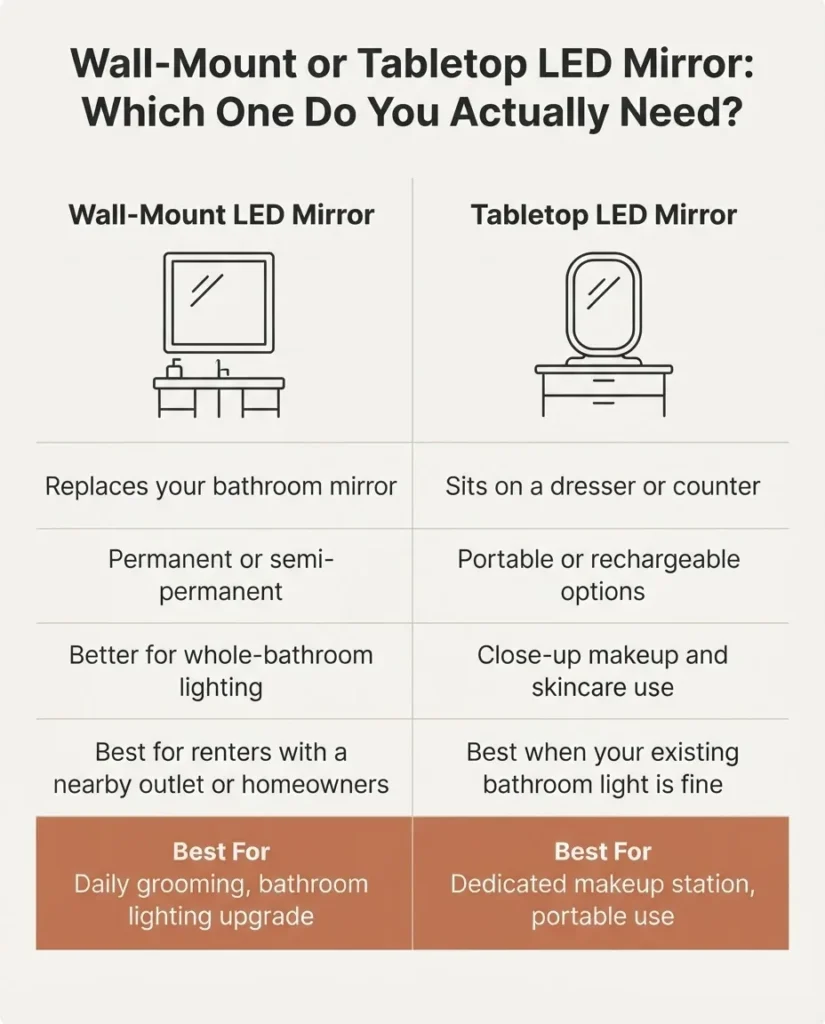
If your bathroom lighting is genuinely bad and you want even face-level light every morning, the wall-mount is the functional fix. If you mainly want a close-up makeup mirror at a specific spot and your bathroom light is fine, a quality tabletop model is the better, lower-commitment buy.
For sizing a wall-mount mirror: the general rule is that your mirror should be roughly 70-90% of your vanity’s width and should never be wider than the vanity itself. For a 30″ single-sink vanity, a 24″-28″ wide mirror is the right range. For a 60″ double-sink vanity, something in the 48″-54″ range reads proportional. The matrix mirror sizing guide has a clean reference table by vanity width if you want specific numbers before you buy.
Which Features Are Worth Paying For (and Which Ones Aren’t)
Not everything on an LED mirror spec sheet is worth the premium. Here’s the honest breakdown.
Worth it every time:
- Dimming with a touch control. Full brightness for detail work, lower for everything else. This is a daily-use feature, not a gimmick.
- Three selectable color temperatures. Already explained above. The most practically useful feature on the list after dimming.
- Anti-fog (demister) pad. Genuinely useful if your bathroom steams up regularly. Not important for a powder room or a bathroom that vents well. As Tetote’s detailed breakdown of anti-fog mirrors explains, the heating pad warms a defined area of the glass, not necessarily the whole mirror. For high-steam bathrooms, it earns its cost. For a rarely-used guest bath, it doesn’t matter.
- Memory function. Saves your preferred brightness and color temp so the mirror powers on at your setting, not default. Small thing, daily payoff.
- Tempered glass. Not a feature so much as a build standard. Tempered glass is significantly harder to shatter than standard glass, and if it does break, it crumbles into small, less dangerous pieces rather than large shards. Non-negotiable for a bathroom mirror.
Skip or don’t pay extra for:
- Bluetooth speakers. Fine if it’s included free, but I wouldn’t pay a significant premium for it. Bathroom acoustics are rough, and most people are already listening through a phone nearby.
- Built-in clock display. Convenient for about a week, then you stop noticing it. Not a reason to choose one model over another.
- Magnification zones on a wall-mount. These work, but they require you to stand at exactly the right distance. A separate dedicated magnifying mirror does this better if you actually need 5x or 10x magnification for detail work.
The Two Wall-Mount LED Mirrors Worth Considering
For wall-mount LED mirrors in the budget-to-mid range, two models stand out consistently based on what buyers report and what their specs actually show.
The LOAAO 24″x32″ (ASIN: B09TP5WHTQ) is ETL-certified, uses tempered glass, includes both front-lit and backlit LED, dimmable with three color temperature settings, and has a memory function and anti-fog. It carries an Amazon’s Choice badge with strong buyer ratings. The 24″x32″ size works well for a single-sink vanity in the 28″-36″ range. It supports both plug-in and hardwired installation, which makes it a reasonable option for renters who have a nearby outlet as well as owners.
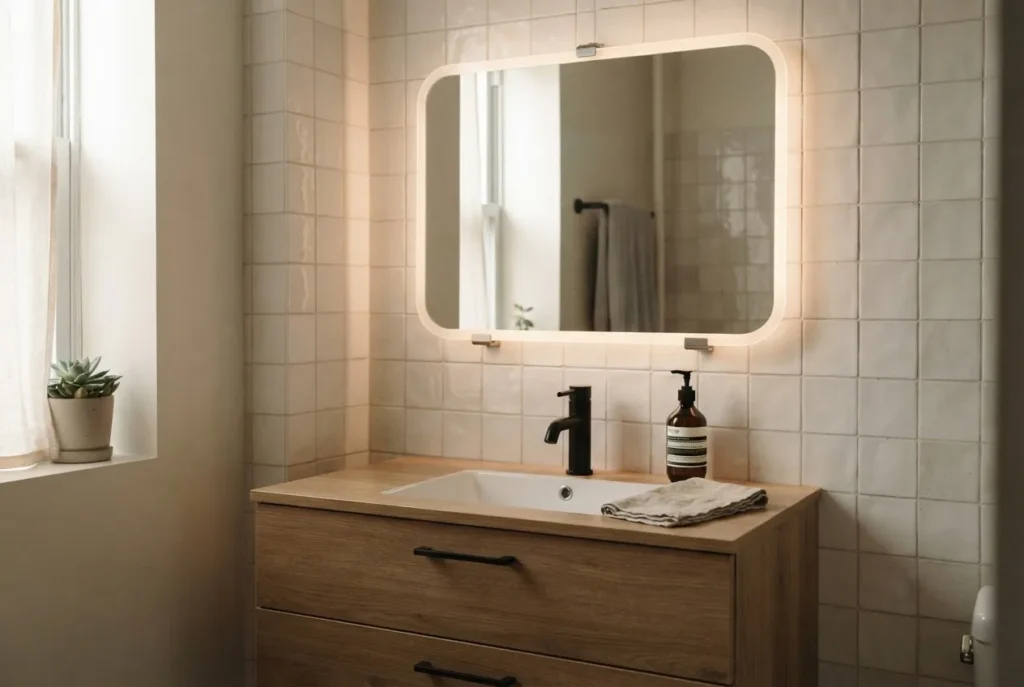
This is a genuinely solid budget-to-mid option.

- 【Backlit+Front-lit, Double Lighting Sources】: loaao led bathroom mirror is designed with both backlight and front light;…
- 【Dimmable & 3 Color Temperature】: The brightness is adjustable for the lighted bathroom mirror; Simply long press the to…
- 【Defog Feature & Memory Function】: Fogless mirror with defog function; No bother to wipe the mirror down after a shower;…
If you have a larger vanity, or you want the most complete feature set in the mid-range category, the Keonjinn lineup is the next step up. The Keonjinn 48″x30″ (ASIN: B09VBS6T8N) covers larger single-sink or smaller double-sink setups, and the Keonjinn 16″x24″ (ASIN: B0DR2LWRTV) handles compact vanities in smaller apartments. Both are ETL-certified (which UL and ETL are equivalent NRTL certifications), use tempered glass, and include front+backlit LED, three color temp modes, stepless dimming, anti-fog, and both plug-in and hardwired options.

- 【Upgraded Backlit Illumination】This LED backlit bathroom mirror is built with UL-certified high-density LED strips (120 …
- 【3 Color Temperature & Dimmable Lighting】Easily switch between three color temperatures to match different moments of yo…
- 【HD Tempered Glass with Shatterproof Safety】Made with HD tempered glass, this LED mirror for bathroom delivers clear, di…

- 【Save More with Efficient Lighting】 Experience top-tier illumination while saving energy with our energy saving frontlit…
- 【Convenient Light Control at Your Fingertips】 Enjoy seamless light control with just one touch. Easily switch between th…
- 【High-Performance Lighting】The LED bathroom mirror offers superior front and back lighting with high-power LEDs that pro…
The Tabletop LED Vanity Mirror Options
If you’re not looking to replace your bathroom mirror but want a dedicated, well-lit surface for makeup or skincare close-up work, tabletop LED mirrors serve a different and more specific purpose.
Fancii Vera is the tabletop LED vanity mirror that shows up most consistently at the top of buyer conversations and reviews. It’s rechargeable (no cord to manage while you’re using it), has three dimmable light settings, and uses what Fancii describes as natural daylight LEDs. The rechargeable design makes it genuinely flexible: use it at your bathroom vanity, move it to a bedroom dresser, take it traveling. It’s not a cheap buy, but it’s built with actual quality, and Fancii backs it with a 24-month warranty, which is better than most in this space.

- Perfect Touch-Ups Anywhere:: Choose from 3 dimmable light settings (warm, neutral, natural daylight) for flawless, color…
- Dual Magnification: 1x for full face and 10x magnifying mirror for precision tasks like tweezing or contact lenses.
- Compact & Stylish: Ultra-portable 4-inch mirror fits perfectly in your purse, easy to hold with one hand, with a premium…
For the Hollywood-style vanity mirror with bulbs around the perimeter (the classic dressing-room look), the Impressions Vanity Hollywood Glow Pro Trifold (ASIN: B0925QL4GJ) is the one that keeps landing at the top of serious beauty setups. It’s a freestanding trifold with 15 dimmable clear LED globe bulbs, a dimmer switch, and built-in USB ports and outlets on the side. The bulbs are replaceable, which is worth noting since bulb-style mirrors give you the option to swap in different color temps. This is a bulkier, heavier mirror (around 68 lbs.), and the price reflects it. It’s also the one that’s overkill if you just want even bathroom lighting. But if you’re building out a dedicated makeup space at a desk or vanity table and you want the full Hollywood setup, this is what that looks like.

- 【Height Adjustable】 In direct response to our customers, we now offer this height‑adjustable LED mirror for desk or vani…
- 【30x Magnifying Vanity Mirror Tabletop】 This tabletop mirror with stand includes a 1X regular side and a 30x magnifying …
- 【3 Color Lights + Stepless Dimming】 This magnifying mirror with light has 3 color modes (cool, warm, natural) and steple…

- vanity mirror with lights
- 【 Detachable 10X Magnifying Mirror 】- Our light up makeup mirror has 10X magnifying mirror to help applying mascara, eye…
- 【Touch-Sensitive Control & Smart Memory Function】 – Simply turn on/off the light up vanity mirror and adjust the brightn…
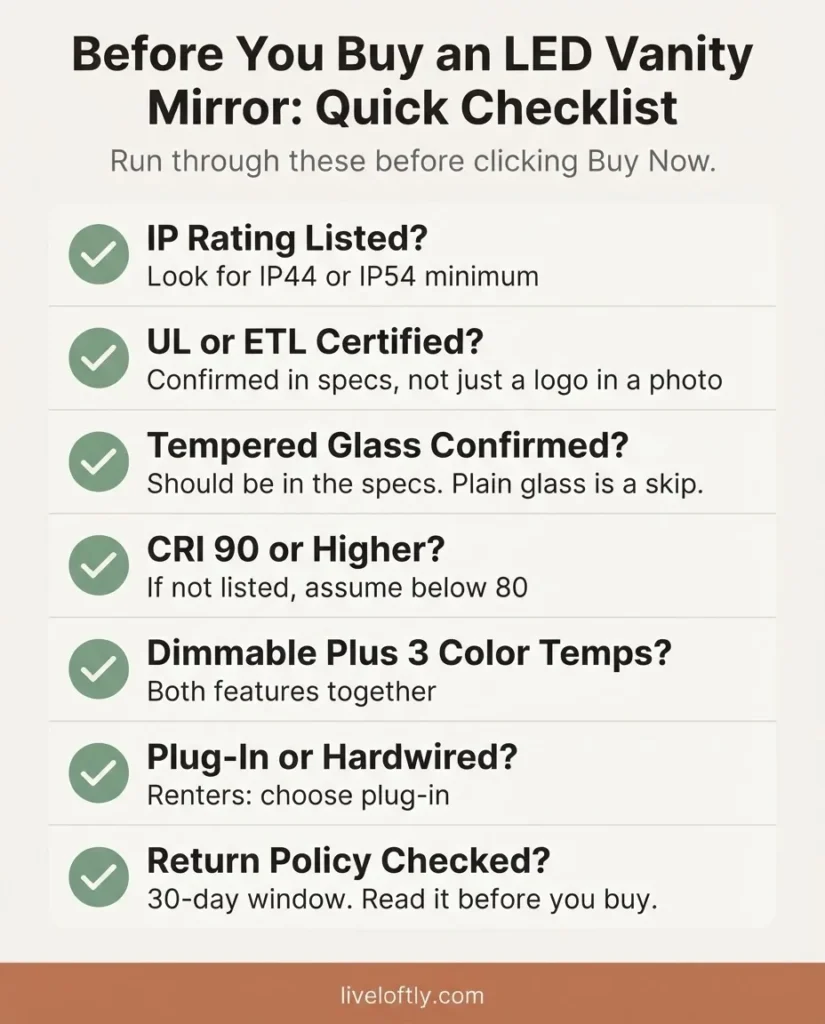
What to Check Before Buying (The Quick Inspection List)
Before you click Buy Now on any LED vanity mirror, run through these quickly. I run this same filter on anything I’d actually recommend.
- IP rating. Look for IP44 or IP54 in the specs. If no IP rating is listed, that’s a red flag for bathroom use.
- Certification mark. UL listed or ETL certified, confirmed in the product description, not just a logo in a photo.
- CRI. Look for CRI 90+ in the specs or listing. If it’s not listed, assume it’s below 80.
- Tempered glass. Should be in the specs. Plain glass is a hard skip for a bathroom mirror.
- Three-color temperature AND dimming. Both together. One without the other is a step down.
- Anti-fog. Only matters if your bathroom steams up regularly. Don’t pay extra for it if it doesn’t apply to your situation.
- Return policy. LED mirrors are heavy and fragile. Amazon’s standard return window is 30 days. Read the specifics before buying, not after.
- A large mirror that arrives damaged or looks different than the listing is a genuinely painful return to arrange.
For installation guidance beyond the basics of plug-in vs. hardwired, WarmlyYours has a thorough step-by-step LED mirror installation walkthrough that covers both mounting and wiring options in plain terms.
The Honest Bottom Line: Worth It, or Skip It?
Worth it for:
- Anyone whose bathroom has ceiling-only lighting and frustrating shadows when grooming
- Renters who want better bathroom lighting without any permanent changes (plug-in model)
- Anyone doing detailed makeup or skincare work who is making color-accurate decisions from the mirror
- Homeowners upgrading a bathroom on a mid-range budget who want the most visible functional improvement per dollar
Skip it if:
- Your bathroom already has good side-mounted or face-level lighting and you just want a larger mirror
- You’re looking at models with no IP rating listed and no verifiable certification
- You’re eyeing a very cheap option from a no-name brand with a fake or unverifiable safety mark
- The anti-fog feature is the main reason you’re buying, but your bathroom is actually well-ventilated and doesn’t have a steam problem
There is a thorough industry-level look at the full pros, cons, and energy numbers in this LED bathroom mirror worth-it breakdown from Stanhom that goes deeper into the commercial and energy-efficiency side of it if you want to go further into the specs.
The short version: a quality LED vanity mirror with verified certification, tempered glass, CRI 90+, and three-color dimming is a real upgrade and a durable one. A cheap mirror with no IP rating and an unverifiable safety mark is not a bargain. It’s a roll of the dice in a wet room.
Frequently Asked Questions
How long do LED vanity mirrors actually last?
The LED strips inside a quality mirror are rated for 30,000 to 50,000 hours. At two hours of use per day, that works out to over 40 years of LED life before meaningful degradation. In practice, the driver or touch control is more likely to be the first component that fails, not the LEDs themselves. A mirror with a verifiable brand and a clear warranty (look for at least one year) is the safer buy.
Can renters install an LED bathroom mirror without rewiring?
Yes. Renters should choose a plug-in LED mirror, which runs from a standard GFCI bathroom outlet, requires no wiring changes, and can be removed when you move without leaving permanent marks (depending on the mounting method). Hardwired mirrors are the better choice for homeowners who want a cord-free look, but plug-in models look identical once they’re on the wall.
What CRI should an LED vanity mirror have?
For grooming and makeup accuracy, look for CRI 90 or higher. Below CRI 80, colors shift enough that what you see in the mirror does not match what you look like in natural light. Many budget mirrors don’t list CRI at all. That omission is itself a signal.
Is anti-fog on an LED mirror actually useful?
It depends on your bathroom. Anti-fog (demister) pads heat a defined zone of the glass to prevent condensation after hot showers. In a windowless, low-ventilation bathroom where steam lingers, it’s a genuine daily convenience. In a well-ventilated bathroom that clears quickly, it’s a nice-to-have but not something to pay a big premium for. It also does not replace a working exhaust fan.
What’s the difference between UL listed and ETL certified for LED mirrors?
Both UL (Underwriters Laboratories) and ETL (Intertek) are NRTL-certified testing laboratories in the U.S. that test to the same safety standards. Either mark on a product description is a valid indicator that the mirror has been evaluated for electrical safety. The important thing is that the mark is real and verifiable, not just a logo added to a listing photo. UL Solutions’ public safety database at ul.com lets you check whether a specific product and model number are genuinely certified.