Cheap canvas prints can be good. That is the honest answer, and I want to say it clearly up front, because a lot of content on this topic is written by canvas print companies who have a financial reason to tell you that cheap always means bad. The truth is more useful than that. The difference between a budget canvas print that looks like real wall art and one that looks like a poster stapled to a stick frame comes down to four things: the canvas fabric, the ink, the frame construction, and whether the listing actually tells you any of those details. None of those four things are automatically solved by paying more, and none of them are automatically ruined by paying less.
What I can tell you, from running every potential purchase through a “is this actually worth it, or does it just look good in the listing photo” filter, is that the gap between the best and worst cheap canvas prints is wider than you might expect. Some budget canvas prints look genuinely good on a wall and hold up fine for years. Others arrive looking flat and faded, sag at the corners within months, or have a frame so thin it bows when you press on it. Knowing which is which before you hand over money is the whole point of this guide.
Is Cheap Canvas Print Art Worth Buying?
For renters, first-time homeowners, and anyone furnishing a space on a budget, pre-made canvas prints sold in the budget-to-mid range are a completely reasonable choice for most walls. They are not the same as a high-end giclee print from a fine art studio, and they are not trying to be. But bought correctly, from a listing that actually tells you what you are getting, they are a practical, low-return-risk way to add something to a blank wall without spending what you would on a piece of furniture.
What Actually Determines a Canvas Print’s Quality
Understanding these four factors takes about five minutes, and it will save you from spending money on something you wish you could return.
Canvas fabric: the material the image is actually printed on
Quality canvas prints use a poly-cotton blend or pure cotton fabric, typically rated at 360 gsm (grams per square meter) or above. That weight produces a dense, slightly textured surface that holds ink evenly and looks the way you expect canvas art to look. Budget prints that cut corners use thin, loosely woven pure polyester canvas, often under 280 gsm. On that surface, ink sits unevenly, colors look muted, and the texture looks more like fabric than art. The problem is you usually cannot feel or see this difference in a listing photo.
What to look for in a listing: any mention of “poly-cotton,” “cotton canvas,” or a specific gsm rating is a good sign. A listing that just says “canvas” without any further detail is almost always using the cheaper option. As CanvasDiscount’s quality guide explains, the canvas weight is one of the clearest signals of a quality-focused production process because it is a testable, specific number, not a marketing phrase.
Ink type: the single most important quality variable for longevity
This is the one I wish more people knew before buying. There are two types of ink used in canvas printing. Pigment-based inks use solid particles suspended in liquid, they bond to the canvas fibers deeply, and they are rated to resist fading for 75 years or more under normal indoor conditions. Dye-based inks look vivid when they arrive, but the color molecules are less stable and can begin fading within five to ten years, especially near windows where UV light accelerates the process.
Almost every budget canvas print on Amazon uses dye-based inks. Many do not mention ink type at all, which is itself a signal. A listing that specifies “archival pigment inks,” “UV-resistant inks,” or “HP latex inks” is making a real technical claim. A listing that just uses the word “vibrant” or “vivid” without any ink specification is almost certainly not using archival-grade inks. This does not mean you cannot buy it, but you should know that the colors may not look quite as crisp in five years as they do on day one, particularly if you hang it in a bright spot.
Frame construction: what is actually holding the canvas taut
Behind the printed fabric is a wooden frame, called stretcher bars. On a quality canvas print, these bars are made from kiln-dried solid wood, usually pine or a similar species. Kiln-drying removes moisture from the wood so it cannot warp, twist, or bow as it ages. On a cheap canvas print, the frame is often made from undried or “green” wood that still contains moisture, or in some cases from MDF or wood fiberboard. Green wood warps as it dries out over months. MDF is stable but it does not hold staples well, so the canvas can pull loose from the frame over time.
Budget prints often use a 0.75 inch deep frame, which is the standard depth and completely fine for smaller prints. The 1.5 inch deep “gallery wrap” frame has a more substantial presence on the wall and looks finished without needing an added frame. For anything 16×20 or larger, a 1.5 inch depth looks noticeably better from the side. For smaller accent pieces in the 8×10 or 11×14 range, 0.75 inch works well.
The listing detail to look for here: if a listing mentions “kiln-dried solid wood,” “solid pine stretcher bars,” or “1.5 inch wood frame,” those are real quality signals. A listing that says “wood fiberboard” or just “wood frame” without further detail is almost certainly using a cheaper construction method, which is fine for a print you plan to replace in a few years, but it is worth knowing.

Protective UV coating: the finishing layer most cheap prints skip
A UV-resistant coating or varnish applied over the printed surface after printing does three things: it slows color fading from ambient UV light, it makes the surface moisture-resistant enough to wipe with a dry cloth, and it provides a consistent finish (matte, satin, or gloss) that makes the colors look more finished and less “inkjet.” This step adds minimal cost to the production process, but many budget manufacturers skip it entirely to keep prices low. The result is a canvas that looks fine on day one but loses its freshness faster, especially in rooms that get a lot of natural light.
How to Read an Amazon Canvas Print Listing
Here is the practical checklist I run through when looking at a canvas print on Amazon. As a general framework for what quality-focused brands will and won’t tell you, CanvasChamp’s pre-purchase buying checklist covers many of the same signals.
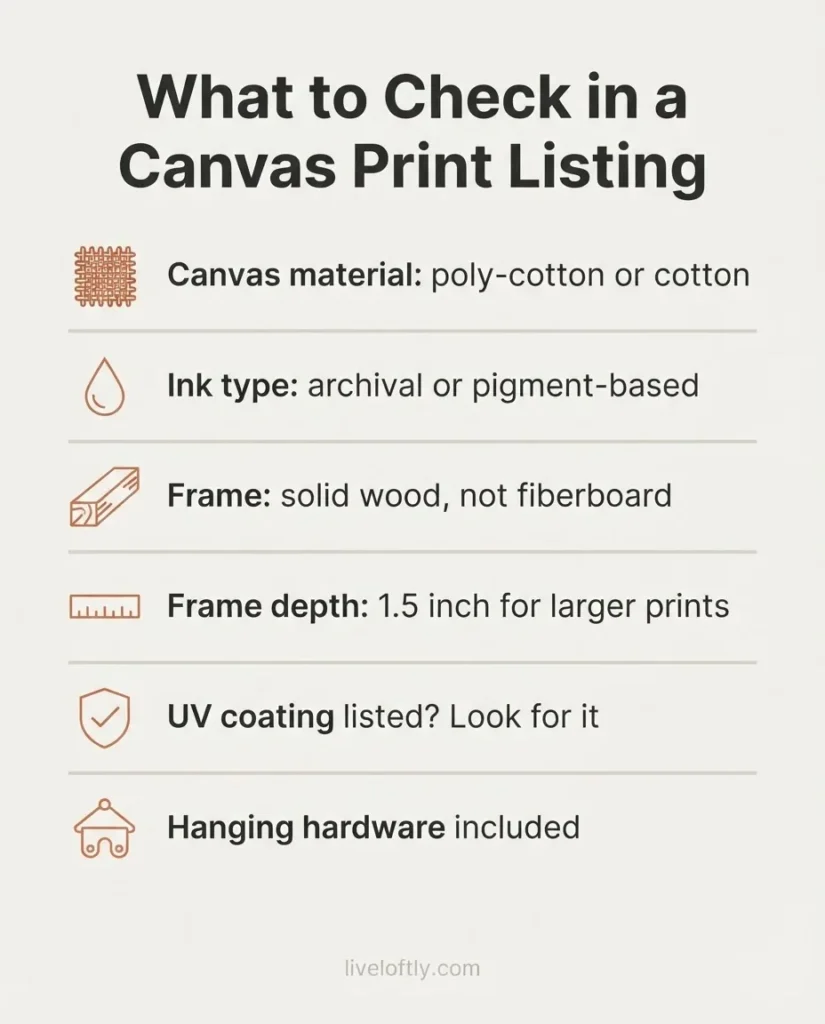
Check the product description, not just the title. Look for: canvas material type (poly-cotton is better than “canvas” alone), ink specification (archival, pigment, UV-resistant is better than “vivid colors”), frame material (kiln-dried solid wood is better than fiberboard or just “wood”), frame depth (1.5 inch is more substantial), and whether hanging hardware is pre-installed.
Look at the product photos carefully, not just the first one. Scroll to the detail shots and the review images. Do the colors look accurate or oversaturated? Do the corners look tight and even or slightly puckered? Is the frame visible in the side shot, and does it look solid or thin? Review photos from actual buyers are more honest than listing photos, which are almost always shot in perfect lighting against a well-staged wall.
Check the review count and the review date spread. A product with 400 reviews that are spread over 18 months is a more trustworthy signal than 400 reviews that all appeared in the same two weeks. Also read the one and two-star reviews specifically, not because one bad review should stop you, but because patterns matter. If four separate reviewers all mention warping frames or colors that look nothing like the listing, that is real information.
Check the return policy before you buy. Amazon’s standard return window is 30 days from delivery for most items. The one major caveat: custom or personalized canvas prints, where you upload your own photo or choose personalized text, are typically listed as non-returnable because they are made to order. This is an important distinction. A pre-made canvas print where you pick from existing designs can usually be returned. A canvas printed with your photo usually cannot. Read the product page carefully before ordering a personalized print.
Does Your Photo Actually Matter for a Custom Canvas?
If you are ordering a custom canvas print using your own photo rather than a pre-made design, the quality of your source image matters as much as the quality of the print service. The minimum recommended resolution for a canvas print is about 150 DPI at the final print size. For a 16×20 canvas, that means at least 2,400 by 3,000 pixels. Most smartphone photos taken in the past few years comfortably exceed this for sizes up to 20×24 or so. CanvaPop’s resolution guide has a helpful size-by-size breakdown if you want to check whether a specific photo file will hold up at a larger size.
The practical rules: use the original photo file, not a screenshot or a downloaded-from-social-media version. Social media platforms compress images significantly, and that compression is invisible on a four-inch phone screen but very visible when enlarged to canvas size. If the photo looks slightly blurry on your laptop screen when you zoom in, it will look blurry on canvas. If it is crisp and sharp at full size on your laptop, it will almost certainly be fine for a standard canvas size.
What Size Should You Actually Buy?
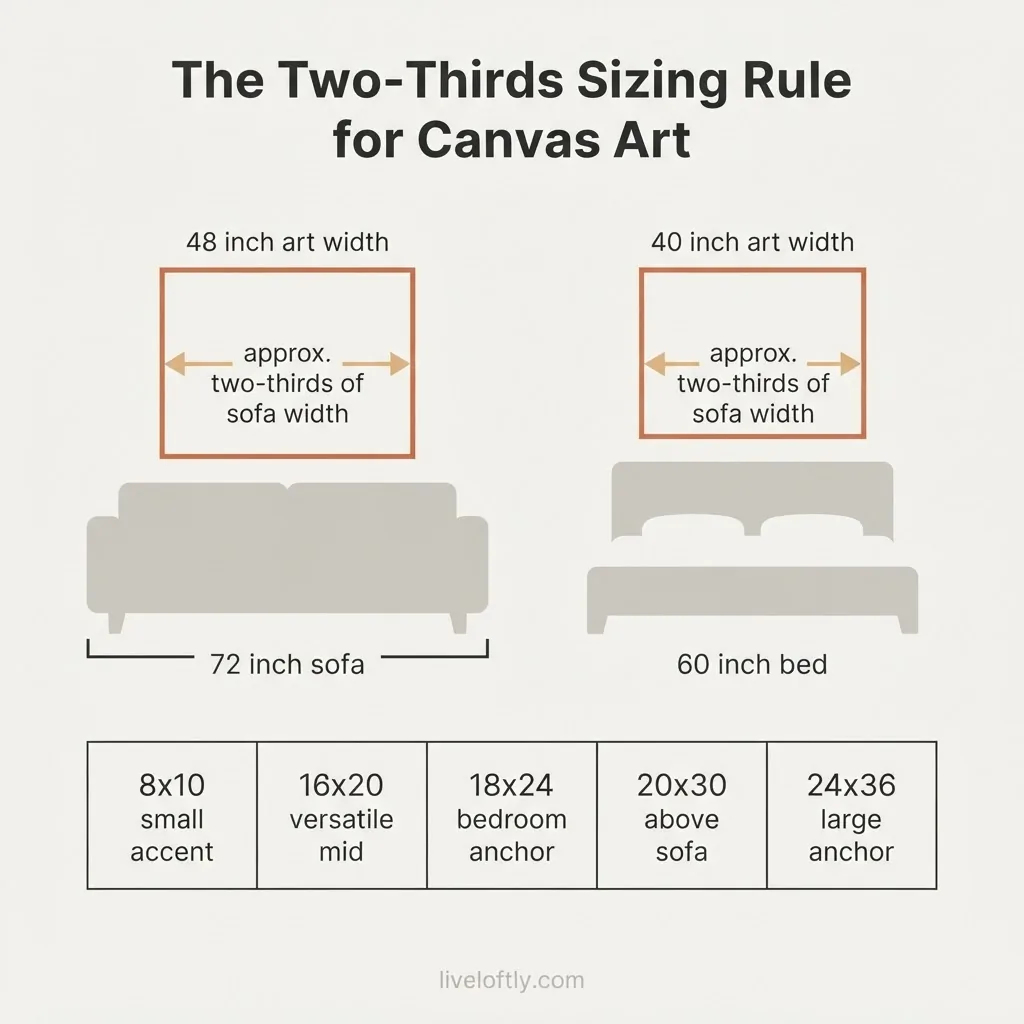
Sizing is one of the most common mistakes with canvas prints, and it is also one of the most fixable if you measure first. The most useful sizing rule for everyday buyers is the two-thirds rule: a piece of art, or a group of pieces, should span about two-thirds the width of the furniture below it. A sofa that is 72 inches wide needs art that spans roughly 48 inches. A queen bed headboard at 60 inches wide calls for art that spans about 40 inches. Artfully Walls explains the two-thirds rule in plain English if you want a fuller breakdown with size charts.
For reference, here is what common canvas sizes actually look like in typical spaces:
- 8×10 and 11×14: Small accent pieces. Good above a desk, in a bathroom, on a small gallery wall, or on a short stretch of wall in a hallway. These are not statement pieces; they are detail pieces.
- 16×20 and 18×24: The most versatile mid-sizes. These work above most nightstands, on the wall of a small bedroom, or grouped together for a gallery wall. A 16×20 feels substantial enough to stand alone in a smaller space.
- 20×30 and 24×36: Anchor pieces. These go above a sofa, above a bed, or on a large empty wall. For a standard 84-inch sofa, a single 24×36 is close to the lower end of what looks intentional; a pair of 20×30 canvases side by side often works better.
Measure your wall and your furniture before you buy. Write the number down before you open Amazon. It sounds obvious, but this one step eliminates probably 90 percent of “the art looked perfect in the photo but it’s tiny on my wall” returns.
A Brand Worth Knowing: Stupell Industries
One brand I see consistently come up when buyers are looking for canvas prints that are actually a step above anonymous Amazon listings is Stupell Industries. They manufacture in the US, use in-house Mimaki printers (a professional-grade printing system), print on 1.5-inch deep stretched canvas, and include ready-to-hang hardware on every piece. Their listings specify the canvas depth and the hanging system, which means they are actually telling you what you are getting. They are mid-budget, not bargain-basement, and not premium either. For someone who wants to buy once and not wonder if it will look different in person, they are a reliable option.

- Dimensions: 24 x 1.5 x 16 Inches
- Wall Art is Ready to Hang with Hardware Free Hanging. No installation required. For Easy Set Up Lean or Layer Artwork on…
- Our stretched canvas is created with the highest standards. We use only the highest quality inks and canvas on our in ho…
Budget Canvas Prints Worth a Look on Amazon
If you are buying at the lower end of the price range and want to filter for options with real review volume and better-than-average construction signals, here are four that have earned their ratings honestly. I am not telling you these are great quality in an absolute sense. I am telling you these have the review counts and buyer feedback patterns that make them worth considering at their price points, and each listing specifies more than the average anonymous product.
The MHARTK66 3-piece framed canvas set (Abstract Mountain Forest) has over 2,900 reviews at a 4.5-star rating, which is the kind of review base that is hard to fake. Solid wood mounting, clean framing, and a landscape subject that holds up well at mid-room viewing distance.
The InSimSea framed canvas (Hydrangea vintage decor, 8×10) sits in the budget tier with over 900 reviews at 4.6 stars. The listing specifies a gel medium finish for waterproofing and color longevity. Frame is wood fiberboard, not solid kiln-dried pine, which is a real limitation for longevity, but at this price range and this size it is a reasonable trade-off for a small accent piece.
The HUARCEY Vintage Framed Canvas (Fall Birch, 12×16) holds 4.7 stars across 200+ reviews with no obvious review-padding patterns. It is a compact, framed piece in a classic landscape subject. Good for a first attempt at putting something on a wall without much investment.
GREATBIGCANVAS is a different model entirely. They license art images, print on canvas, and sell through both their own site and Amazon.
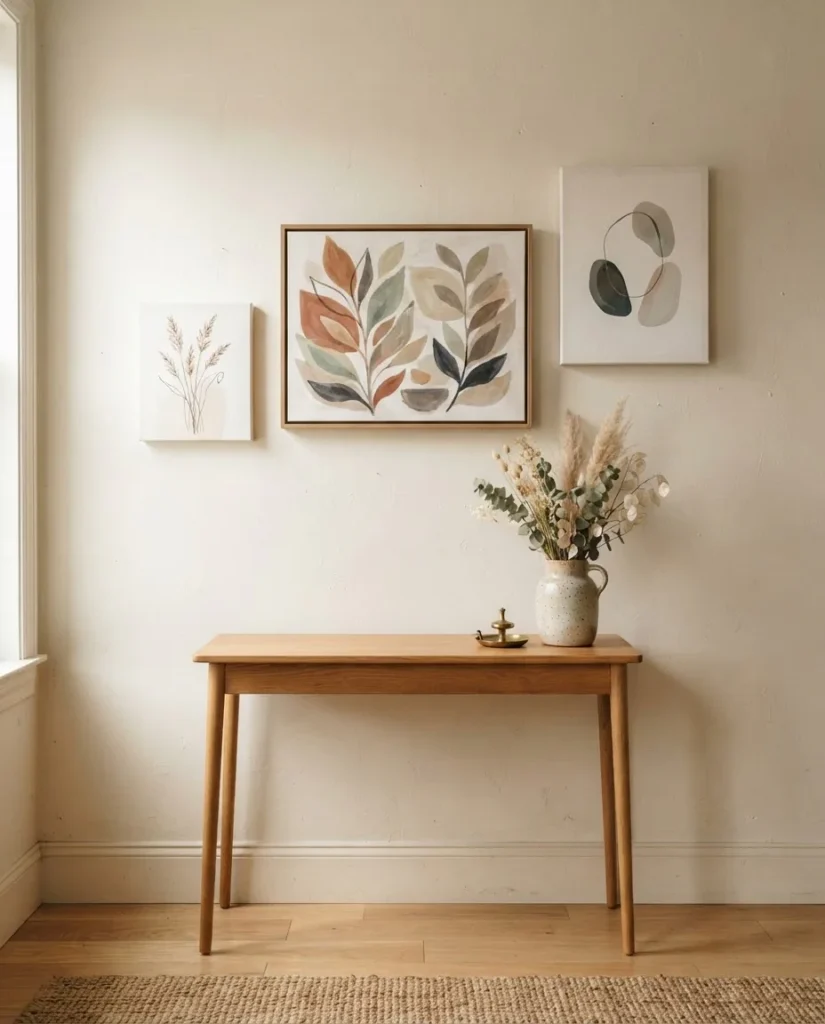
Print quality is generally solid and color accuracy is often praised in reviews. The GREATBIGCANVAS Ornaments of Gold canvas (24×12) is one of their well-reviewed Amazon listings with pre-installed hanging hardware.

- Size: Each canvas panel is 16″x24″ (40 cm x 60 cm), total 3 panels; Canvas wall art decor provides aesthetic decoration …
- Easy To Hang: Choose natural wood frame, high definition inkjet pictures; High quality canvas wall art, each canvas pain…
- Ideal Choice: Suitable for home interior wall decoration, such as living room,bedroom, bathroom, office, guest room, hot…

- Emotional Expression: Hydrangeas often symbolize grace and elegance, and the white color conveys purity. The painting ev…
- Premium Quality: This classical painting is printed on canvas and wrapped on wood fiberboard, finished with clear gel me…
- Ready To Hang: This framed canvas art wall decor measures 8×10 inches, comes with 2 hooks which makes it easy to hang. P…

- Classic American Autumn Scene: Richly detailed oil-style painting featuring fall trees and natural boulders, capturing t…
- PREMIUM QUALITY: HuarCey gold framed canvas artwork adds a touch of vintage charm to any space, making it an addition to…
- EADY TO HANG: Measuring 12x16inch, this golden framed canvas art wall decor is designed for convenience. It comes with t…

- SIZE: 24″ W x 12″ H x 1.5″ D. Orientation of canvas is horizontal.
- READY TO HANG: Canvas comes with pre-installed hanging hardware already attached to the back of the product. Items 16″x2…
- MADE IN USA: Canvas is made-to-order in the United States using high quality artist-grade canvas and archival inks that …
How to Make a Cheap Canvas Print Last Longer
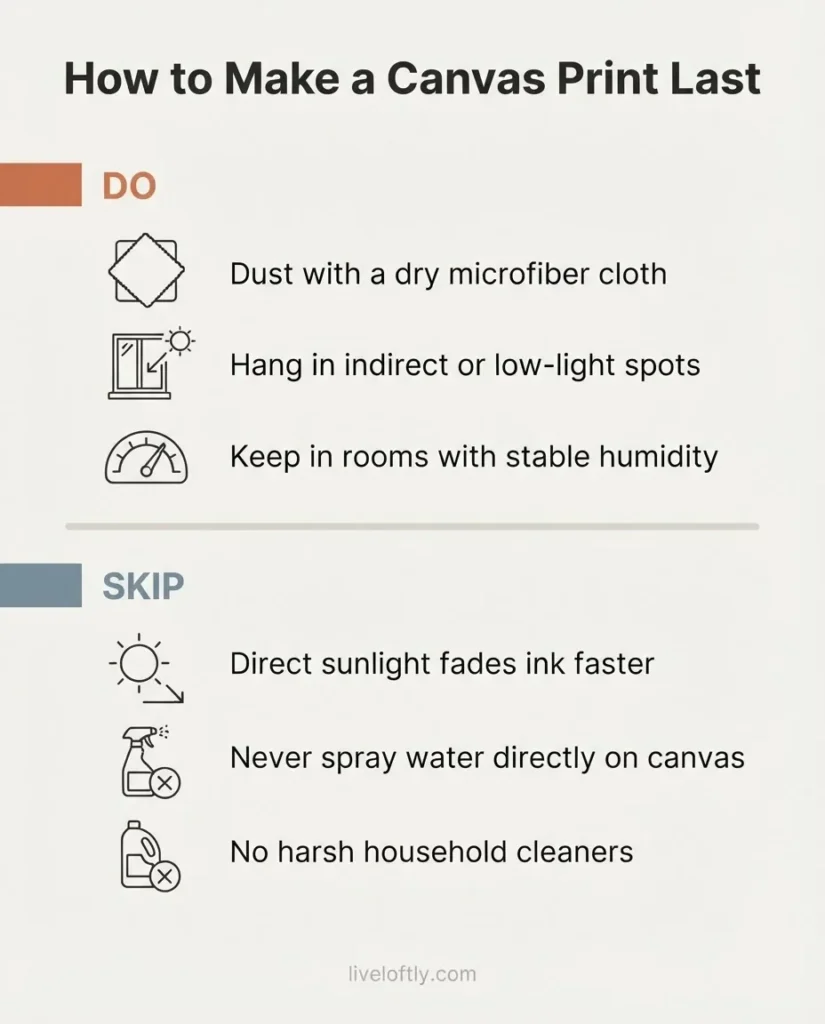
Even a mid-budget canvas print will hold up noticeably better if you hang it correctly. The single biggest enemy of canvas print quality is direct sunlight. UV light breaks down ink over time regardless of the ink type, and it does it faster on prints that skipped the UV protective coating. Keep canvas art out of direct sun. Indirect natural light, or even a spot that gets no direct sunlight at all, will extend the life of a budget canvas print significantly.
Humidity is the second concern, especially for thinner frames. Avoid hanging canvas prints in bathrooms with poor ventilation, directly above a cooking range, or on exterior walls in very humid climates where temperature swings cause the wood to expand and contract repeatedly. For rooms with higher humidity, look for listings that specify a UV or moisture-resistant coating.
For cleaning, the answer is simple. As Thomas Kinkade Studios’ canvas care guide recommends, use a soft, dry microfiber cloth and very gentle strokes. Never spray water directly onto a canvas print. Never use household cleaning products. Dust once in a while, handle gently, and keep it out of direct sun, and most mid-budget canvas prints will look presentable for years.
The Honest Worth It / Skip It Verdict
Worth it: A pre-made canvas print from a listing that specifies canvas material, frame construction, and has real review volume at 4.5 stars or above. Mid-budget prints from brands like Stupell Industries that specify their materials and include hardware. Any canvas print in the right size for your actual wall (measure first). MHARTK66 for multi-piece sets. GREATBIGCANVAS for licensed art prints with real color accuracy.
Skip it: Any listing that says “canvas” with no further material detail. Any listing with no ink type mentioned and no UV coating specified, especially for a spot that gets direct sun. Any personalized/custom canvas print where you are uploading your own photo, if you are not sure about the return policy and you cannot verify the source photo resolution. A canvas that is priced extremely low for a very large size (20×24 or bigger at single-digit prices almost always means a quality compromise on all four factors). Any listing with a review base entirely made up of five-star text reviews with no photos and no detail.
The filter I come back to every time is simple: does the listing actually tell you what you are getting? A brand that is confident in its materials will say what they are. A brand that is not confident in its materials will tell you the colors are “vibrant” and the art is “beautiful” and nothing else.
That distinction is worth more than any specific brand recommendation I can give you.
FAQ: Canvas Print Buying Questions
Are cheap canvas prints good quality?
Cheap canvas prints can be good quality if the listing specifies decent materials: poly-cotton or cotton fabric, pigment-based or UV-resistant inks, and a solid wood frame. Cheap canvas prints made with pure polyester fabric, unspecified dye-based inks, and wood fiberboard frames are lower quality in a real and measurable way. The price alone does not tell you which you are getting; the listing details do.
How long do cheap canvas prints last?
A budget canvas print hung indoors out of direct sunlight, in a room with normal humidity, should hold its appearance for several years with basic care. Canvas prints made with dye-based inks (which most budget prints use) can show noticeable fading within five to ten years, especially in bright rooms. Canvas prints with archival pigment inks are rated for 75 years or more, but most cheap options do not use them.
Can you return a canvas print from Amazon?
Pre-made canvas prints sold from existing designs are generally returnable within Amazon’s standard 30-day return window. Custom or personalized canvas prints, where you upload a photo or choose personalized text, are typically listed as non-returnable because they are made specifically for your order. Always check the product page’s return policy before buying a personalized canvas.
What size canvas print should I buy for above my sofa?
Measure your sofa’s width and aim for art that spans about two-thirds of that measurement. For a 72-inch sofa, that means art covering roughly 48 inches. A single 24×36 canvas works as a starting point, though two 20×30 canvases side by side often fills the space more naturally.
Always measure before you order, because canvas prints that look correctly sized in a listing photo can look surprisingly small on an actual wall.
What should I look for in a canvas print listing to know if it’s worth buying?
Look for specific material details: canvas type (poly-cotton is better than just “canvas”), ink type (archival or pigment-based is better than “vibrant”), frame material (solid wood is better than fiberboard), frame depth (1.5 inch looks more substantial than 0.75 inch for larger pieces), and whether hanging hardware is included. Real review volume with buyer photos is more reliable than a high star rating on a product with few reviews.