Faux Flower Vase Arrangements That Actually Fool People

I have a confession. For years, I was a faux flower skeptic. I had tried them a couple of times in my early rental days, jammed a bunch of stiff plastic stems into a vase, felt vaguely embarrassed every time someone visited, and quietly shoved the whole thing into the back of a closet. They looked exactly like what they were: fake.
Then I started paying attention to what was actually going wrong, and it turned out the problem was never really the flowers. It was everything around the flowers. The wrong vase. The wrong stem count. Stems standing ramrod straight instead of leaning into each other the way real flowers do. No greenery, no variation, no life. Once I understood the rules behind why fresh flowers look the way they look, making faux arrangements feel believable became a lot more straightforward.
Now I use them throughout my home. And yes, people ask if they’re real.
This is everything I know about getting faux flower vase arrangements right, from which materials to buy to exactly how to put them together, for any room, any style, and any budget.
Why Faux Flowers Make So Much Sense for Renters and Small Spaces:
Before the tips, a quick word in defense of faux flowers, because they genuinely deserve more credit. Fresh flowers cost real money on a recurring basis. Depending on where you shop, a decent weekly bunch runs anywhere from $12 to $40, and within a week it’s gone. Over a year, that adds up fast for a renter who is already watching their budget carefully.
Faux arrangements, done well, cost you once and last for years. Quality stems can hold their shape and color for five to ten years or longer with basic care. They do not drip on windowsills, they do not drop petals on a rental carpet you are responsible for, and they work in rooms like bathrooms where real flowers would be fighting humidity constantly. They are also pollen-free, which matters if you or a roommate have allergies.
For small spaces in particular, they give you something fresh flowers rarely can: patience. You can rearrange them, try them in different spots, swap them between rooms, and never once feel guilty that a $30 bunch is going to be compost in four days.
The one place faux flowers earn their bad reputation is when they are styled carelessly. Let’s fix that.
The Material Difference (This Is Where Most People Go Wrong First):
Not all faux flowers are made the same way, and the material you buy makes a bigger difference than almost any other single decision. There are three main categories to understand.
Silk (fabric-based) is the most common category and the most confusing, because “silk” is used loosely to mean almost any fabric-petal faux flower. Most of what is actually sold as silk uses polyester blends rather than real silk. The best silk stems have matte petals with soft color variation and flexible wired stems. The worst have shiny petals in flat, single-tone color with stiff plastic leaves. Quality varies wildly within this category, and price is a reasonable but imperfect guide. Silk stems work beautifully in larger arrangements viewed from across the room, where volume and color matter more than close-up texture.
Real touch (polymer-coated) is the category that has changed the game for faux flowers in the past several years. These stems use a soft polymer or latex-style coating designed to mimic the feel and light behavior of a real petal, not just the look. The difference when you hold one is genuinely surprising the first time. They photograph well, they feel soft rather than plasticky, and they do not give off the reflective shine that makes cheap faux flowers so identifiable. For a centerpiece on a coffee table, an arrangement in an entryway, or anywhere people will get close, real touch is almost always worth the extra cost. A helpful breakdown of how silk, real touch, and plastic faux flowers compare explains the material differences in plain terms if you want to dig into the details before you shop.
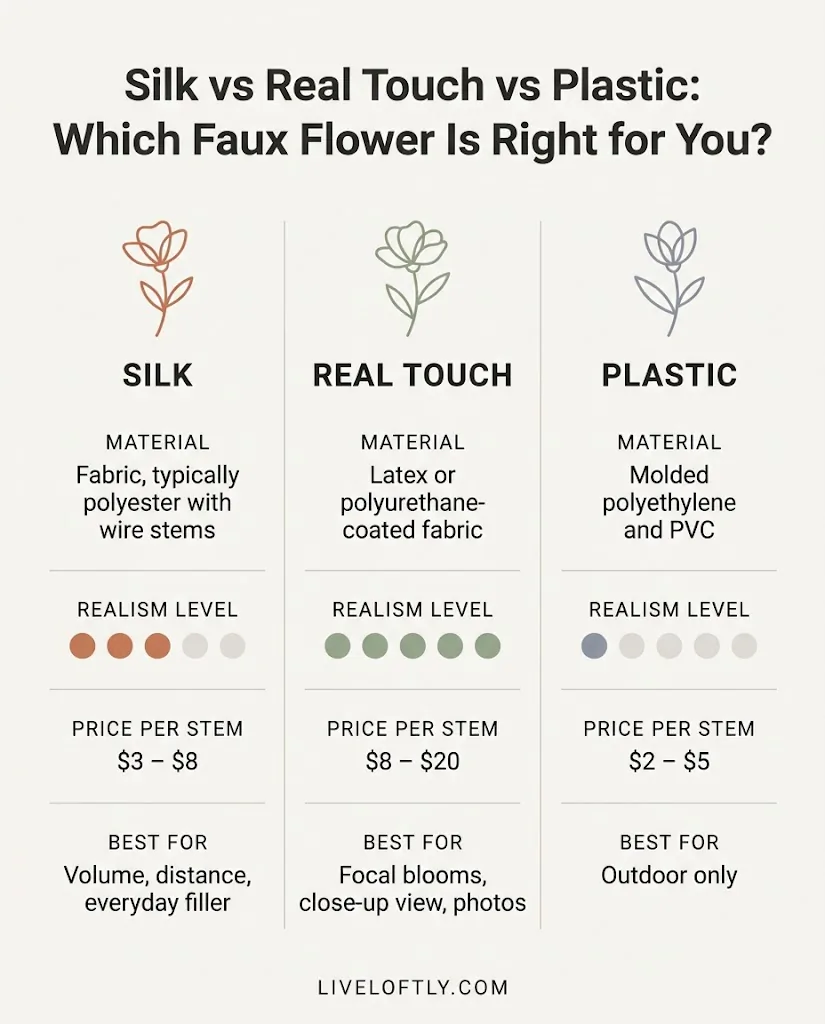
PE and plastic stems are the most durable and the most obviously fake under indoor lighting. The petals tend to look shiny and stiff. They are fine for outdoor use where durability matters more than realism, but inside a home, they read as craft-store leftovers no matter how you style them. If you are working with a tight budget and plastic is all you can find, the tricks later in this article will help, but I would rather spend $6 on one good silk stem than $2 on three plastic ones.
A practical budget guide: individual silk or polyester stems from Target, IKEA’s SMYCKA line, or Hobby Lobby typically run $3 to $8. Mid-quality real touch stems from Afloral or Prestige Botanicals land around $8 to $20. Premium real touch pieces from higher-end suppliers can reach $20 to $40 per stem, but those are an investment in a focal arrangement, not an everyday purchase. For most renters and budget decorators, mid-range silk for volume and a few real touch stems as the focal flowers is the smartest combination.
The “Fooling the Eye” Rules: What Real Flowers Always Do That Fake Ones Often Don’t:
Here is the core insight I kept coming back to. The reason fresh flowers look alive is not because they are expensive. It is because they behave in specific, natural ways: they lean, they curve, they vary in how open the blooms are, they have slight color differences from stem to stem, and they have irregularities in the leaves. When a faux arrangement looks fake, it is almost always because one or more of those things is missing.
Stems that stand perfectly upright. Real flowers lean. They reach for light. Bend each faux stem gently before you arrange it so it has some natural arc, some give, some direction. Even a small curve changes the whole energy of an arrangement.
Blooms that all open at the same stage. A fresh bunch always has a mix of tight buds, half-open blooms, and fully open flowers. Try to buy faux stems at different stages, or bend petals gently to simulate different openings.
Flat, single-tone color. Real flowers show gradient color, deeper at the center, lighter at the petal tips, or the reverse. Look for faux stems where the petals are not one flat solid shade. This is one of the easiest quality tells when you are shopping.
Leaves that all lie perfectly flat and identical. Give leaves a gentle twist or slight curl. Wired leaves are your best friend here. A leaf that sits at a slight angle looks relaxed. A perfectly flat symmetrical leaf looks stamped.
No greenery. Almost no fresh arrangement comes without some kind of green. Add faux eucalyptus, olive branches, ruscus, or even a few stems of dried grass. Greenery is often less expensive than blooms and it adds the single most naturalizing element to any arrangement.
Vase Choice: The Decision That Makes or Breaks Everything:
The vase you choose is not decoration around the flowers. It is a structural and visual partner to the arrangement, and the wrong one will make even great stems look off.
Opaque vases (ceramic, stoneware, terracotta, woven baskets) are your most forgiving option. Because you cannot see inside, you do not have to worry about what the stems look like below the waterline, which means you can simply bend them to fit, use floral foam to anchor them, or even stuff some crumpled newspaper in the bottom for support. If you are new to faux arranging or working with budget stems, an opaque vase removes about half the potential problems.
Clear glass vases look beautiful and feel fresh, but they reveal everything below the surface. If you go this route, cut your stems cleanly with wire snips rather than bending them, add 2 to 3 inches of real water to the bottom to create that familiar glass-and-water look, and seal the wire end of each stem with a small dot of hot glue or a dab of clear nail polish before it goes in the water. This prevents the metal wire inside the stem from rusting or discoloring the water. Refresh the water every week or two, since discoloration can still happen over time. For a permanent installation you never want to change, some crafters use clear acrylic faux-water resin instead, which creates a completely convincing frozen-water effect. That is a more involved project, but it is worth knowing about if you want a set-it-and-forget-it option.
On sizing: a vase that is too tall makes stems look sparse and lost. One that is too small makes an arrangement feel top-heavy and crowded. The most reliable guideline is to choose stems that are roughly 1.5 to 2 times the height of the vase.
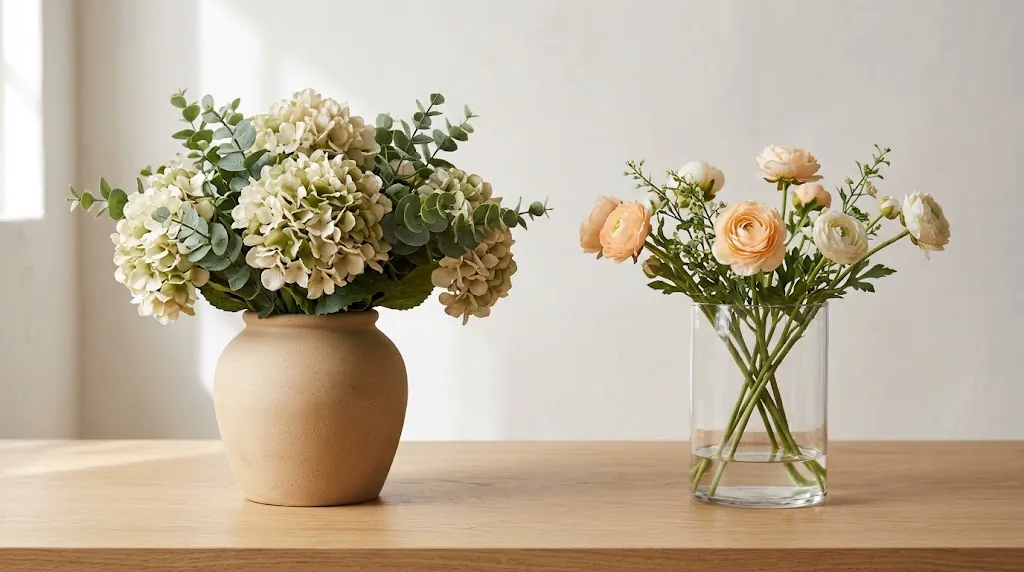
A 6-inch vase pairs naturally with stems in the 9 to 12-inch range. A 4-inch bud vase works with 6 to 8-inch stems. Bloomist’s guide to arranging faux flowers in a vase walks through the proportion principles in more detail, including how many stems to use for different vase opening sizes, which I find one of the most practically useful reference points when you are building an arrangement from scratch.
How Many Stems? Getting the Count Right:
This is one of those questions where people either under-fill (three sparse stems in a wide-mouthed vase looking sad and lonely) or over-fill (two dozen stems crammed in so tightly nothing can breathe). Getting the count roughly right makes a visible difference.
For small vases with 3 to 4 inch openings, 4 to 8 stems give you a full, natural look without crowding. For medium vases with 5 to 6 inch openings, 8 to 12 stems. For large vases or urns with openings 7 inches or wider, you are looking at 12 to 18 stems for a genuinely abundant arrangement.
Beyond raw numbers, the rule of odd numbers is a genuine design principle worth following. Our eyes read odd-numbered groupings as more natural and less rigid than even ones. Use three stems for a small bud vase, five or seven for a medium arrangement. Afloral’s styling guide on the rule of three explains this well and shows how to apply it even with just three good stems, which is helpful if you are building an arrangement on a tight budget and need to make a small number of stems look intentional rather than sparse.
A practical mix that works well in most arrangements: roughly 60 percent soft blooms (peonies, hydrangeas, ranunculus, orchids) and 40 percent supporting elements (greenery, grasses, branches). This ratio gives you texture, depth, and that garden-gathered feeling that makes an arrangement look collected rather than purchased.
The Flowers That Look Most Convincingly Real:
Some flower types simply translate better to faux than others, and knowing which ones to lean on saves you money and disappointment.
Peonies are consistently the most convincing at mid-range price points. Their full, layered blooms hide construction details naturally, and good silk peonies are genuinely hard to distinguish from fresh ones at a conversational distance.
Hydrangeas are another strong choice. Their dense clusters of small florets mean there is less single-petal scrutiny, and they hold their dome shape well in a vase without much fussing.
Ranunculus has become one of the most popular faux options for good reason. The layered petals look organic in real touch form and feel lush in a way that punches above the price point.
Orchids photograph beautifully as faux and look elegant in a single stem with a simple vase. They are the go-to for bathroom shelves, nightstands, and any spot that needs something refined and minimal.
Eucalyptus (as a greenery filler) is almost universally convincing in faux form. It dries naturally in real life anyway, so the faux version raises almost no eyebrows.
The flowers that are hardest to pull off convincingly: roses (very common, very scrutinized, hard to get right at lower price points) and tulips (the stem curve and droop of real tulips is almost impossible to fake without very deliberate bending). That said, high-quality real touch versions of both can look excellent. Just know that for these two in particular, quality matters more than it does for peonies or hydrangeas.
Room-by-Room Placement: Small Spaces Done Right:
One of the best things about faux flower vase arrangements is how naturally they fit into small spaces, once you stop trying to recreate a large centerpiece in every spot and start thinking about scale.
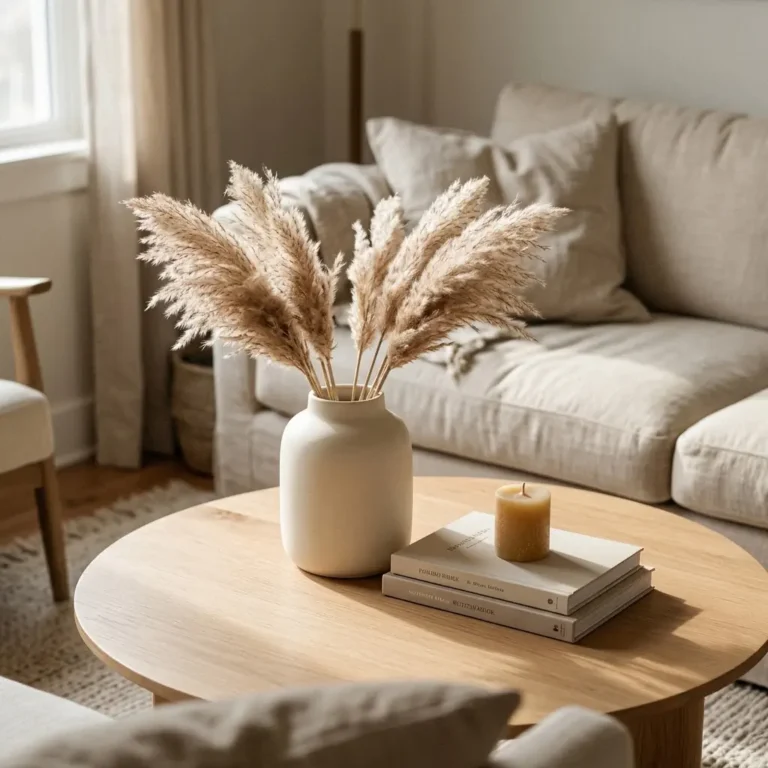
Living room coffee table: A medium ceramic vase with 5 to 7 stems at a moderate height (stems around 12 to 14 inches for a 7 to 8 inch vase) reads as a centerpiece without blocking conversation. Add one or two eucalyptus stems to ground it.
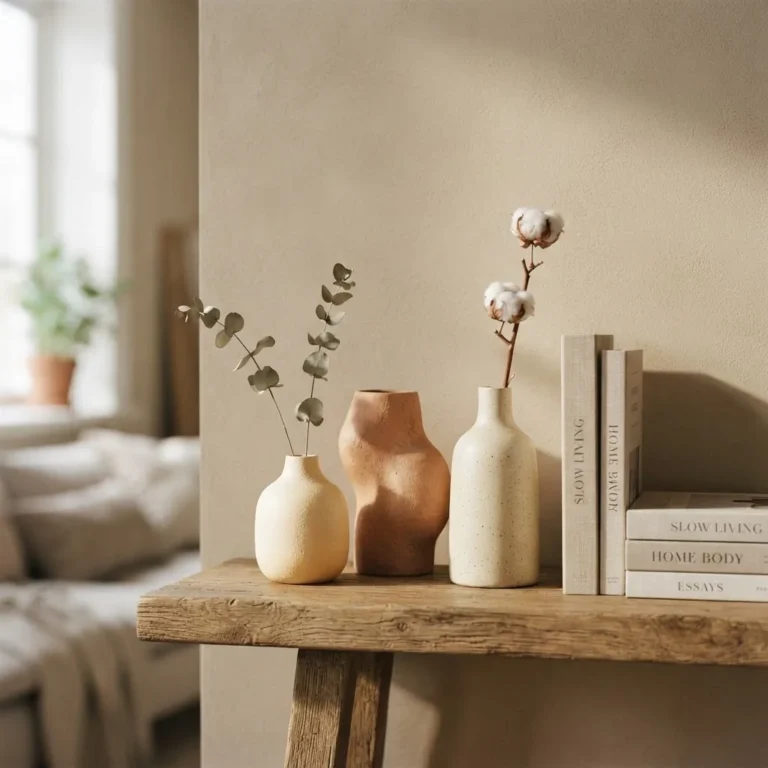
Kitchen counter or windowsill: A narrow bud vase cluster, two or three small vases of varying heights with one or two stems each, takes up almost no horizontal space and looks styled rather than decorative. Lavender, single orchid stems, or cotton stems work beautifully here.
Bedroom nightstand: One single good stem in a small ceramic or stone vase is enough. Restraint is the point. A ranunculus or orchid stem at roughly 8 inches in a 4-inch vase is calm and pretty without competing with the rest of the room.
Bathroom shelf: Faux flowers are ideal in bathrooms because real flowers struggle with humidity and temperature swings. A small orchid or eucalyptus arrangement on the vanity adds exactly the spa-like calm that makes a tiny bathroom feel like somewhere you want to be. Prestige Botanicals’ guide to decorating small spaces with faux florals has good practical advice on using vertical space, windowsills, and corners in apartments and condos, which is worth reading if your space has awkward or underused spots you are not sure how to fill.
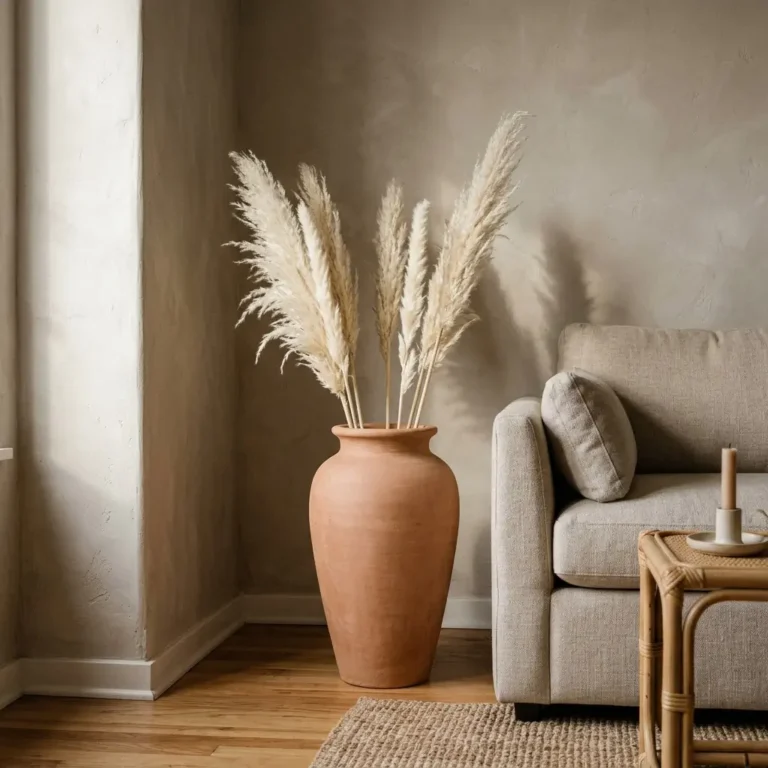
Entryway console: A taller arrangement in an opaque urn or pitcher makes a strong first impression without requiring a lot of flowers. Magnolia branches, olive branches, or pampas grass at 18 to 24 inches in a 10 to 12 inch vessel is dramatic, inexpensive, and completely renter-safe. No nails, no mess, no maintenance.
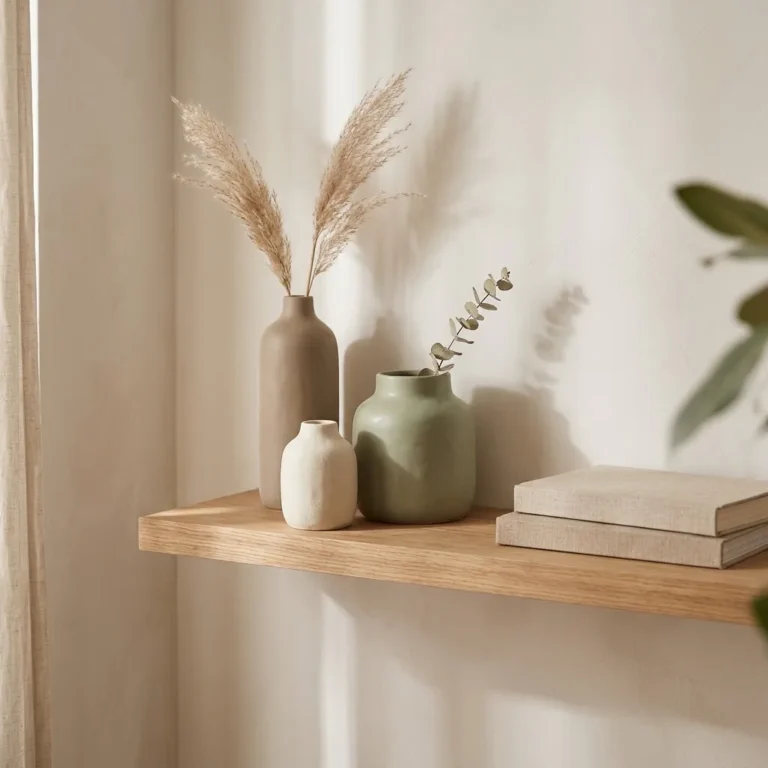
Floating shelves: Two or three small bud vases at different heights, each with a single stem or a small cluster, styled alongside books and a candle, is one of the most effective small-space tricks there is.
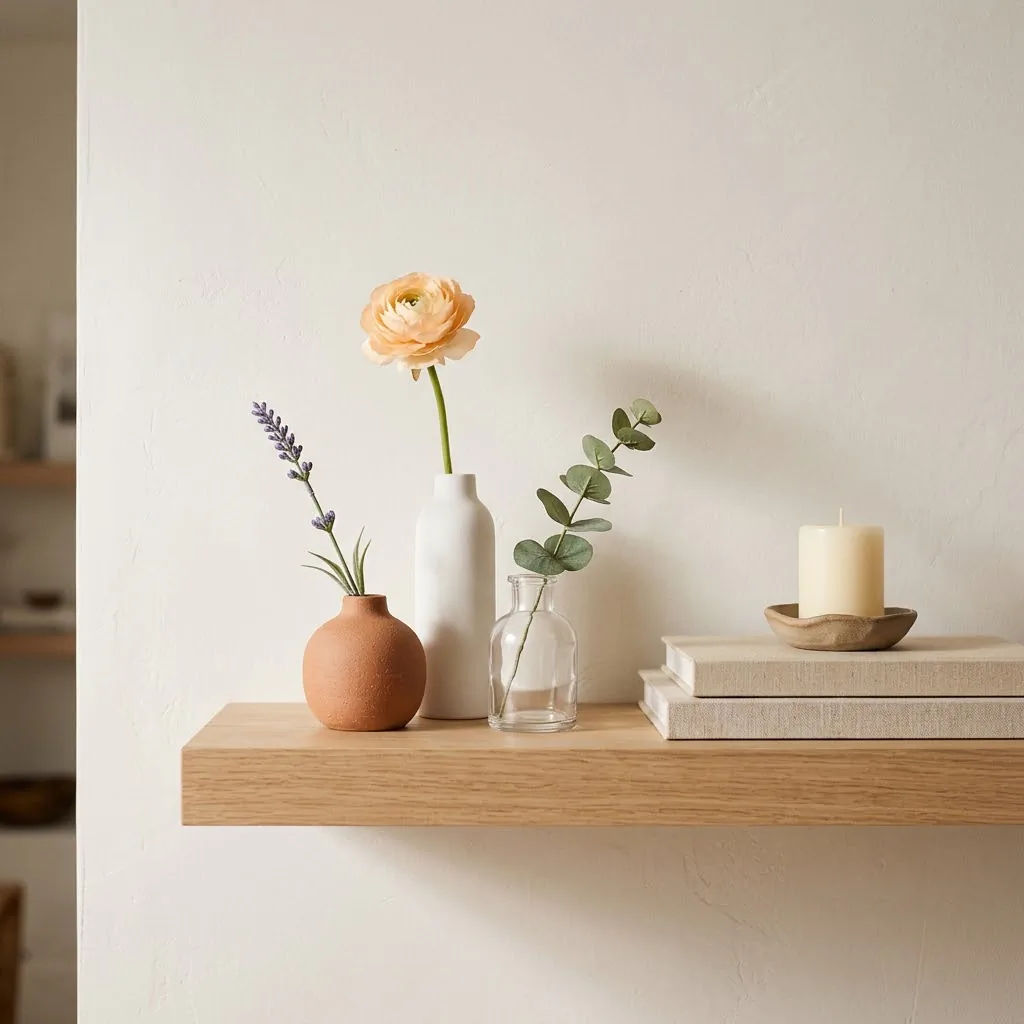
It breaks up the hard lines of the shelf and makes the whole thing feel lived-in.
Building Your Arrangement: A Practical Step-by-Step:
You do not need a florist’s training to put together a faux arrangement that looks professional. You need a clear sequence and a little patience.
Start by fluffing every stem before it goes anywhere near a vase. Pull petals gently apart, reshape any bloom that got squished in packaging, give every leaf a slight curve or twist. This step alone transforms cheap stems. Then bend each main stem slightly before it goes in, so no two stems are perfectly parallel.
Place your most substantial blooms first, your anchor flowers, at three to four different heights with a few inches of variation between them. Insert them at gentle angles rather than vertically, because this is the single biggest visual tell that separates natural-looking from constructed. Fill in around them with greenery and mid-sized blooms, focusing on creating depth rather than filling every gap. Negative space is good. Let the eye rest somewhere. Finish with any trailing or reaching elements (a curved eucalyptus branch, a stem that extends a few inches past the main cluster) to give the arrangement a relaxed, unfinished silhouette.
Take a step back and look at it from the angle it will actually be seen from.
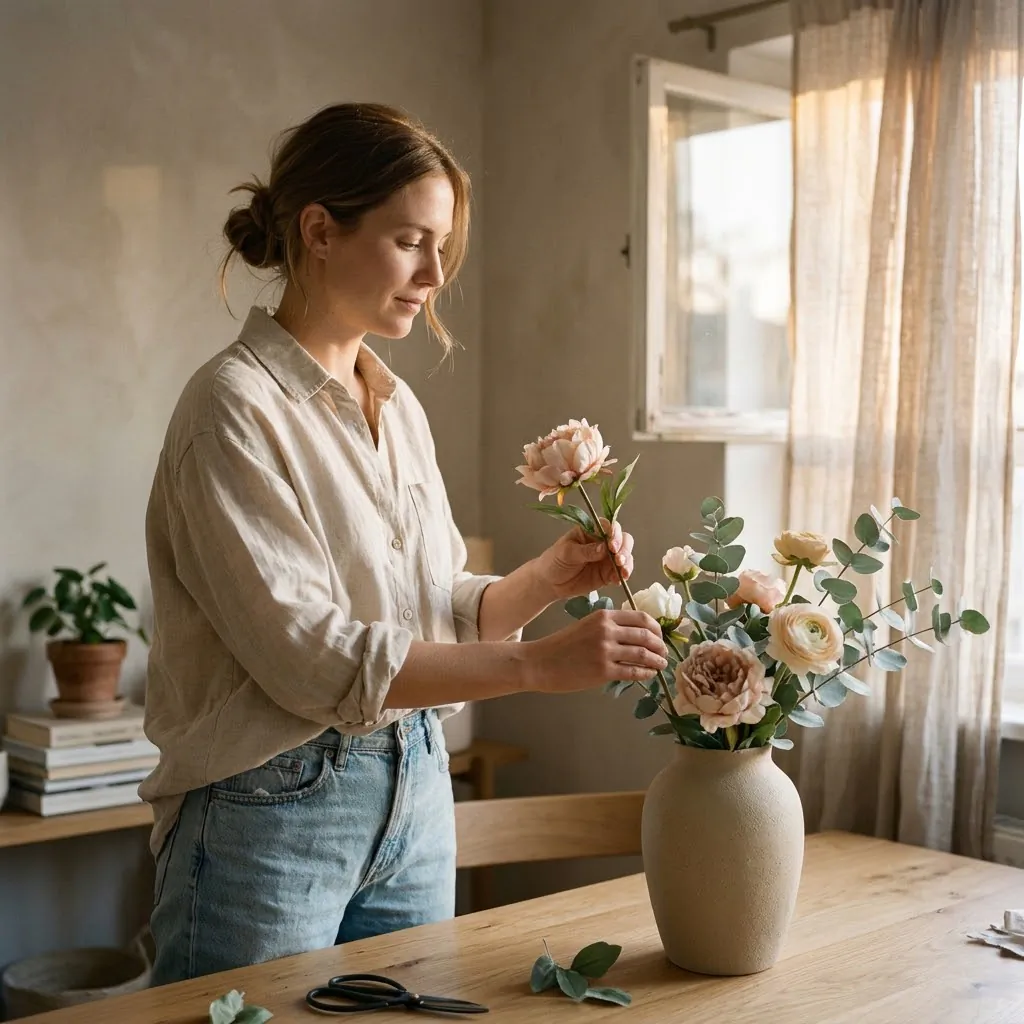
Is everything leaning slightly inward or perfectly upright? Adjust. Are all the blooms at nearly the same height? Pull one up and push one down. Does it look like someone arranged it or like someone gathered it? Those are two very different things, and the second one is what you want.
Style Notes: What Kind of Arrangement Works for Your Aesthetic:
Faux arrangements are not one-size-fits-all, and matching the style of your stems and vase to the overall feel of your room makes a real difference.
Minimalist rooms want restraint: a single statement stem (one tall orchid, one architectural allium, one branch), an interesting simple vase, and almost no filler. Three stems maximum. The vase does as much work as the flowers.
Boho and cottagecore rooms can take abundance: pampas grass, dried-style grasses, wildflower-style stems, loose arrangements in terracotta pots or woven baskets, the kind of arrangement that looks like it was gathered on a walk. Mix textures freely.
Coastal rooms love soft whites, creams, and muted blues, airy arrangements with space to breathe, grasses, sea lavender, and simple clear or white ceramic vases.
Modern farmhouse does well with magnolia branches, cotton stems, and simple neutral-palette stems in matte ceramic or dark stoneware, keeping the arrangement clean and structured.
Traditional or classic rooms can handle more formal arrangements: peonies, roses, and tulips in a classic urn shape with symmetrical placement.
Caring for Faux Flower Arrangements So They Last:
This is the section most people skip, and it is why faux arrangements start looking sad a year in. Basic care is genuinely easy and it extends the life of your arrangements significantly.
Dust is the main enemy. Set a light habit of using a cool-setting hair dryer held 12 to 18 inches away to blow dust off your arrangement every week or two. For more detailed cleaning, a soft paintbrush (a clean makeup brush works perfectly) reaches into petal folds and leaf crevices without snagging. For polyester or plastic stems that have gotten grimy, a cloth dampened with cool water and a tiny amount of mild dish soap, about one teaspoon per cup of water, can gently wipe petals clean. Never submerge silk or paper elements in water, and always dry wire stems quickly to prevent any rusting at the core. Bloomist’s guide on caring for faux flowers is the most thorough reference I have found on this topic, covering specific cleaning methods by material type, storage technique, and how to handle the seasonal transitions.
Direct sunlight fades faux materials over time no matter what they are made of, so keep arrangements away from windows with strong direct sun, or rotate them occasionally.
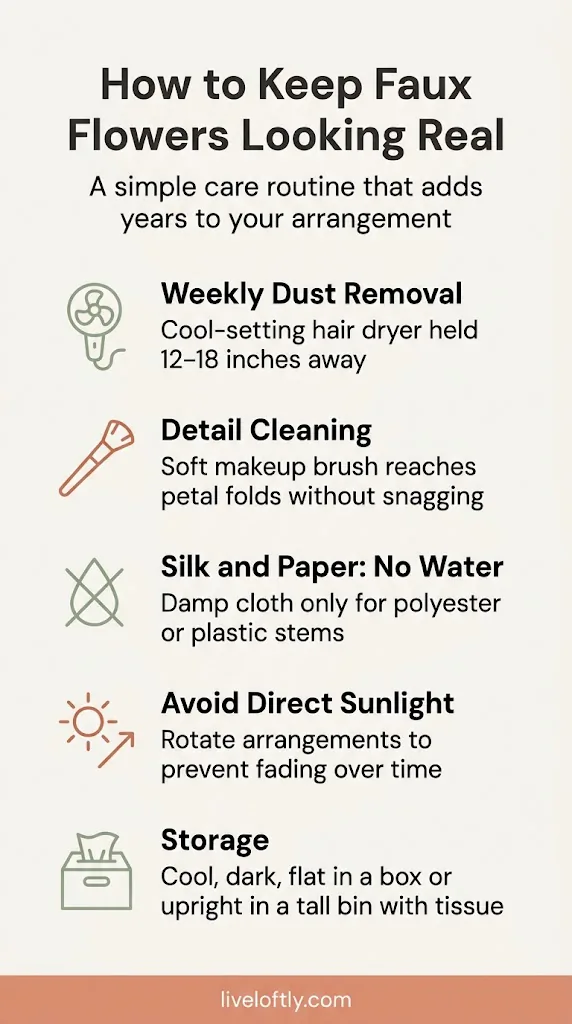
Store flowers you are not currently displaying in a cool, dark spot, laid flat in a long box or upright in a tall bin, wrapped loosely in tissue paper to protect the blooms. Quality stems treated this way can genuinely last five to ten years, which changes the math on what is worth spending.
Worth It vs. Skip It: An Honest Budget Breakdown:
Since this is a genuine question for most people decorating on a real budget, here is my honest take.
Worth it: One or two real touch statement stems for a focal arrangement (a peony or ranunculus for the coffee table, an orchid for the nightstand). A good quality ceramic or stoneware vase that will work for years across different seasonal arrangements. A few realistic faux eucalyptus or olive branch stems for filler, because these look convincing at almost every price point.
Skip it: Pre-made arrangements in cheap plastic vases sold as a set. You are paying for the arrangement labor and a container you probably do not want. Individual stems let you build what you actually need. Also skip: novelty or oversaturated colors in flower types that read as fake easily (bright red plastic roses, anyone). And skip anything labeled “UV-treated” if it is for indoor use only, because that coating sometimes adds an unnatural sheen under indoor light.
Budget-friendly starting point: Two stems of faux eucalyptus (roughly $4 to $6 each from IKEA or Target), three mid-quality peony or hydrangea stems (roughly $5 to $10 each), and a simple opaque ceramic vase you already own or thrift for a few dollars. That is a complete, convincing living room arrangement for around $25 to $35 total, one you will still have in good condition several years from now.
One Small Trick That Sells the Whole Thing:
If I had to pick a single tip from everything above, it would be this: add scent. Spritz a little floral essential oil or a few drops of rose or peony fragrance on the petals before guests arrive, or keep a candle nearby when the arrangement is the focal point. Our noses are very good at identifying “fake,” and a room that smells like flowers overrides a lot of visual skepticism. It is a silly small trick, but it works.
The goal with faux flowers was never to trick anyone forever. It was to give yourself a home that feels fresh, calm, and cared-for on a real budget, without the weekly maintenance, the mess, the allergy flare-ups, or the landlord damage. Done right, faux flower vase arrangements do exactly that. They make a room feel more like home. And that is the whole point.