For decorative prints at standard sizes, buying pre-framed art is usually cheaper when you count everything. A ready-to-hang canvas print on Amazon can run less than the cost of a quality bare frame alone. But DIY framing wins when you already own a specific print, it fits a standard size, and you want a frame that looks better or lasts longer than what comes bundled in a budget pre-framed piece. The answer really does depend on which situation you are in, so let me walk you through both.
I have assembled more flat-pack frames than I can count, and I have also bought plenty of pre-framed art that was a better deal than sourcing the parts separately. The question I always ask first is the same one I ask about any buy: is this actually worth it, or does it just look good in the listing photo?
How the Cost Comparison Actually Works
Most people compare these two things without adding up the real total. Here is what the math actually looks like.
When you buy pre-framed art, one price covers both the image and the frame. You are not paying for them separately. A small canvas print with a basic wood or MDF frame, ready to hang, can run anywhere from $10–$30 for an 8×10 or smaller size on Amazon. Step up to a 16×20 or 24×36 pre-framed piece with a canvas print and a more substantial frame, and you are typically looking at $40–$90 depending on the construction. You hang it, you are done.
When you frame it yourself, the costs stack up differently. You need a frame, and if you want something decent, not a flimsy plastic poster frame that bows in a year, you are looking at roughly $15–$55 for a standard-size bare frame from a brand like Americanflat or MCS, depending on size. That gets you the frame but not the print. You still have to source, print, and trim the image to fit. If you are printing a digital download at a photo lab or print shop, add another $5–$25 depending on size and paper quality. Now you are at $20–$80 before you have even assembled anything. For a single piece, a budget pre-framed option often still comes out ahead or about even, especially at small sizes.
Where DIY pulls ahead is when you already own the print, when you want to upgrade to a noticeably better frame than what comes with a budget pre-framed piece, or when you are framing several pieces at once and can amortize the cost of buying frames in multi-packs. Per the cost research I reviewed on this topic, DIY frame kits save roughly $20–$40 per frame compared to custom framing at a shop, but the savings shrink once you factor in your time, and they disappear entirely on the first frame if you need tools you do not own.
The Third Option Nobody Talks About: Full Custom Framing
For completeness, there is a third path: taking your art to a custom frame shop or ordering through an online framing service. This is where costs jump significantly. Full-service custom framing typically adds $40–$100 in labor on top of materials, and for a medium 16×20 print, total custom framing costs generally range from $75 to $250 depending on your selections, with larger or premium pieces going well beyond that.
For renters and budget shoppers furnishing a first apartment, full custom framing is usually not the right call for everyday decorative art. It makes sense for one or two pieces you genuinely care about preserving, like a wedding photo, original artwork, or anything irreplaceable. For a decorative print you found online and liked because it fits the vibe of your living room? Probably not.
Standard Sizes: The Hinge That Makes or Breaks the Decision
This is the thing most guides skip over, and it is honestly the most important factor in the whole comparison. Whether you go pre-framed or DIY, everything gets cheaper and easier when your art fits a standard frame size.
The most common standard sizes are 4×6, 5×7, 8×10, 11×14, 16×20, and 24×36 inches. If you already have a specific print, measure it before you buy anything. Standard sizes are where budget frames exist. Non-standard sizes are where things get expensive fast, either because you need custom framing or because you end up buying the wrong thing and returning it.
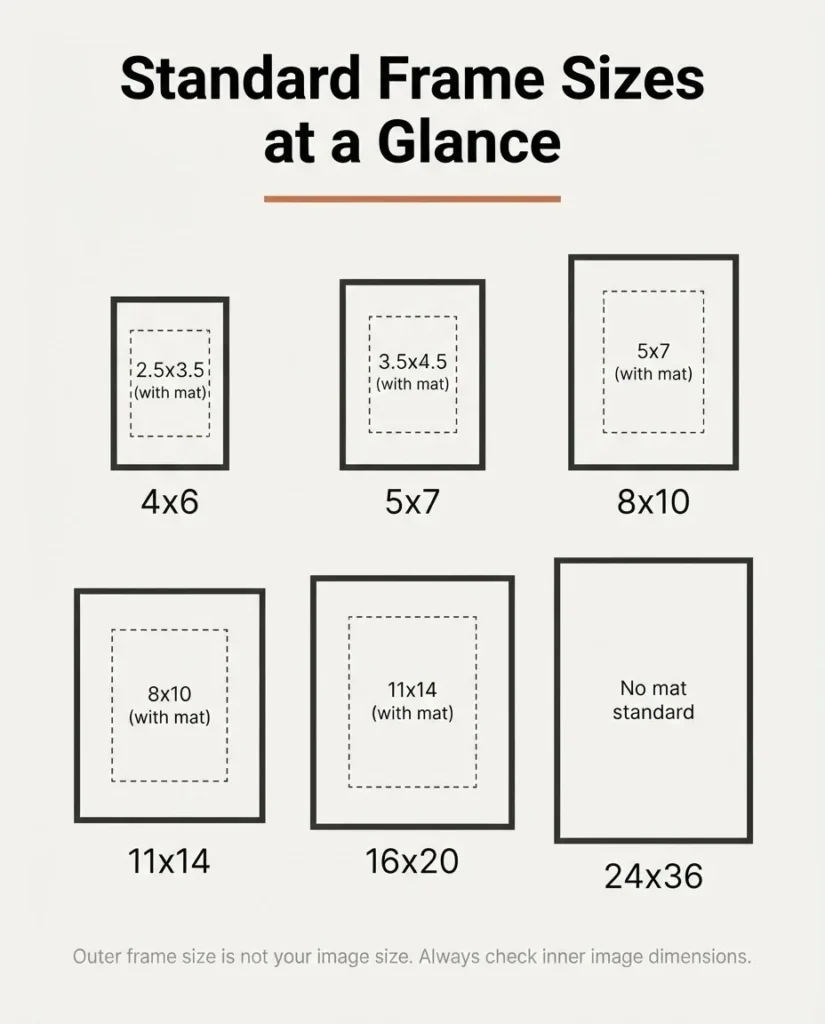
There is also a size-within-a-size thing to know: most frames that include a mat are sized by the frame outer dimensions, not the image dimensions. An 11×14 frame with a mat holds an 8×10 image. A 16×20 frame with a mat typically holds an 11×14 image. The Frame Destination mat and frame dimension guide lays this out clearly, and if you have never framed anything before, that page will save you from the most common buying mistake: ordering a frame that is the right size in name but the wrong size for your actual print.
If you are buying a pre-framed piece, this matters less because the image and frame are designed together. But if you are buying a bare frame to fit a print you downloaded and had printed at a photo lab, you need to know your print size and check whether the frame is sized to the image or to the outer dimensions.
What You Actually Get in a Budget Pre-Framed Piece
Here is where I want to be honest about what the listing photo does not show you.
Budget pre-framed art, meaning pieces that come in under $20–$30 for a canvas print, typically includes a canvas printed on thin poly-cotton blend material, stretched over a lightweight composite or pine frame (not solid wood), secured with staples, and the frame itself is often plastic or a very lightweight MDF with a thin veneer. There is usually no glass or acrylic covering at all because the canvas is the surface, and there is no mat. That is not necessarily bad for what it is, a piece of decorative wall art you want on a rental apartment wall for a year or two. But it is important to understand that you are not getting preservation-quality framing. You are getting a ready-to-hang decoration.
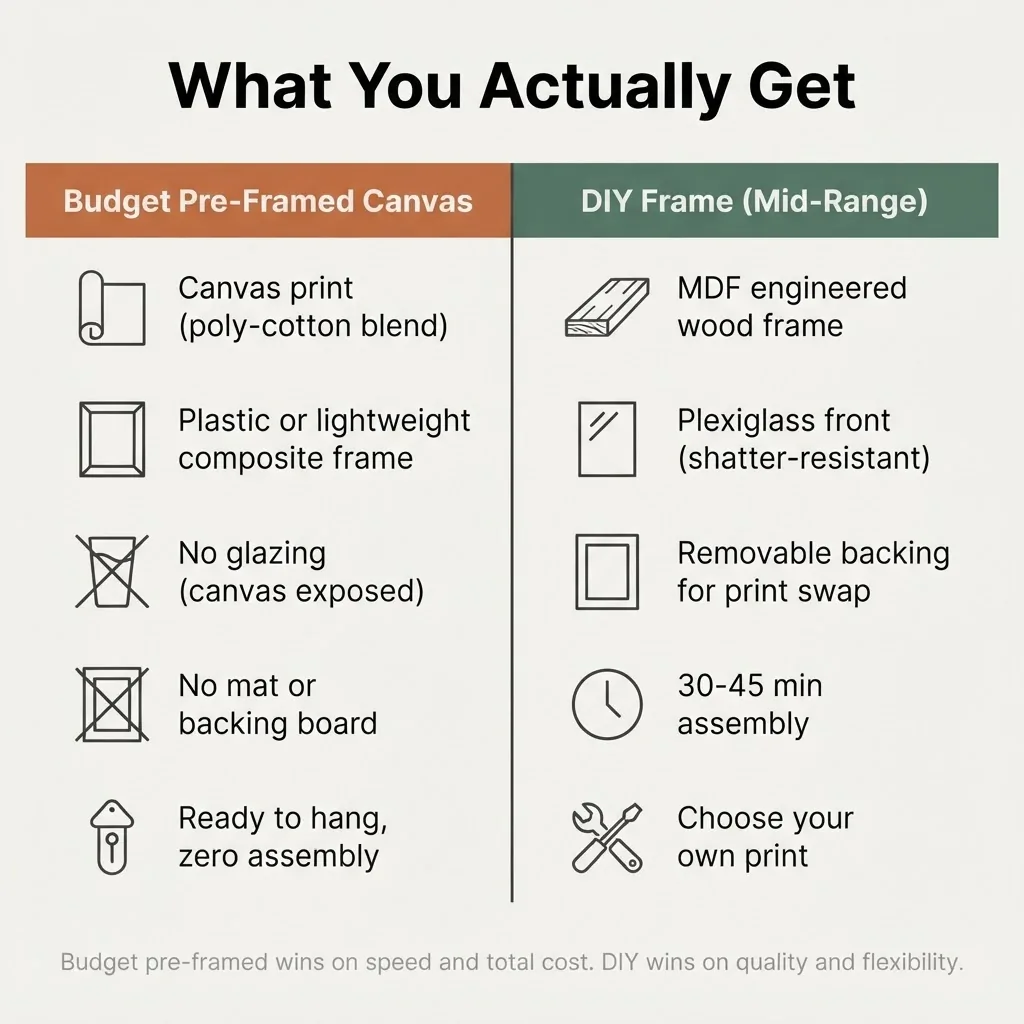
The construction shortcut that matters most is the glazing. Most budget pre-framed canvas pieces skip glass or acrylic entirely. For a canvas print, that is fine because canvas does not need glazing the same way a paper print does. But if you are looking at a budget pre-framed paper print, be aware that standard glass used in most affordable frames blocks only about 45–50% of UV radiation, while UV-protective acrylic blocks 97–99% of harmful UV rays. For a decorative piece you will rotate in a year or two, standard glass is fine. For anything you want to keep looking good for a decade, it is worth either paying more for UV-protective glazing or going the custom framing route.
When buying pre-framed art on Amazon specifically, I always check three things in the listing before buying: does it list the frame material (look for MDF or solid wood, not just “wood-look”), does the outer frame size match what I need for the wall space, and what do the one-star reviews say? One-star reviews on framed art almost always reveal whether the frame bows, whether the canvas arrived dented, or whether the print color looked nothing like the photo.
What You Actually Get in a DIY Frame at This Price Point
When I say “frame it yourself” at the budget-to-mid-range level, I am not talking about building a frame from raw moulding with a miter saw. I mean buying a ready-made bare frame and inserting your own print, which is something anyone can do in under an hour.
At this level, the frame options break into two clear quality tiers. The budget end, roughly $10–$20, gets you a polystyrene (plastic) frame from brands like the basic MCS Original line. These are lightweight, functional, and fine for a poster or a print you plan to rotate seasonally. They are not something to invest in for a piece you care about, because the material will bow, scratch, and look cheap up close.
Step up to the mid-range, roughly $25–$55, and you get into MDF (engineered wood) frames from brands like Americanflat and the MCS Studio Gallery line.
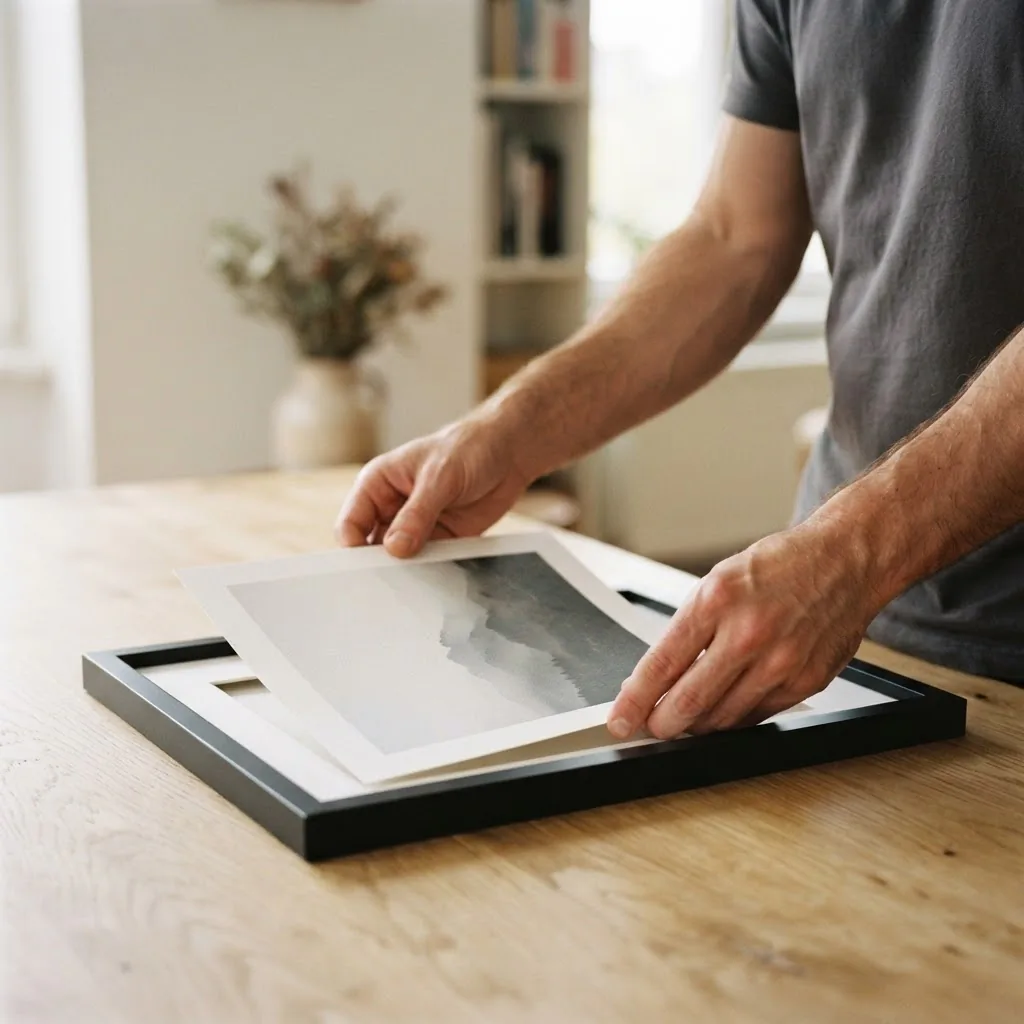
MDF is not solid wood, but it is significantly more durable than polystyrene, holds detail better, and looks cleaner in person than a plastic frame. Most of the Americanflat frames use polished plexiglass rather than real glass, which is actually a practical advantage for shipped frames because plexiglass is lighter and shatter-resistant. The finish options are broader at this price point and the construction is tight enough to look intentional on a wall.
For a quality mid-range DIY frame that lets you choose your own print and mat, this is the range where doing it yourself makes the most sense, especially if you want to frame several pieces with a consistent look.

- Woodgrain Finish
- STUDIO GALLERY SELECT COLLECTION: Picture frames feature a black woodgrain finish designed to help you create the perfec…
- EASY TO USE: These hanging picture frames have easy-to-open turn buttons with slide-in backs that make adding your photo…

- Your cherished memories deserve a timeless frame. Showcase your favorite moments with this sleek picture frame, featurin…
- Our 16×20 frame with medium-wide molding is crafted from engineered wood (MDF) and displays 16×20 photos or 11×14 photos…
- Display it your way with ease! The black picture frames include hanging hardware for vertical and horizontal placement, …
For Large Posters: When Pre-Framed Loses
At larger sizes, say 24×36 inches for a movie poster or oversized print, the calculus shifts more firmly toward buying a bare frame. Pre-framed canvas art at 24×36 tends to either be expensive or lower quality, because stretching a large canvas tightly and finishing the frame well at a low price is genuinely hard to do. By the time you get to a large pre-framed piece that looks good, the price is often close to or higher than a quality bare poster frame plus a digital print.
A 24×36 bare poster frame in MDF from a brand like Americanflat runs in the mid-to-upper end of the budget range, covers the most common poster and large-print size, and gives you the flexibility to print whatever image you want. For large pieces specifically, I think the frame-it-yourself path almost always wins on value. You get better frame quality for the size, you get exactly the image you want, and returning a bare frame is far less of a pain than wrestling a large pre-framed canvas back into a box.

- 【Exact 3-Pack Size】 This 3 pack of 18 x 24 poster frame has an outer size of 19.5″x25.5″. Use the mat for 16×20 photos o…
- 【Warp-Proof & Eco-Friendly】 Unlike cheap narrow frames that warp and crack, our FSC-certified 18 x 24 frame is 1.0″ wide…
- 【Safe Plexiglass】 This 18 x 24 picture frame uses 1.8mm thick shatter-resistant plexiglass – thicker and stronger than o…
When Pre-Framed Art Is the Better Buy
There is a real scenario where buying pre-framed art wins, and I want to be honest about it because plenty of guides talk it down unfairly.
If you are furnishing a first apartment, you have a blank wall, you do not have a specific print in mind, and you want something on that wall quickly without measuring and ordering separately, a quality budget pre-framed canvas print from a brand with solid reviews genuinely makes sense. The art and frame are designed to go together. The size is already resolved. You pay one price and hang it. At the budget end of the market, the total cost is often less than buying the frame alone.
The best pre-framed picks at this level are small-to-medium canvas prints in standard sizes with a real frame (check the listing for MDF or wood, not plastic), good rating volume (200+ reviews is a reasonable baseline), and a return rate that indicates the listing photo is accurate. The #1 best seller in Amazon Paintings at the time of research was a small framed canvas in the $12–$15 range with 400+ reviews. At that price, even if the construction is modest, the value proposition is genuine.

- 【Vintage Wildflower Wall Art】 Framed vintage canvas wall art featuring a scenic country road surrounded by blue wildflow…
- 【Ideal Size】 Framed canvas wall art measures 8×10 inch, perfect for adding countryside nature charm to your living room,…
- 【Ready to Hang】 Printed on durable canvas with vibrant colors, this vintage wall art comes with a sturdy wood frame and …
When Does Preservation Actually Matter?
For most renters and first-time homeowners buying decorative wall art for an apartment, the honest answer is that archival preservation is not a priority. A decorative canvas print you found online is not something that needs museum-quality protection.
Preservation starts to matter when the piece is irreplaceable: a printed wedding photo, a piece of original art, a meaningful photograph, or anything you genuinely expect to keep for 10+ years. For those, the material choices matter a lot. Research from the framing industry shows that standard mat boards made from untreated wood pulp can cause acid damage, including yellowing and embrittlement, within roughly 15 years, while museum-grade cotton fiber boards protect for a century or more. UV-protective glazing, acid-free mat board, and reversible mounting are not things to think about for a seasonal decorative print. They are absolutely things to think about for anything you want to hand down.
For that category of piece, the frame-it-yourself path using a quality bare frame with UV-protective plexiglass and acid-free materials, or an online custom framing service, is worth the step up in cost. The Frame Destination’s standard size chart for frames and mats is a useful reference when you are trying to figure out which frame size to order for a specific print size before you buy.
The Return Risk Factor
This one matters more than most guides acknowledge. If you buy a pre-framed canvas print and it looks nothing like the listing photo, or it arrives with a dented canvas corner or a bowed frame, returning it is a headache. A 16×20 pre-framed canvas is not small. Getting it back into the original box, requesting a return label, and dropping it somewhere is real effort. Amazon’s standard return window is 30 days, which is reasonable, but large or bulky items are genuinely annoying to return.
A bare frame, by contrast, is much easier to return. It is lighter, packs flat, and if it is the wrong size, swapping it out is straightforward.
My rule of thumb for avoiding return hassle: for pre-framed art, only buy from listings with high review counts and recent reviews that confirm the product matches the photos. If a listing has under 50 reviews or the most recent ones are from over a year ago, skip it. For bare frames, check the inner image dimensions and the outer frame dimensions before ordering, because those are two different numbers and confusing them is how people end up with a 16×20 frame for an 11×14 print.
Quick Decision Guide: Which Path Is Right for You?
Use this as your shortcut:
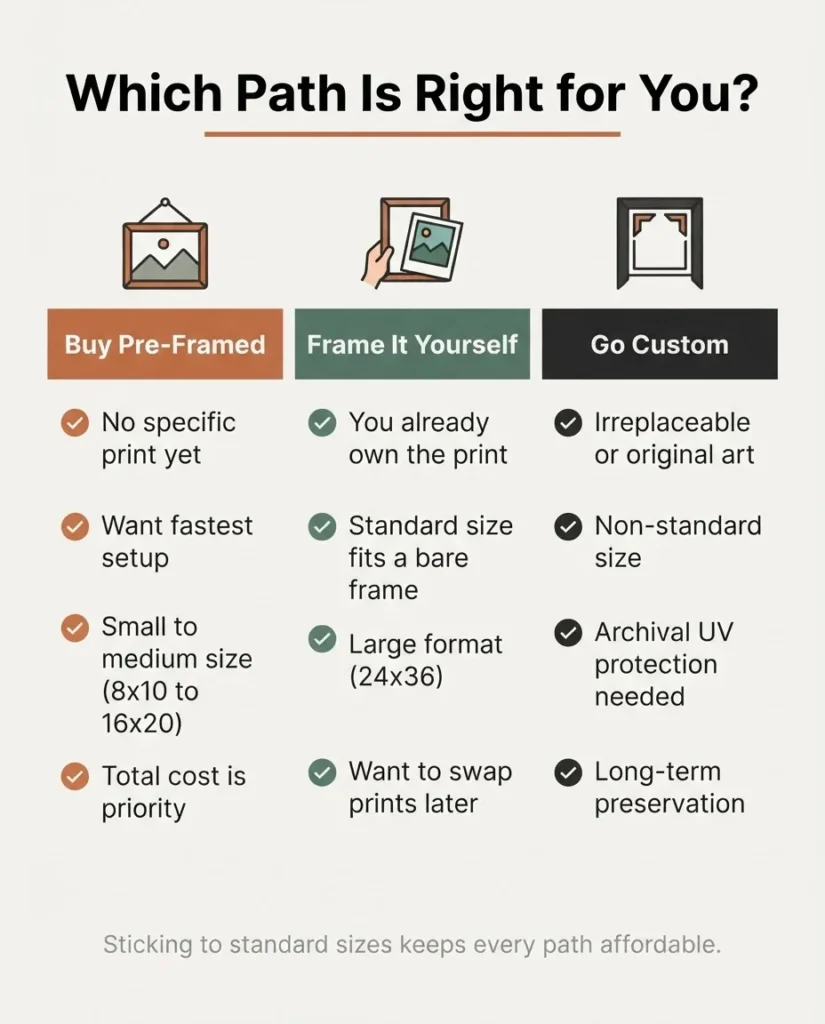
Buy pre-framed art when:
- You do not have a specific print already and just want something on the wall
- The piece is small to medium (8×10 to 16×20) and decorative, not something you are preserving
- You want the fastest, lowest-effort solution
- Total cost is the main priority and you are comparing all-in price
Frame it yourself when:
- You already have a specific print, poster, or image in a standard size
- You want a better-quality frame than what most budget pre-framed pieces include
- You are framing several pieces and want a consistent look
- The print is at a large format (24×36) where pre-framed options are either scarce or expensive
- You want the flexibility to swap the image out later
Go custom (framing service or frame shop) when:
- The piece is irreplaceable: original art, a wedding or family portrait, something you expect to keep for decades
- The size is non-standard and a ready-made frame simply will not fit
- You want archival materials, UV protection, and acid-free mounting done right the first time
FAQ
Is it cheaper to buy pre-framed art or frame it yourself?
For small and medium decorative pieces, buying pre-framed art is often cheaper because the art and frame are bundled into one price, frequently under $30 for an 8×10 canvas print. DIY framing becomes cheaper when you already own the print, it fits a standard size, and you want a better-quality frame than budget pre-framed options provide.
What is the real cost of DIY framing for a standard print?
For a standard 16×20 print using a mid-range MDF frame with plexiglass, you are typically looking at $25–$55 for the frame plus whatever it costs to print the image. Compare that to a budget pre-framed piece at the same size, which often runs $30–$60 with art and frame included.
Does the type of glass or acrylic in a frame actually matter?
For decorative prints you plan to rotate in a year or two, standard plexiglass or glass is fine. For anything you want to keep long-term, it matters. Standard float glass blocks only about 45–50% of UV radiation, while UV-protective acrylic blocks 97–99%. If the piece is irreplaceable, pay for UV protection.
What frame sizes are considered standard?
The most common standard sizes are 4×6, 5×7, 8×10, 11×14, 16×20, and 24×36 inches. Sticking to these sizes keeps costs low and gives you the most options at both the pre-framed and bare frame level. Non-standard sizes push you toward custom framing, which costs significantly more.
Can I put my own print in a frame that came with pre-framed art?
Sometimes, if the inner dimensions match your print size. Canvas frames are usually not easy to swap because the canvas is stapled directly to the frame. Frames with removable backing, typical of bare frames with glass or plexiglass fronts, are designed to be swapped. Check whether the frame has a removable backing before assuming you can reuse it.