
Here is the short answer: a floor mirror (also called a leaning or freestanding mirror) is the better choice for renters and anyone who can’t or won’t drill into walls, because it requires no mounting hardware and can move with you when you leave. A wall-mounted mirror is the better choice if you have a permanent space, want a cleaner look, and are willing to do the mounting work properly. Both can give you a great full-body reflection. The difference is mostly about your living situation, your space, and how much you want to deal with on installation day.
If you want the full breakdown, so you actually buy the right one for your specific setup, keep reading.
What’s the Actual Difference Between a Floor Mirror and a Wall Mirror?
These two terms describe how the mirror is supported, not the size of the glass. A floor mirror leans against the wall at an angle, rests on a built-in stand, or leans freely, and it sits on the floor. A wall mirror is hung directly on the wall using mounting hardware, usually a cleat, D-ring, or Z-clip system, and it hangs flush or near-flush against the wall surface.
Both types come in full-length sizes. Both can give you a head-to-toe view. The decision between them comes down to four real-world factors: your walls (can you mount into them without risking your deposit?), your floor space (do you have room for a leaning mirror base?), your household (kids or pets who could tip something over?), and your lifestyle (do you move often enough that portability matters?).
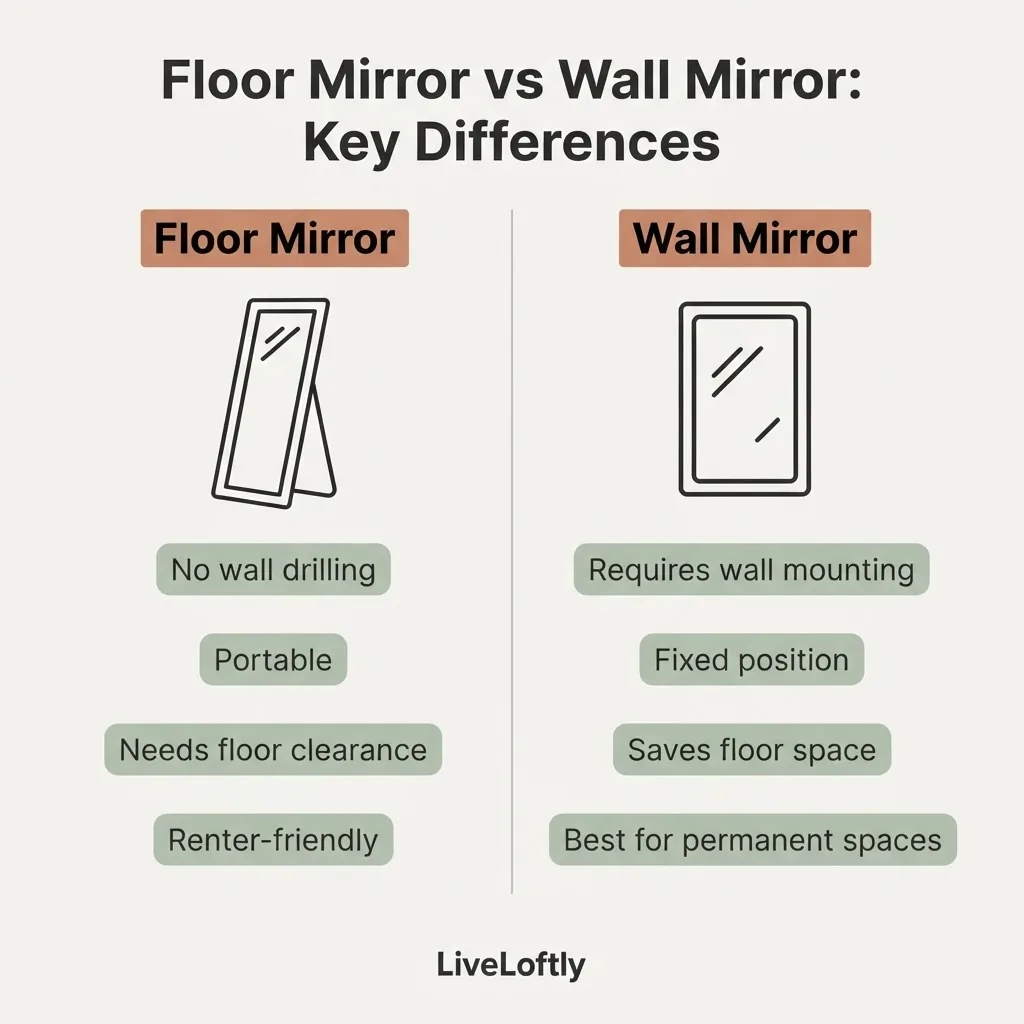
That is the whole framework. Everything else is just details.
The Renter Reality: Walls You Can’t Always Touch
I want to lead with this because it is the factor that most buying guides gloss over completely.
If you rent, hanging a mirror on the wall is not as simple as “find a stud and drive a screw.” Depending on your lease and your landlord, drilling into drywall can cost you part or all of your security deposit when you move out. Small nail holes from picture frames are usually fine. A pair of heavy-duty drywall anchors for a 30-plus pound mirror are a different conversation. Patching and painting is time and money most renters do not want to deal with.
For renters, the leaning floor mirror is the default-safe option. It requires zero wall contact. You can reposition it. You can take it with you when you move. And honestly, plenty of them look great leaning against a wall.
That said, some renters do mount wall mirrors successfully. If your mirror is genuinely lightweight (under about 20 pounds), products like the 3M CLAW drywall hangers can hang mirrors up to 65 lbs without drilling large holes, and they leave minimal damage. That is a real option for a lighter wall mirror in a rental. But it requires reading the weight carefully and using the right hardware, and it is not a guaranteed deposit saver.
If your lease specifically prohibits wall anchors, or you just want zero stress on move-out day, a floor mirror is the clear winner for your situation.
How Sizing Actually Works (and Why It Matters More Than You Think)
This is where a lot of people make a frustrating mistake: they buy a mirror based on how it looks in a listing photo and completely ignore how the dimensions interact with their own height and their room.
According to the full breakdown at OkayMirror’s complete sizing guide, standard full-length mirrors run 48 to 72 inches tall and 16 to 30 inches wide. The most common retail sizes you’ll see are 59×20 inches, 65×22 inches, 71×32 inches, and 76×34 inches. Here is what that actually means for you:
A 65×22-inch mirror is the comfortable adult default. Most people between 5’4″ and 6′ will see themselves head to toe without straining.
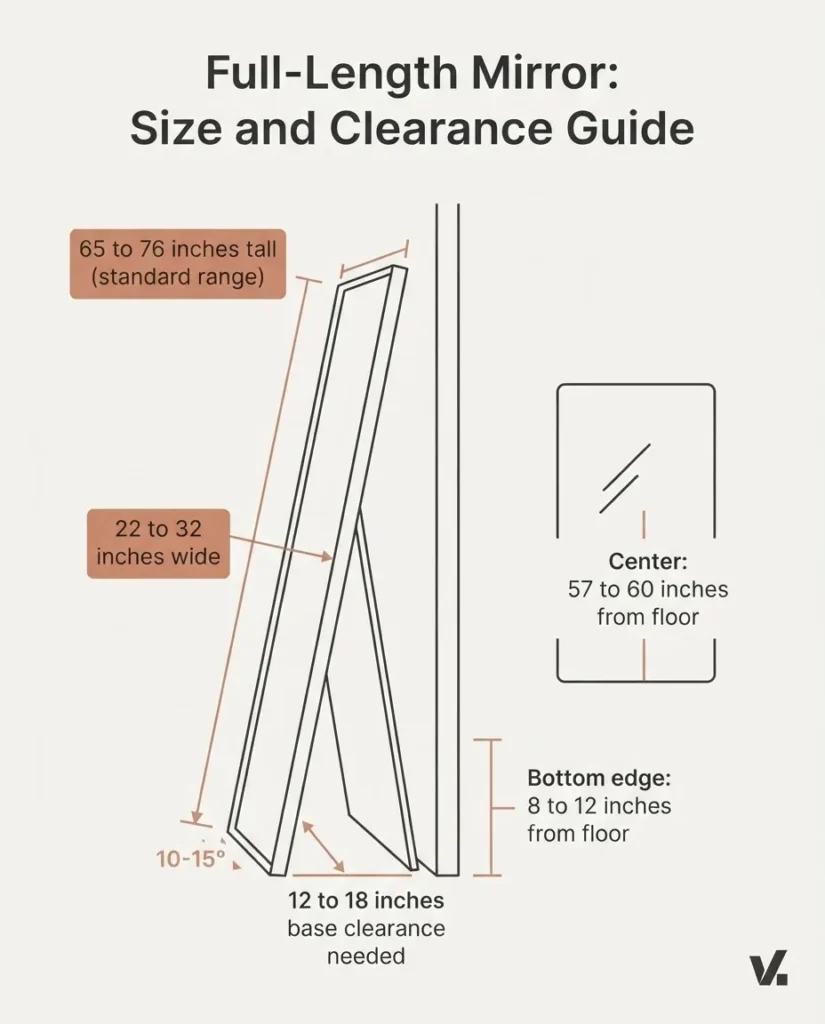
Width matters more than people realize: anything narrower than 20 inches means you will have to take a few extra steps back to see your shoulders clearly. If you are looking at a 16-inch-wide mirror to save space, know going in that the view will feel narrower than you expect.
For a floor or leaning mirror, there is one detail almost no one mentions in listings: because the mirror leans at an angle (typically 10 to 15 degrees off vertical), the reflected angle shifts. A 65-inch mirror leaning against a wall may show a 6’3″ person head to toe, while a 65-inch mirror hung flat on the wall might cut off the top of their head unless hung at the right height. The lean actually works in your favor for taller people. But it also means the mirror picks up more of the floor and less of the ceiling, which can make your space look slightly different than a wall-mounted version at the same size.
For a wall-mounted mirror, the sweet spot is to hang the bottom edge 8 to 12 inches off the floor, with the center of the mirror at roughly eye level, around 57 to 60 inches from the floor. That placement lets you see your full body without the mirror needing to match your exact height.
One more size rule worth bookmarking: a mirror should not exceed roughly 75% of the width of the wall section it occupies. On a 48-inch-wide section of wall, a mirror wider than about 36 inches will feel crowded. That “75% rule” applies to both types.
What to Look for in the Glass and Frame (From a Listing Photo)
Most mirror listings do not make quality easy to read. Here is what to actually look for.
Glass thickness and type: Look for “1/4-inch” (6mm) or “HD float glass” or “distortion-free” in the listing. According to Lowe’s mirror buying guide, 1/4-inch glass is the recommendation for home décor mirrors, especially full-length ones, because thinner glass is more susceptible to warping over time, which shows up as slight distortion in your reflection. For mirrors 48 inches or wider, 1/4-inch is the standard to look for. A listing that says “tempered” or “shatterproof/explosion-proof film” is giving you a useful safety signal, but tempered is about safety, not clarity. The HD float glass language is what tells you about reflection quality.
Reflection coating: The quality signals to look for are “silver-backed” with a sealed protective coat. As covered in detail at OkayMirror’s mirror quality breakdown, silver-coated mirrors are the standard for home use; the key is that the backing is properly sealed to resist moisture and tarnishing over time. A mirror in a bathroom or high-humidity room that lacks a sealed silver coating will start to show dark spots or “foxing” (black edge marks) within a couple of years.
Frame material: Aluminum alloy frames are lightweight, rust-resistant, and genuinely the practical choice for most budgets. They will not swell or warp in a humid room. MDF frames look solid but can swell in high-humidity spaces like a master bathroom, so factor in where you are putting this mirror. Solid wood frames are heavier, more durable in dry rooms, and add a premium feel, but they also add significantly to the total weight, which matters if you are wall-mounting. A wood-framed mirror can easily tip the 33-pound threshold that triggers the need for two wall anchors.
Frame construction: A frame joined at the corners with mortise-and-tenon or metal corner brackets holds up better long term than one that is simply glued and stapled. You usually cannot see this from a listing photo, but buyer reviews that mention wobbling frames or corners separating after a year are a red flag worth reading before you buy.
The Safety Question: Floor Mirrors and Tip-Over Risk
This is the one I want to make sure does not get buried.
A leaning floor mirror can tip over. A freestanding mirror with a stand is more stable, but large mirrors on stands still carry some risk if bumped hard enough. If you have young children or pets who knock things over, this matters more than any aesthetic consideration.
The U.S. Consumer Product Safety Commission (CPSC) is explicit about this. Their Anchor It! campaign, which hit its 10th anniversary in 2025, specifically advises securing “furniture and mirrors” with anti-tip devices. The campaign has contributed to roughly a 50% decline in tip-over injuries and deaths over the past decade. That is a real number worth taking seriously, especially if you have small kids.
For a leaning mirror, the practical solution is an anti-tip anchor strap.
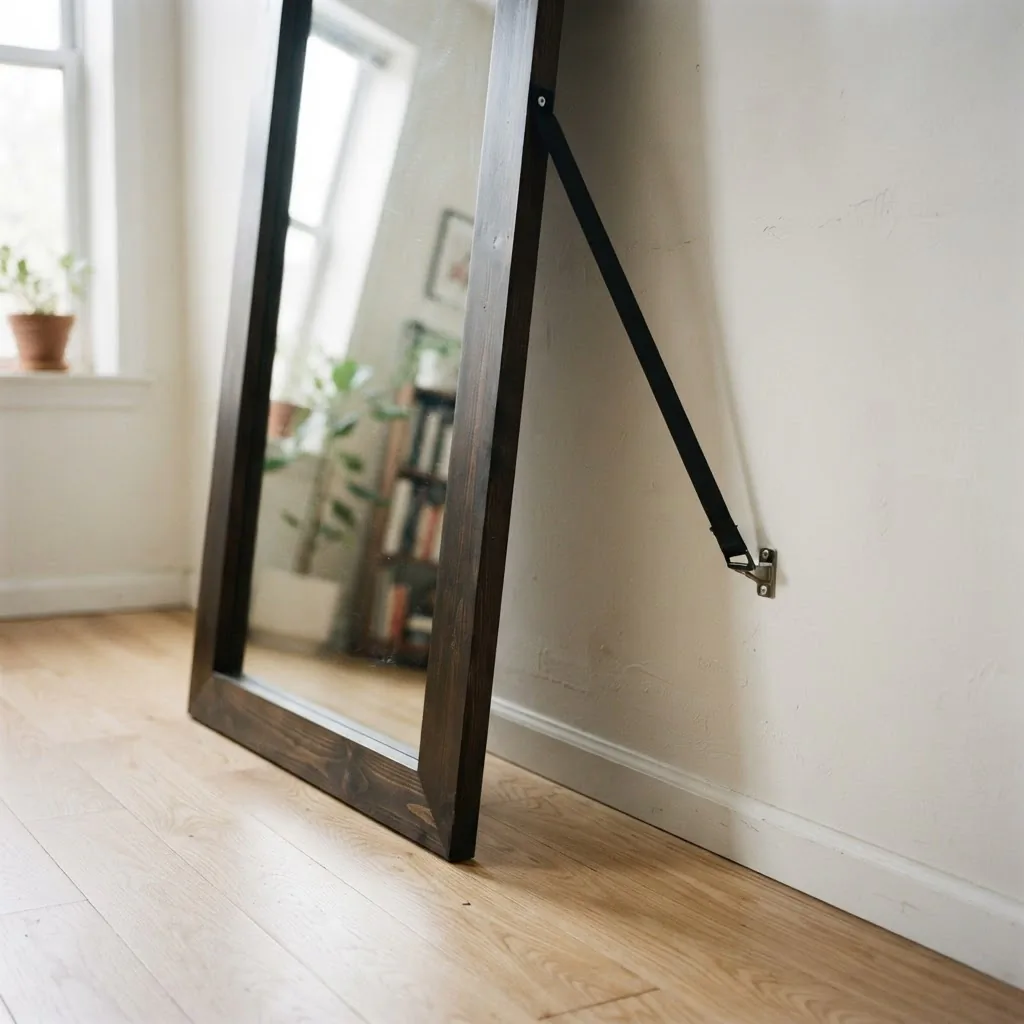
These attach from the back of the mirror frame to a wall stud or drywall anchor, keeping the mirror from falling forward while still letting it lean. The DIY Playbook’s step-by-step guide to securing a leaning mirror walks through exactly how to do this. The straps are low-profile, inexpensive, and do minimal wall damage, making them a reasonable option even in most rentals.
Also note: a leaning mirror needs 12 to 18 inches of base floor clearance in front of it so it leans at a stable angle and does not pitch forward. If your room does not have that clearance, a wall-mounted mirror eliminates the problem entirely.
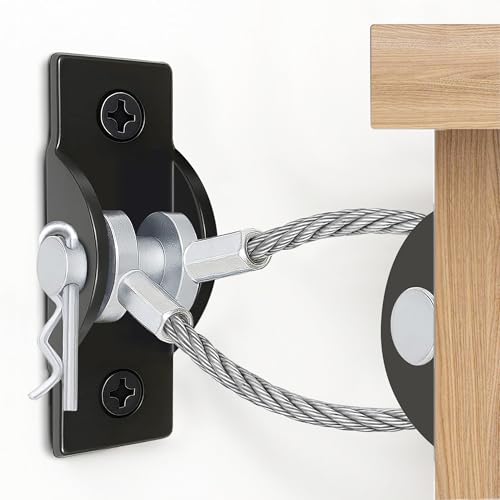
- Baby Proofing & Pet Safety: Furniture wall anchors keep furniture stable and reduce the risk of accidents. furniture wal…
- Strong & Heavy-Duty Materials: The anti-tip furniture anchors are crafted from 2mm thickness cold-rolled steel with a bl…
- Release Design: The furniture strap wall anchors features a dual-opening design that can be easily loosened at any time,…
Floor Mirror vs Wall Mirror: Side-by-Side Comparison
Here is the honest breakdown across the factors that actually matter at buying time:
| Factor | Floor / Leaning Mirror | Wall-Mounted Mirror |
| Renter-friendly | Yes, no wall drilling needed | Riskier, depends on weight and lease |
| Installation | Set it down, lean it; 15-30 min if stand assembly required | Requires stud-finding, hardware, leveling |
| Floor space needed | Yes: 12-18″ base clearance required | None, saves floor space |
| Portability | High: move it room to room or on move-out day | Low: unmounting leaves hardware holes |
| Safety with kids/pets | Lower without anchor strap; use anti-tip hardware | More secure once properly mounted |
| Reflection quality | Slightly angled view due to lean | True vertical reflection |
| Budget entry point | Wide range, from under $60 to $300+ | Similar range |
| Best for | Renters, movers, small budgets, flexibility | Permanent spaces, kids/pets, clean look |
Who Should Get a Floor Mirror
A floor or leaning mirror is the right buy for you if: you rent and do not want to risk your deposit on mounting hardware. You move semi-regularly and want a mirror that travels with you. You want flexibility to try it in different spots. You have a spot against a wall with 12 to 18 inches of open base clearance. Your budget is tighter and you want the most mirror for your money. You do not have young children or pets who are climbers, or you are willing to use an anchor strap.
For renters and first-time apartment dwellers especially, a solid leaning floor mirror is almost always the practical starting point. You get the full-length view you want, you do not touch your walls, and if the placement does not feel right, you move it. That is a lot of flexibility for the money.

- SIZE: Full size, 65″x22″, large enough for you to see your entire figure in a single glance.
- FRAME: Aluminum alloy frame, gold color, elegant. Very thin frame (only 0.16″ wide on front), wire drawing treat, simple…
- GLASS & MIRROR: High-definition. Scatter prevention and explosion-proof membrane, burst-proof, shattered glass will not …
Who Should Get a Wall Mirror
A wall-mounted mirror is the right buy if: you own your place or have a landlord who is genuinely fine with reasonable wall anchors. You want to save floor space in a smaller room. You have children or pets and want the mirror securely fixed. You prefer the look of a hung mirror versus one leaning at an angle. Your room does not have a natural wall with 12 to 18 inches of clearance for a leaning base.
The one thing to be realistic about before buying a wall mirror: the mounting matters as much as the mirror itself. A heavy wall mirror on a single drywall anchor that was not driven into a stud will not hold forever, and a 30-to-40-pound mirror coming off a wall is a genuinely bad situation. Glass alone in a 59×20-inch mirror weighs roughly 26 to 27 pounds before adding any frame weight. If your mirror plus frame tips 33 pounds (about 15 kg), you need two mounting points, and stud mounting is the right call.
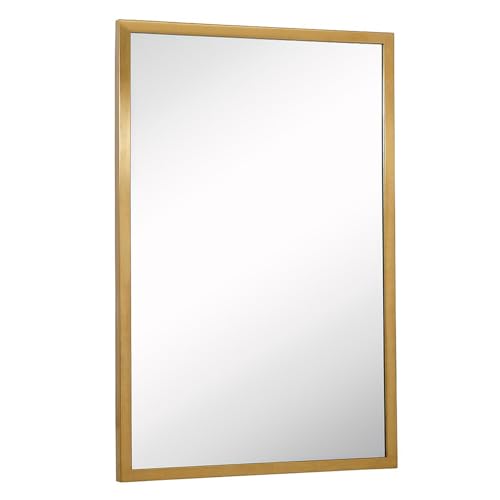
- SOPHISTICATED DESIGN: One of our Best Sellers, this simple 24″ x 36″ industrial commercial grade mirror is a favorite. A…
- SAFE AND EASY TO INSTALL: Our authentic silver backed glass is covered by the high grade brushed metal frame offering a …
- 3 GENERATIONS OF EXCELLENCE: Our family has been manufacturing and producing mirrors for over 3 generations. We stand by…
Budget Tiers: What You Actually Get at Each Price Point
At the budget end, roughly under $100, you are getting thin aluminum or MDF frames, thinner glass (sometimes 3/16″ rather than 1/4″), and basic hardware. These mirrors can look perfectly fine and serve the function. The risk at this price is frame corner wobble, slightly greenish or distorted glass, and hardware that is just adequate. If you are buying your first apartment mirror and you will upgrade in a few years, this tier is reasonable. If you plan to keep it long-term, put a little more in.
In the mid-range, roughly $100 to $300, you start getting consistent HD float glass, better frame joinery, aluminum alloy or solid wood frames, and more reliable hardware. This is the sweet spot for most people. The mirrors that consistently show up in Wirecutter’s tested picks, like those in their current full-length mirror roundup, sit in this range and above.
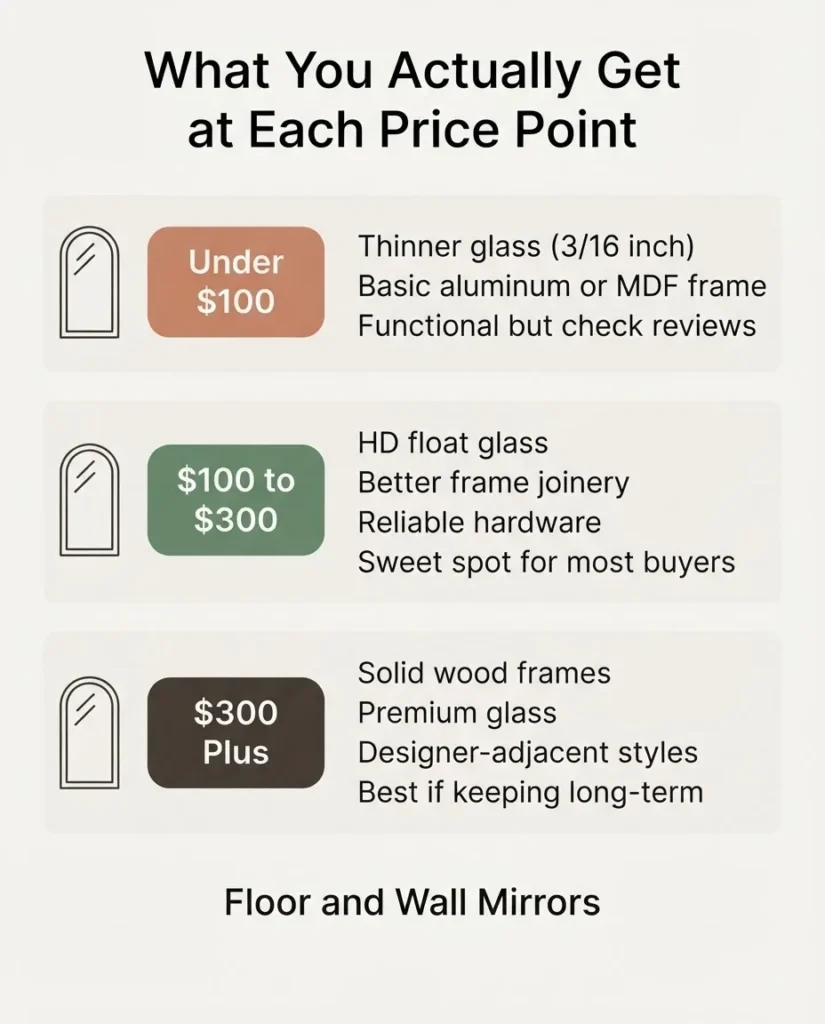
You are paying for distortion-free glass and a frame that will not rack or wobble in a year.
Above $300, you are getting solid wood frames, premium glass, and often better aesthetic options (arch shapes, wide rattan frames, designer-adjacent looks). The functional improvement is real but incremental. For most renters and budget-conscious buyers, the mid-range hits the sweet spot. Save the premium for a piece you are very sure you want to live with for a long time.
Return Risk: What to Know Before You Buy a Mirror Online
Mirrors are among the least pleasant things to return online. Large ones are heavy and awkward to repack. The return process often requires you to be home for a carrier pickup. Some sellers charge return shipping on large items, which can run $30 to $70. And mirrors can crack in transit, which turns a simple return into a documentation headache.
Before you buy, check three things: the return window (30 days is standard; anything shorter on a large mirror is a yellow flag), whether return shipping is free or at your cost, and whether the listing has photos or reviews that confirm the actual delivered size feels right in a real room. A mirror that looks dramatic in a styled product photo on a white background can feel tiny leaning against your actual wall.
Also worth measuring before you click: the wall width where you plan to put it, the ceiling height of the room, and the clearance from the baseboard out if you are getting a leaning mirror. The 30 seconds of measuring is genuinely worth it. I learned that the hard way hauling a too-big piece back to the store.
A Quick Word on Cleaning and Care
Glass cleaner with ammonia is fine on the glass surface, but avoid spraying directly on the frame edge. On silver-backed mirrors (which is most home mirrors), ammonia sprayed repeatedly near the edge can work its way behind the frame and attack the silvering over time, which causes those black edge spots. Spray onto a cloth first, then wipe. For aluminum alloy frames, a dry or barely damp cloth is all you need. For solid wood frames, keep moisture away; wipe with a dry cloth. For MDF frames in any humid room, the same rule applies twice over.
Frequently Asked Questions
Is it better to lean a mirror or hang it?
It depends on your situation. Leaning is better for renters, movers, and anyone who wants flexibility and zero wall damage. Hanging is better in permanent spaces, for households with children or pets who could knock a leaning mirror over, and when you want to save floor space. Both can give you an equally good full-body reflection.
Can a leaning floor mirror fall over?
Yes, it can. A leaning mirror that is not secured poses a real tip-over risk, especially around children and pets. The fix is a low-cost anti-tip anchor strap that attaches from the mirror frame to the wall, which the CPSC recommends for all mirrors and furniture prone to tipping.
What size full-length mirror do I actually need?
For most adults, a 65×22-inch mirror is the comfortable default. Width under 20 inches means stepping further back to see your shoulders. For a leaning mirror, match the height to roughly your own height or slightly taller, since the lean angle means you need a little extra length to see your feet clearly.
Can I hang a wall mirror in a rental without losing my deposit?
Sometimes. Lightweight wall mirrors (under about 20 lbs) can be hung using products designed for minimal wall damage, like certain heavy-duty adhesive hangers. For heavier mirrors, drilling into studs is the safe mounting method, which does leave holes. Check your lease before committing to a heavier wall mirror if deposit damage is a concern.
What is the difference between a floor mirror and a leaning mirror?
Technically, a leaning mirror is one that rests at an angle against a wall without a built-in stand. A floor mirror with a stand includes feet or a frame structure that allows it to stand upright on its own without wall support. In casual use, the terms are often used interchangeably in listings, so check whether the product you are looking at has a freestanding stand or simply leans.