
A good full-length mirror comes down to three things: glass that does not distort your reflection, a frame that holds up over time, and a size that actually works for your space and height. Get those three right and almost everything else is secondary. Get any one of them wrong and you end up with a mirror that makes you look wavy, falls apart in a year, or shows your reflection from the nose down because you bought a leaner that is six inches too short.
I went through this category the same way I go through every piece of furniture that lands in a buying guide: I looked at what matters on the spec sheet, what the common complaints are in buyer reviews, what quality signals you can actually assess from a listing, and where the real money-wasting traps live. Here is everything I found.
Why Most People End up Unhappy With a Cheap Mirror
The number one complaint in full-length mirror reviews is not about the frame style or the color. It is distortion. People notice their reflection looks slightly wavy, stretched, or just “off.” They assume it is the angle, or the lighting, or maybe just them. Often, it is the glass.
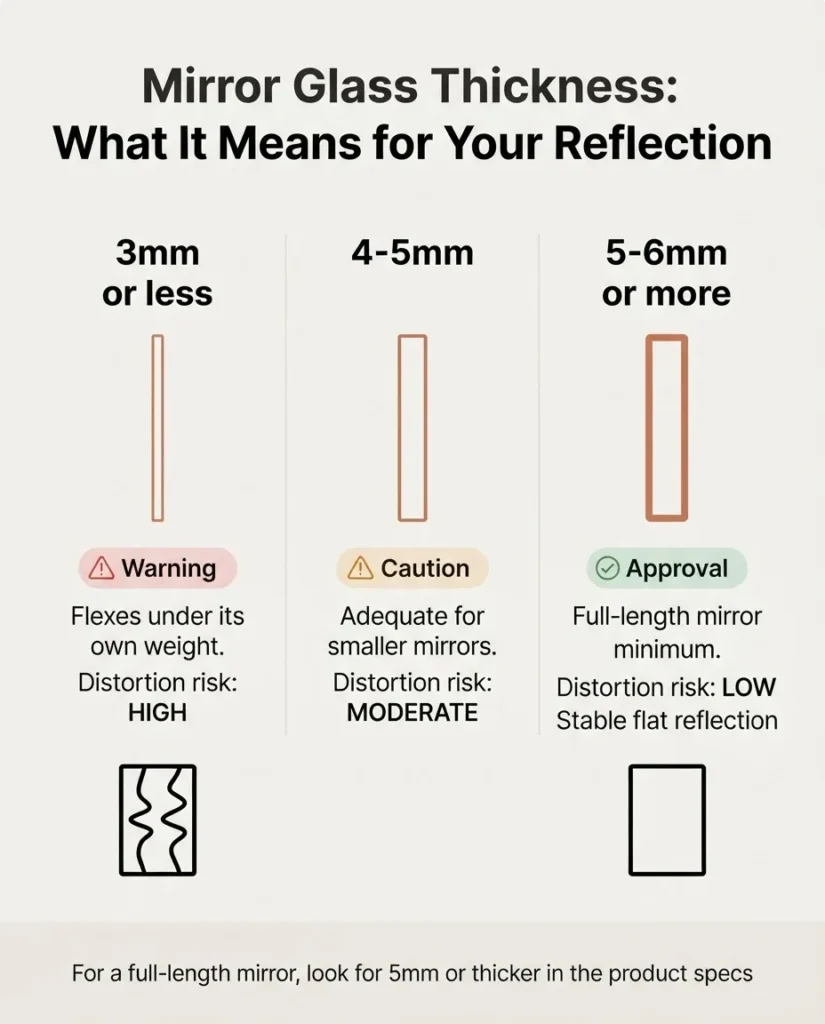
Thin glass flexes. When glass is too thin for the size of the mirror, it bends slightly under its own weight, and a bent mirror reflects light unevenly. That uneven reflection shows up as a subtle but visible warp. According to Edward Martin’s mirror quality guide, mirrors under 3mm often flex visibly, and for a full-length mirror, glass should be at least 5-6mm thick to stay stable. That is roughly 3/16 to 1/4 of an inch. It does not sound like much of a difference, but in terms of rigidity across a 60-plus-inch panel, it is significant.
The quotable answer for anyone Googling this question: a full-length mirror needs glass that is at least 5mm thick; thinner glass flexes under its own weight and produces a wavy, distorted reflection even when brand new.
The problem is that glass thickness is rarely listed clearly on budget listings. You will see phrases like “shatter-proof film,” “explosion-proof glass,” “nano glass,” and “tempered glass” thrown around, and none of them tell you the thickness directly. Here is what those terms actually mean in plain English.
Tempered glass is standard float glass that has been heat-treated to be roughly four to five times stronger than regular glass. When it breaks, it shatters into small, relatively blunt pieces rather than sharp shards. Most decent full-length mirrors use either tempered glass or add an explosion-proof safety film to the back for the same reason. This is a safety feature, not a quality-of-reflection feature.
Nano glass is a marketing term used on many Amazon listings, particularly from brands like DUMOS. In practice, it typically refers to a mirror with a very thin glass panel (sometimes under 4mm) that has a safety film laminated to the back to hold the pieces together if it breaks. It is lightweight, which keeps shipping costs down and makes it easier to hang. The tradeoff is that the thin glass is more prone to distortion. Some nano glass mirrors are fine, and many buyers report no visible distortion. But they are more variable than a true 5-6mm tempered glass mirror, and you have less room for error if the backing is uneven or the mirror is not hung or leaned perfectly flat.
Copper-free silver backing is worth understanding because it affects how long the mirror looks good, not just how accurate the reflection is from day one. Traditional silver-backed mirrors use a copper layer as part of the manufacturing process. That copper layer is prone to oxidation over time, especially at the edges, which is what causes those dark, creeping spots you see on older mirrors. Copper-free mirrors skip that layer, which according to mirror materials research can push reflectivity up to 93-95% versus roughly 90% on traditional silver mirrors, and dramatically reduces edge corrosion over the life of the mirror. If a listing mentions copper-free silver or simply “copper-free” in the specs, that is a genuine quality indicator worth noting.
Frame Materials: What Holds Up and What Does Not
The frame does two jobs: it protects the glass edges and it carries the weight of the mirror for mounting or leaning. The material matters more than most buyers realize.
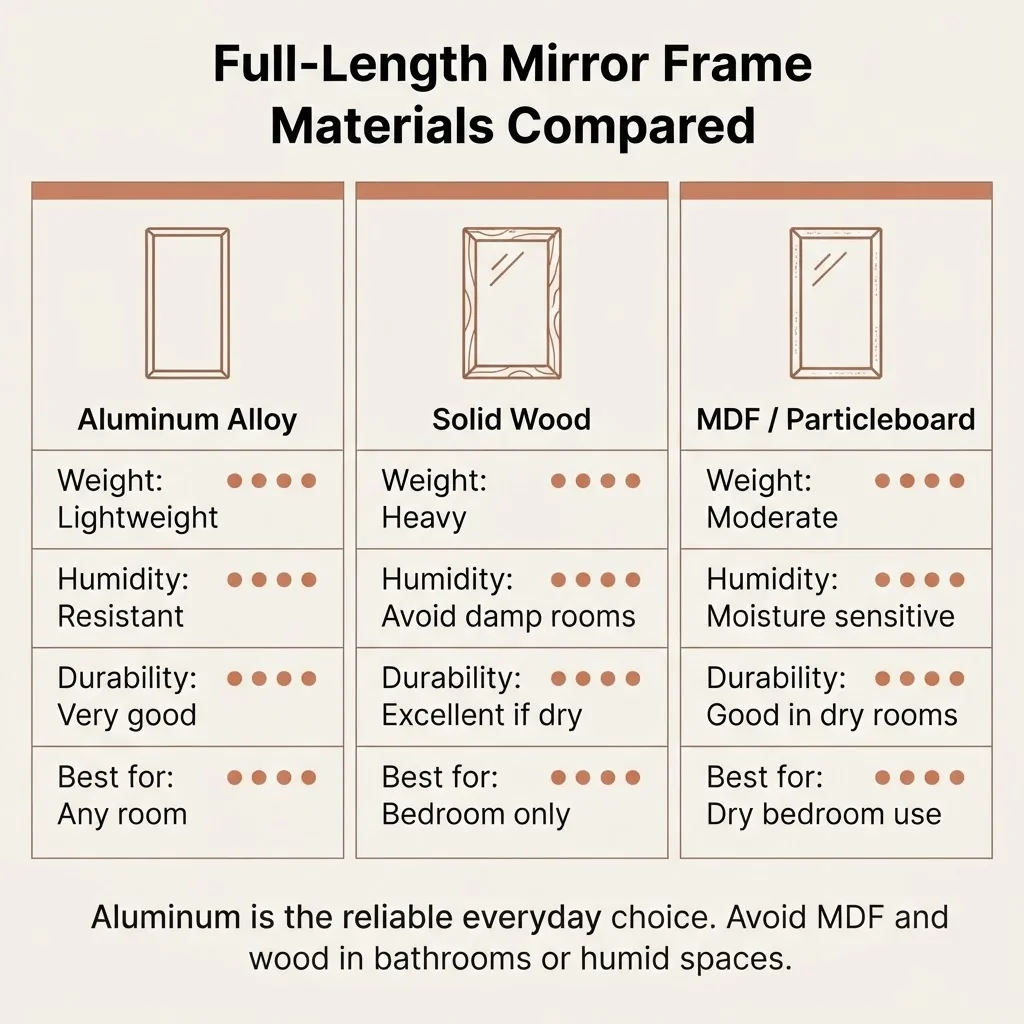
Aluminum alloy is what you will find on the majority of full-length mirrors at the budget and mid-range price points, and for good reason. It is lightweight, it does not rust or warp in humidity, and the thin profiles (often 0.16 to 0.4 inches wide) keep the mirror looking modern without adding much weight. For a bedroom, living room, or entryway, aluminum alloy is the right call at most price points. The frame itself is not going to be your weak link.
Solid wood frames are heavier, warmer-looking, and genuinely more durable when they are made well. The tradeoff is weight (a solid wood-framed mirror can weigh 15 to 20 pounds more than an aluminum equivalent), and wood is moisture-sensitive, so it does not belong in a bathroom or any damp space where it will warp or crack over time. If a listing says “wood frame” and the price is very low, it is more likely MDF or particleboard with a wood-look veneer than actual solid wood. Neither MDF nor particleboard is inherently bad in a dry bedroom, but they will not survive humidity, and they are heavier than aluminum for the same size.
MDF and particleboard frames are common in budget-tier options. They paint and finish cleanly, they are cost-effective, and in a dry bedroom they hold up fine for years. Just keep them away from bathrooms, keep them dry if you ever clean the frame, and do not expect them to shrug off a bump the way solid wood would.
The comparison of wood, metal, and MDF floor mirror frames from KingWin Decor summarizes the tradeoffs well: aluminum wins on weight and humidity resistance, solid wood wins on long-term durability and premium feel, and MDF is the budget-friendly middle ground that works well in the right conditions.
What Size Do You Actually Need?
This is where a lot of people buy the wrong thing, and it is almost always because they bought a leaner without accounting for the angle.
Standard full-length mirrors run 48-72 inches tall and 16-30 inches wide. The most common retail sizes are 59×20, 65×22, 71×32, and 76×34 inches. A good breakdown of all standard full-length mirror dimensions and when each size is appropriate is covered in this sizing guide from OkayMirror, which I found useful for double-checking the numbers.
Here is the part that trips people up. For a wall-mounted mirror, the physics work in your favor. Because it hangs perpendicular to the wall at eye level, a wall-mounted mirror only needs to be roughly half your height to show your full body. A 64-inch tall person can get a full head-to-toe reflection from a 32-36-inch tall wall mirror if it is hung at the right height (bottom edge 8-12 inches off the floor, center at roughly 57-60 inches from the floor).
A leaning mirror is different. Because it tilts back at an angle, the angle eats into the reflection. The same 64-inch-tall person who only needed a 36-inch wall mirror now needs a leaner that is at least 64 inches tall, and ideally 65-66 inches, to see head to toe without stepping back an awkward distance. This is why most popular full-length leaners are 64-65 inches minimum. If you are taller than average, go to 71-76 inches for a leaner.
Width matters too. Under 20 inches wide, you will need to step back to see both shoulders in the same frame, and that gets annoying fast for an everyday getting-dressed mirror. The practical minimum for comfortable daily use is 20-22 inches wide. If you want to see more of your outfit at once, 24-28 inches is better.
As a safe default size for most adults: a 65×22 inch leaner or a 64×21 inch leaner with a stand covers the vast majority of people comfortably. For taller buyers (6’2″ and up), aim for 71 inches or taller.
One more sizing note for small spaces: a framed mirror projects 1.5-2.5 inches from the wall once it is hanging. In a narrow hallway or behind a door, that projection matters. Measure before you order.
Leaning vs. Wall-Mounted vs. Over-the-Door: Which One Should You Buy?
This is a genuine buying decision, not a styling question, so it belongs here.
Leaning/floor-standing mirrors are the most popular option for a reason. They require minimal installation, they are easy to reposition, and most come with a detachable stand that lets them lean without any wall contact at all. The downside is that they take up floor space (a leaner on a stand typically needs 12-18 inches of base depth), they tip over if bumped, and they are the worst option in a house with small kids or large pets unless you anchor them. More on that in a moment.
Wall-mounted mirrors require drilling, which means they are a bigger commitment in a rented space, but they free up floor space completely and they are inherently more stable. They can also be shorter (using the half-your-height math above), which can save money on the glass. If you are willing to drill or if you own your space, wall-mounting is the safer, more space-efficient option.
Over-the-door mirrors are the renter’s best friend. No drilling, no floor space used, no landlord conversation needed. The tradeoff is that you are limited by your door height (most over-door mirrors max out around 48-55 inches, which is enough for most people to see torso-to-toe but not necessarily from the very top of their head), and the reflection angle changes every time the door moves. They also only work if you have a door you can permanently dedicate to the mirror, meaning you will not be opening and closing it constantly.
The Safety Thing Nobody Talks About Enough
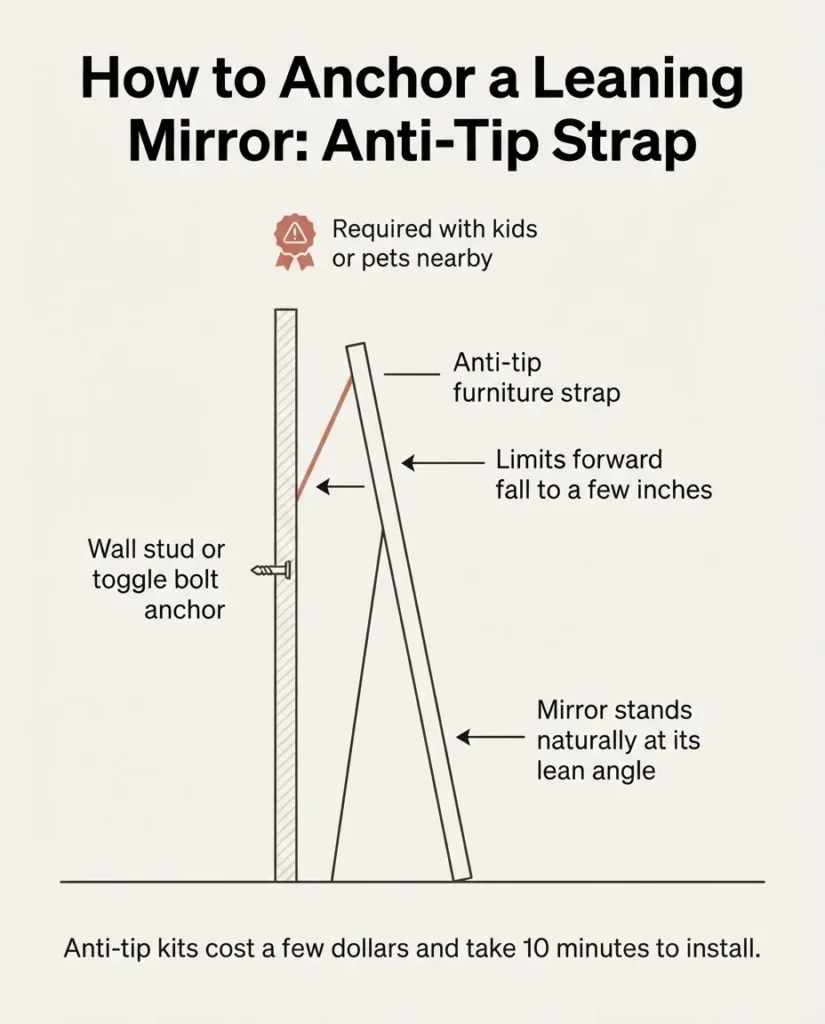
A leaning full-length mirror is a large piece of glass that can fall on a person. This is not an exaggeration. The CPSC runs an entire national campaign called Anchor It! specifically about tip-over hazards in the home, and while it focuses primarily on furniture like dressers and bookshelves, the principle applies directly to large leaning mirrors. A 65-inch mirror on a stand is top-heavy, and a bump from a child, a dog, or even a door swing can send it over.
The fix is simple and cheap: an anti-tip strap (a furniture anchor kit) attaches the top of the mirror to the wall with a short strap that allows the mirror to lean naturally but stops it from falling more than a few inches forward. Most cost just a few dollars. If you have kids, pets, or a small space with a lot of foot traffic, this is not optional. Even if you are solo, it is cheap peace of mind.
How to Hang a Wall-Mounted Mirror Without Wrecking Your Wall
If you go the wall-mounted route, the weight of the mirror drives everything. Centennial Glass’s guide on hanging heavy mirrors safely breaks the thresholds down clearly: under 20 lbs, standard picture hooks are adequate; 20-50 lbs, you need rated toggle bolts or a screw into a wall stud; over 50 lbs, you need to fasten into studs or use a French cleat.
Most full-length mirrors in aluminum frames weigh 15-30 lbs, so toggle bolts into drywall or a single stud-mount is usually sufficient. Always use two mounting points, because two anchors halve the load on each one and keep the mirror from drifting out of level over time.
Renters: if you cannot or do not want to drill, go with a leaner and use an anti-tip strap. Do not try to make Command strips work on a mirror that weighs more than 5-6 lbs. That is a glass-on-the-floor situation waiting to happen.
What You Actually Get at Each Price Tier
I am going to describe what buyers consistently report at each price range rather than name specific prices, since prices move constantly.
Budget tier: Very thin glass (often under 4mm, nano glass style), aluminum frame that is lighter and sometimes slightly flimsy, minimal packaging. These work fine for a lot of buyers, especially if the mirror is going to stay leaned in one spot and not get bumped around. The distortion risk is higher. The glass quality is more variable. The frame finish can chip at corners with rough handling. Worth it if you need a mirror now and are on a tight budget, but do your homework on the reviews for the specific listing and look for complaints about warping or distortion.
Mid-range tier: This is where most of the reliable everyday full-length mirrors live. Glass is typically 5mm or described clearly as tempered, frames are aluminum alloy and feel solid, and the stand (if included) locks in reliably. Assembly is usually 10-20 minutes. Most of the popular name-brand options on Amazon fall here. From what buyers consistently report across these listings, this tier delivers the sweet spot of build quality and price for most renters and first-time homeowners.
Premium tier: Solid wood frames or thick metal frames, noticeably heavier glass, better packaging, and often a better warranty or return window. If you are buying a mirror you want to keep for a decade, this is where to look. Not necessary for everyone, but genuinely a different quality experience.
The Mirrors I Would Point You to Right Now
After working through the research on this category, these are the real products I would send a budget-conscious first-time buyer to look at. The NeuType 65×22-inch is one of the most consistently well-reviewed full-length mirrors on Amazon and has been around long enough to have genuine durability feedback from buyers. The DUMOS and NicBex arched options are newer but have accumulated strong reviews and are worth comparing side by side. The OLIXIS is another solid contender in the same footprint.

- SIZE: Full size, 65″x22″, large enough for you to see your entire figure in a single glance.
- FRAME: Aluminum alloy frame, gold color, elegant. Very thin frame (only 0.16″ wide on front), wire drawing treat, simple…
- GLASS & MIRROR: High-definition. Scatter prevention and explosion-proof membrane, burst-proof, shattered glass will not …
For those who want to compare a few arched options in this size class side by side before committing, here is a look at three that are currently well-reviewed:

- Full Size: Our OLIXIS large mirror full length is 64″ in length and 21″ in width, which is large enough to give you a vi…
- Unique Design: The floor mirror features a clean, right-angled top frame design, blending sharp geometry with practicali…
- High Definition Imaging Glass: Our standing mirror is made of 3mm high-definition glass. Upgraded sterling silver layer …

- See Every Detail, Instantly: No more squinting or twisting—this oversized full length mirror gives you a true, distortio…
- Built Like It’s Meant to Last (Because It Is): We used nano-tempered glass and a solid aluminum alloy frame—so this isn’…
- Three Ways to Make It Yours: Stand it up, lean it casually, or mount it on the wall—you pick what fits your space and vi…

- Aluminum Alloy Frame Full Length Mirror With Stand
- 【Mirror Full Length】This full-length mirror, measuring 64″ x 21″, provides ample coverage for you to view your entire fi…
- 【Gracefully Arched Design】The arched-top design adds a touch of sophistication and timeless elegance to any room, settin…
The Renter Pick: Over-the-Door
If drilling is not an option and you do not want a leaner taking up floor space, an over-the-door mirror is the smart move. The Mirrotek adjustable over-door model is a reliable, no-drama option that has been around on Amazon for several years with consistent reviews.

- Aluminum
- BEAUTIFUL FULL LENGTH MIRROR – You’ll absolutely adore the beautiful modern slim and sleek design of our stunning rectan…
- EASY INSTANT HANGING – No tools required! No damaging your door. In just 5 seconds, click the mirror into place over you…
How to Judge a Mirror Listing Before You Click Buy
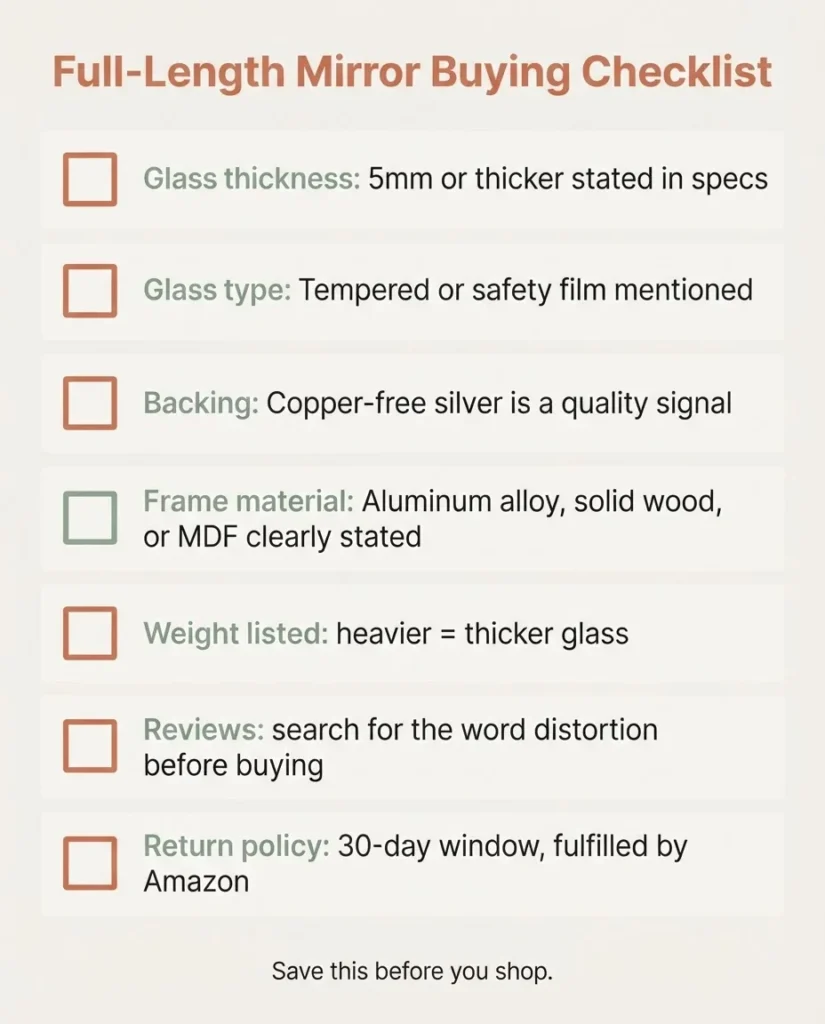
Here is my actual checklist when I am evaluating a full-length mirror listing. These are the specific things I look for because they separate the listings that will disappoint from the ones that will hold up.
Glass thickness: Look for 5mm or thicker specifically stated, or a clear mention of “tempered glass” rather than just “shatter-proof film.” Nano glass mirrors can be fine, but be more selective: look for the specific thickness in the spec sheet.
Backing type: Copper-free silver is a quality indicator. If it just says “silver” with no mention of copper-free, it is probably traditional silver backing, which is fine but will show edge oxidation faster over time.
Frame material clearly stated: Should say “aluminum alloy,” “solid wood,” or similar. Vague words like “metal” or “wood-look” are red flags.
Weight listed: This tells you a lot. A 65×22-inch aluminum-framed mirror that weighs under 12 lbs likely has very thin glass. A similar mirror at 18-22 lbs is more likely 5-6mm glass.
Verified reviews mentioning distortion or no distortion: Search the reviews for the word “distort” specifically. If multiple buyers mention it, move on.
Return policy clearly stated: Amazon’s standard window is 30 days. Confirm the seller is fulfilled by Amazon (not a third-party seller with a shorter or harder-to-execute return window) before you buy anything this bulky.
Assembly instructions included: A mirror that ships with no instructions and unclear hardware is not one I want to assemble over a hardwood floor.
Care and Cleaning: The Short Version
Clean the glass with a microfiber cloth and a diluted glass cleaner or a 50/50 water and white vinegar solution. Spray the cloth, not the mirror directly, because liquid running down behind the frame edge is one of the main causes of backing corrosion over time. Wipe the frame with a dry or barely damp cloth depending on the material. Keep wood frames dry. Aluminum frames can handle a damp wipe.
Do not use abrasive cleaners on the glass or frame. That is genuinely all there is to it.
FAQ
How do I know if a full-length mirror will distort my reflection?
Look for glass that is at least 5mm thick, described as tempered glass, and listed with a specific weight that suggests real glass density. In buyer reviews, search for the word “distortion” to see if others have flagged it. Nano glass mirrors are variable, so pay extra attention to reviews on those listings. A well-made full-length mirror with adequate glass thickness should give you a flat, accurate reflection.
What size full-length mirror do I actually need?
For a leaning or floor-standing mirror, you need a mirror that is at least as tall as you are, because the tilt angle cuts into the visible reflection. For a wall-mounted mirror, you only need roughly half your height, hung with the bottom edge 8-12 inches off the floor.
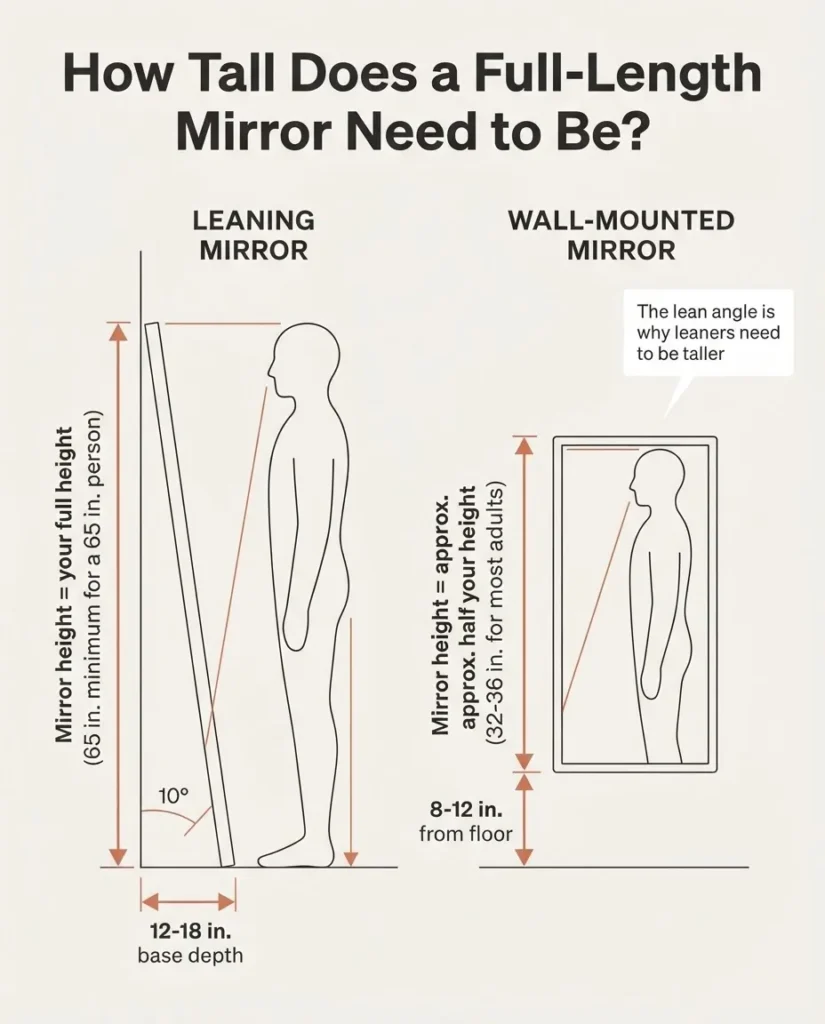
Most adults are well-served by a 64-65 inch leaner that is at least 20-22 inches wide.
Is a leaning mirror safe if I have kids or pets?
Not without an anti-tip strap. A large leaning mirror on a stand is top-heavy and can fall if bumped. The CPSC’s Anchor It! program covers this type of tip-over risk. An anti-tip furniture strap attached to the wall fixes the problem for a few dollars and takes ten minutes to install.
Can I hang a leaning mirror on the wall instead of leaning it?
Yes, most leaner-style mirrors include hardware for both options. The mounting holes or D-rings are usually on the back of the frame. The difference is that a wall-mounted full-length mirror does not need to be as tall as a leaner, so if you know from the start you want to hang it, you can often buy a slightly shorter mirror for the same head-to-toe view.
What is the difference between a leaning mirror and a floor mirror with a stand?
They are often the same product. Many full-length mirrors ship with a detachable stand that props the mirror at a leaning angle without any wall contact. Remove the stand and you can lean it directly against a wall or mount it. “Floor mirror with stand” and “leaning mirror” are usually interchangeable terms on Amazon listings for the same category of product.