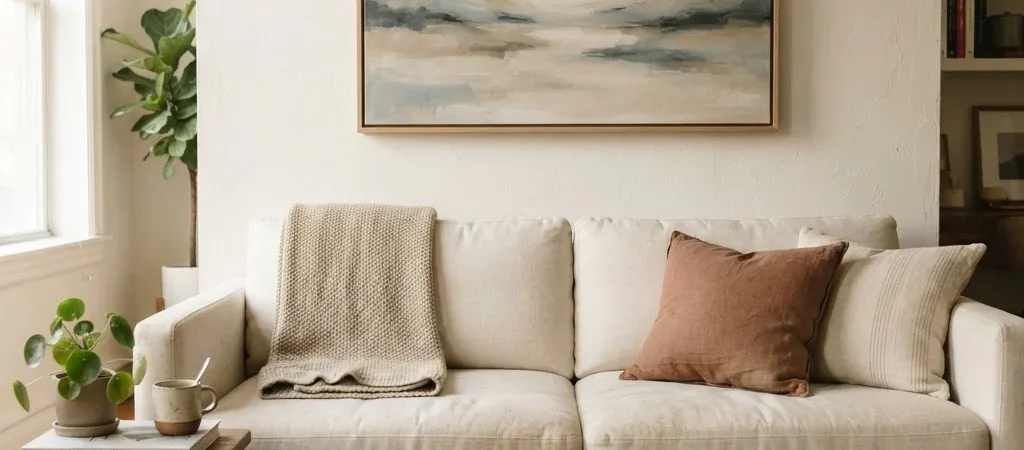
To choose the right wall art size, measure the furniture piece or wall below where the art will hang, then aim for a piece that spans roughly 60 to 75 percent of that width. That single rule handles most situations and takes about 30 seconds with a tape measure. The rest of this guide covers how to apply that rule in every room, what to do in trickier spots, and how to avoid the most expensive sizing mistake people make, which is buying something too small.
The Number-One Mistake People Make (And Why It Happens)
Almost every first-time buyer makes the same call: they go too small. A piece that looks substantial on a listing page, in a nicely styled product photo against a plain white studio wall, arrives and gets hung on an actual living room wall next to an 84-inch sofa, and suddenly it looks like a postage stamp.
It happens because product photos are shot to flatter the art, not the room. The sofa in the background is often much smaller than yours. The wall in the photo might be cropped tight around the piece. Nothing in the image tells you how that 18×24 print is actually going to read against your eight-foot wall.
The fix is simple: before you order anything, grab painter’s tape and outline the size on your actual wall. Literally put tape on the wall where the edges of the piece would be. Step back. Look at it from the spot where you’d normally sit or stand. That rectangle on the wall is what you’re actually buying.
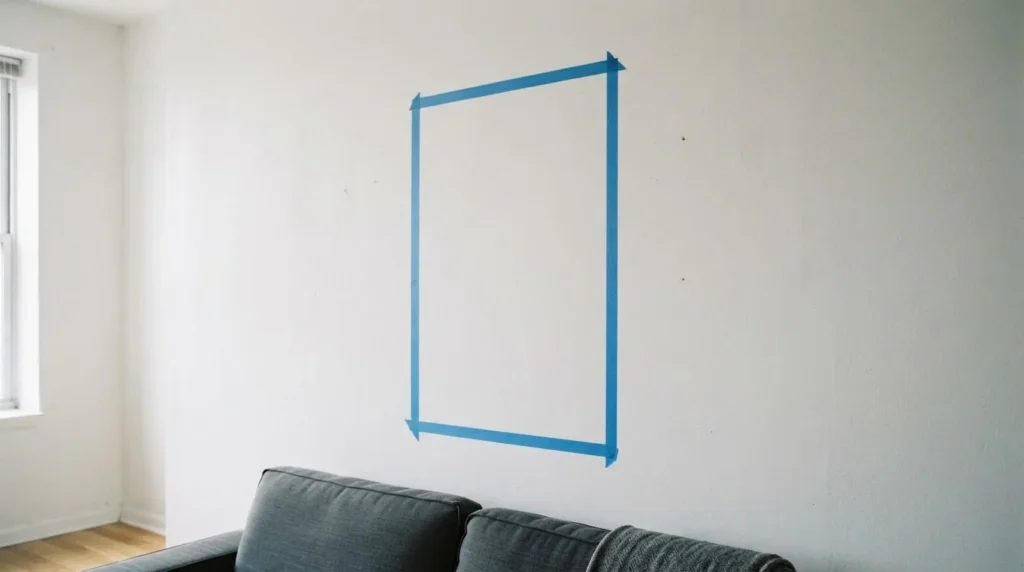
If it looks small from there, go bigger. This is the one trick that prevents the majority of bad buys, and it costs nothing. Per the comprehensive sizing breakdown at Nations Photo Lab’s wall art size guide, filling roughly 60 to 75 percent of the available wall or furniture width is the consistent standard, and the tape test makes it immediately visual.
The Core Rule: 60 to 75 Percent of the Width
Here is how the rule works in practice. Measure the width of whatever the art will hang above, whether that’s a sofa, a headboard, a console table, or a mantel. Multiply that measurement by 0.60 to get your minimum and by 0.75 to get your maximum. Order something in that range, and you’re in solid territory.
Some examples using real furniture widths:
A standard 84-inch (7-foot) sofa calls for art that is roughly 50 to 63 inches wide. A full-size 60-inch sofa calls for art about 36 to 45 inches wide. A queen-size headboard at 62 inches calls for art about 37 to 47 inches wide. A standard 60-inch fireplace mantel calls for art about 36 to 45 inches wide.
When you run these numbers, you quickly see why a single framed print in a common 24×36 size works perfectly above a narrow console table or a full-size bed, but feels under-scaled above a large sectional. On a big sofa wall, a multi-panel set or an oversized canvas (40×30 or wider) is often the right call, not a single medium piece.
If the art is going on a blank wall with no furniture anchor below it, measure the wall’s total width and aim for art that fills about half to two-thirds of it, keeping at least 6 to 8 inches of breathing room on each side.
Room by Room: The Specific Numbers
Above a Sofa
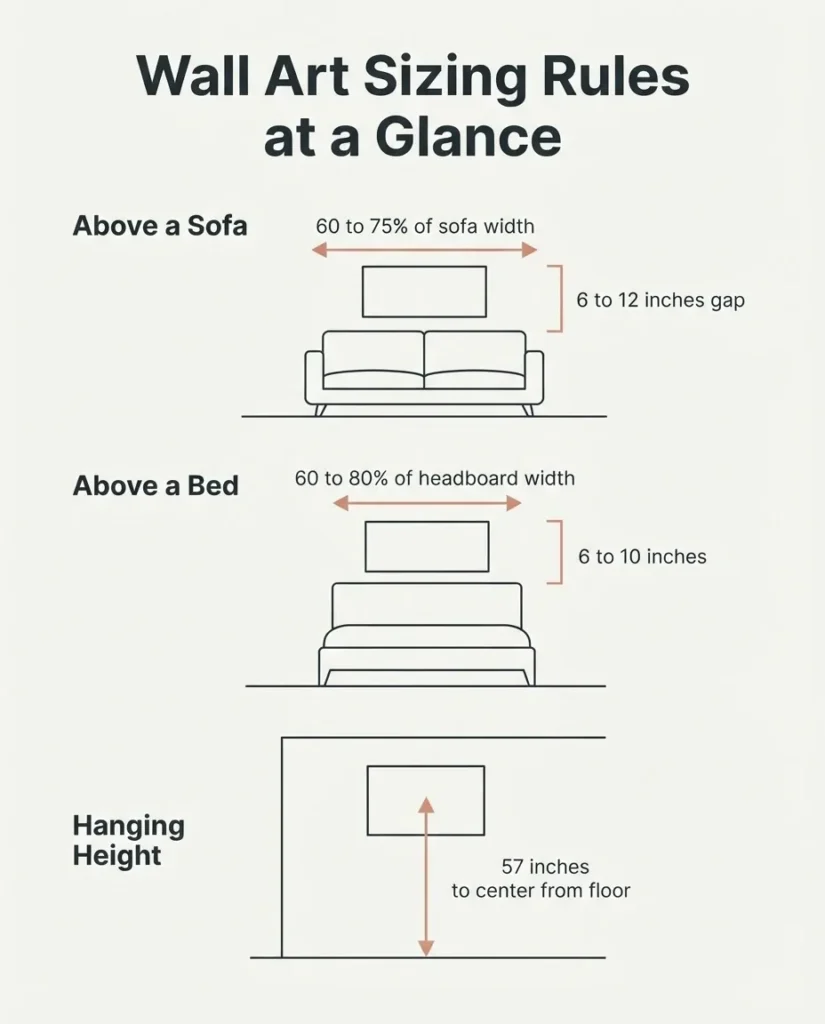
This is the most common placement and the most common place people go wrong. Wall art hung above a sofa should be approximately 60 to 75 percent of the sofa’s width, with its bottom edge sitting 6 to 12 inches above the back cushions. For an 84-inch sofa, that means art in the 50 to 63-inch-wide range, with the bottom of the frame sitting roughly 8 to 10 inches above the top of the cushions.
That 8-to-10-inch gap is important. Hang art too high and it “floats” on the wall, disconnected from the furniture below it. Hang it too close and it looks crowded and feels like a hazard to anyone sitting down.
If you can’t find a single piece that hits the right width, a set of two or three framed prints arranged in a horizontal line works just as well and often costs less. The combined width of all pieces, including the gaps between them, should still fall in the 60-to-75-percent range.
Above a Bed
The standard guidance for art above a bed is the same 60 to 80 percent of headboard width rule, with the bottom of the art sitting 6 to 10 inches above the headboard. For a queen bed, that typically means art 37 to 50 inches wide. For a king, you’re looking at 46 to 64 inches.
The practical concern above a bed that doesn’t exist as much above a sofa: falling art.
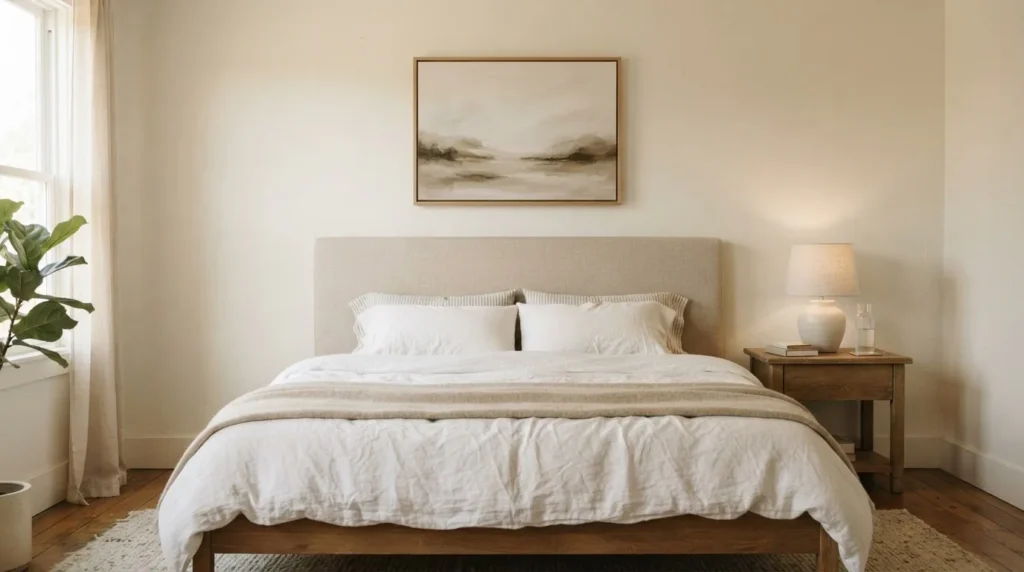
Any piece hung above where someone sleeps needs to be properly secured. If you’re using adhesive strips (more on those below), know their limits. A heavy framed canvas above a bed is worth anchoring into a stud, full stop.
Above a Fireplace
The fireplace mantel sizing rule is a little different because the mantel itself has a defined width and you need breathing room on both sides. Art above a fireplace should be roughly two-thirds the width of the mantel, with a few inches of margin on each side so it doesn’t look like it’s about to topple off. For a standard 60-inch mantel, that means art about 36 to 44 inches wide. Art House SF’s detailed breakdown on sizing above a fireplace recommends leaving 6 to 8 inches of breathing room per side, which is a sensible rule.
Height-wise, hang the bottom of the art 4 to 6 inches above the mantel shelf.
Hallways and Small Walls
Hallways are the trickiest spot because the wall is narrow and vertical. Here the 60-to-75-percent rule still applies to width, but the shape of the piece matters a lot. A tall, narrow piece (portrait orientation) reads better in a hallway than a wide landscape piece. Common sizes that work well in hallways are 12×24, 16×20 (portrait), and 18×24.
In small apartments where every wall is limited, fewer larger pieces almost always look better than a cluster of small ones. One 24×36 piece reads as intentional. Four 8×10 frames clustered together on the same wall often reads as busy or underdone. If budget is a real constraint, one well-chosen larger piece is a better buy than several small ones.
The 57-Inch Hanging Height Rule
Once you know your size, there’s still the question of how high to hang it. The standard gallery answer is the center of the artwork at 57 inches from the floor. That’s the museum standard, it represents average human eye height, and Apartment Therapy’s guide on the 57-inch rule explains the exact math for calculating where the nail or hook should go once you know where the center needs to land.
The 57-inch rule applies to freestanding walls without furniture. When art is hung above a piece of furniture, the relationship to the furniture below it takes priority. In that case, you follow the 6-to-12-inch-above-the-furniture rule and let the center height fall where it may. In practice, above most sofas and headboards, the center ends up somewhere in the 60-to-67-inch range anyway, which is close enough.
One thing that trips people up: they hang art too high. It’s a nearly universal instinct. The 57-inch center feels lower than you expect. Trust it and do it anyway.
Single Piece vs. Multi-Panel vs. Gallery Wall: Which Should You Buy?
This is a real buying decision with real cost and size implications.
A single large piece is the cleanest solution if you can find the right size. It requires no planning, no alignment, no figuring out how to space multiple frames. The challenge is that genuinely large single pieces at the sizes needed for a sofa wall (50+ inches wide) are harder to find in the budget range, and when you do find them they tend to be canvas prints on lightweight frames that need careful quality checking.
A multi-panel set (typically 2 or 3 panels sold together) solves the width problem affordably. A 3-panel set where each panel is 16×24 gives you a combined display about 50 to 54 inches wide (panels plus small gaps), which hits the right range above most sofas. The downside is that panels need to be hung level and evenly spaced, which takes more care. If you’re not comfortable with that, the single piece is easier.
A gallery wall is a group of mixed pieces assembled together. From a sizing perspective, treat the entire grouped arrangement as one big piece and apply the same 60-to-75-percent rule to the total combined width of the arrangement. Apartment Therapy’s measurement guide for hanging artwork recommends 3 to 6 inches of spacing between gallery wall frames as a starting point, noting that less than 3 inches starts to look crowded and more than 6 inches starts to feel like separate pieces rather than one cohesive grouping.
The gallery wall is the hardest of the three to buy and hang well. For a beginner furnishing a first place, I’d start with a single large piece or a 3-panel set before tackling a gallery wall.
Canvas Print vs. Framed Art: What’s Actually the Difference?
This is worth a few minutes of your attention because the quality and longevity differences are real, and they don’t always map to price.
A gallery-wrapped canvas is printed on canvas fabric, stretched over a wooden frame, and the image wraps around the edges so no frame is needed. The quality signals to look for in any listing are: solid wood or kiln-dried pine stretcher bars (not particleboard or MDF backing, which can warp), a gallery-depth wrap of 1.5 inches (which looks substantial on the wall vs a 0.75-inch “thin wrap” that looks flimsy), and whether the listing mentions giclee or pigment-based printing. Pigment-based inks last significantly longer than dye-based inkjet printing, which can fade notably over a few years in a sunny room.
Framed prints are flat prints (paper or thin canvas) inside a frame with a glass or acrylic front. They tend to show more detail and are better for pieces with fine line work or photography. Nations Photo Lab’s detailed comparison of canvas vs framed prints points out that paper prints can show more image resolution, but they’re also more susceptible to glare and need glass protection. For a living room that gets direct light, a matte glass or acrylic front matters more than most people realize.
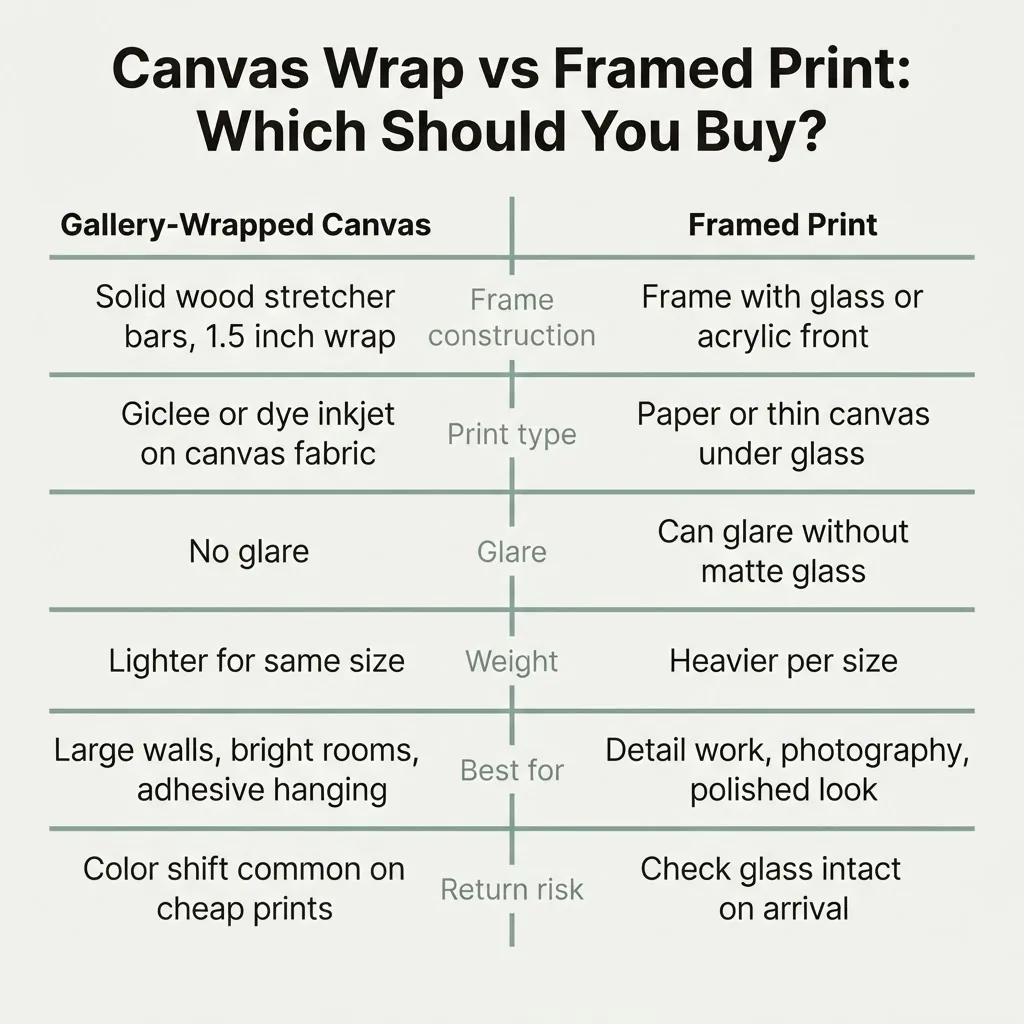
The practical buying difference: canvas wraps are more forgiving in bright rooms (no glare), tend to be lighter weight for a given size (making adhesive hanging more viable), and are the default format for large-format budget art on Amazon. Framed prints are better for smaller detailed pieces, photography, and any spot where you want a more finished, finished look.
Neither is inherently better. They’re different tools for different situations.
A Roundup of Well-Reviewed Large Canvas Art Worth Considering
If you’ve measured, run the tape test, and know the size you need, here are a few real options that consistently pull positive buyer feedback in the formats where most people shop.

- Size: Each canvas panel is 16″x24″ (40 cm x 60 cm), total 3 panels; Canvas wall art decor provides aesthetic decoration …
- Easy To Hang: Choose natural wood frame, high definition inkjet pictures; High quality canvas wall art, each canvas pain…
- Ideal Choice: Suitable for home interior wall decoration, such as living room,bedroom, bathroom, office, guest room, hot…

- {WALL ART SIZE}:Each Canvas Panel Is 24″X48″Inch (60cmx120cm),Canvas Wall Decor Art.
- {MATERIAL AND WORKMANSHIP}:High Definition Giclee Picture Printed On Good Qulity Canvas,And Gallery Wrapped When Get It….
- {ORIGINAL DESIGN}:Wapluam Is A Brand Adhering To Original Designs.Wall Pictures Works that Cover All Themes:Such As Abst…

- Hand-Painting: The abstract wall art 100% hand-painted by our professional artists, due to its thick texture, has a stro…
- Large Wall Art: 71 x 36 inch (Landscape ) for total, 24 x 36 inch for each panel, large wall decor for living room, bedr…
- Easy to Hang: The Gold wall art stretched over solid pine-wood bar comes with bracket and accessories, Framed with gold …
The Renter Question: How Do You Hang It Without Damaging Walls?
This is the part most sizing guides skip entirely, and it’s a real issue for renters who can’t put nails wherever they want or who want to keep their security deposit intact.
Adhesive picture hanging strips are the practical answer for most canvas prints and framed art up to a certain weight. The 3M Command official weight limits page is the clearest reference here: their large strips used in sets of 4 pairs hold up to 16 pounds on a frame no larger than 24×36 inches. For heavier or larger pieces, you need either a nail into a stud or a wall anchor.
Most canvas prints in the 24×36 size range on Amazon weigh between 2 and 5 pounds. Adhesive strips handle that comfortably. A large multi-panel set or a heavy framed piece over 10 pounds starts to push into territory where I’d want a nail, or at minimum a stud finder to confirm you’re anchoring into something solid.
For renters worried about the hole: a single small nail into drywall, patched with a dab of spackle and touched up with wall paint when you move out, is almost always less stressful than finding out your adhesive strips failed and your canvas hit the floor at 3am. Large strips are fine for light-to-medium pieces. Know the weight of what you’re hanging before you trust them with it.

- Strips
- MAXIMUM FRAME SIZE 24 X 36 INCHES: One package includes 14 pairs (28 strips total) of the Command Large Picture Hanging …
- WORKS ON A VARIETY OF SMOOTH SURFACES: Wall hanging strips work on a variety of smooth surfaces, including painted walls…
What to Look for in a Listing Before You Buy
Buying art online has a real return-risk problem. The color you see on a listing photo is calibrated to the seller’s screen and photography setup, not yours. The size listed in the title is sometimes the canvas face, sometimes including the frame. And “ready to hang” means different things from different sellers.
Here’s what to actually check before ordering:
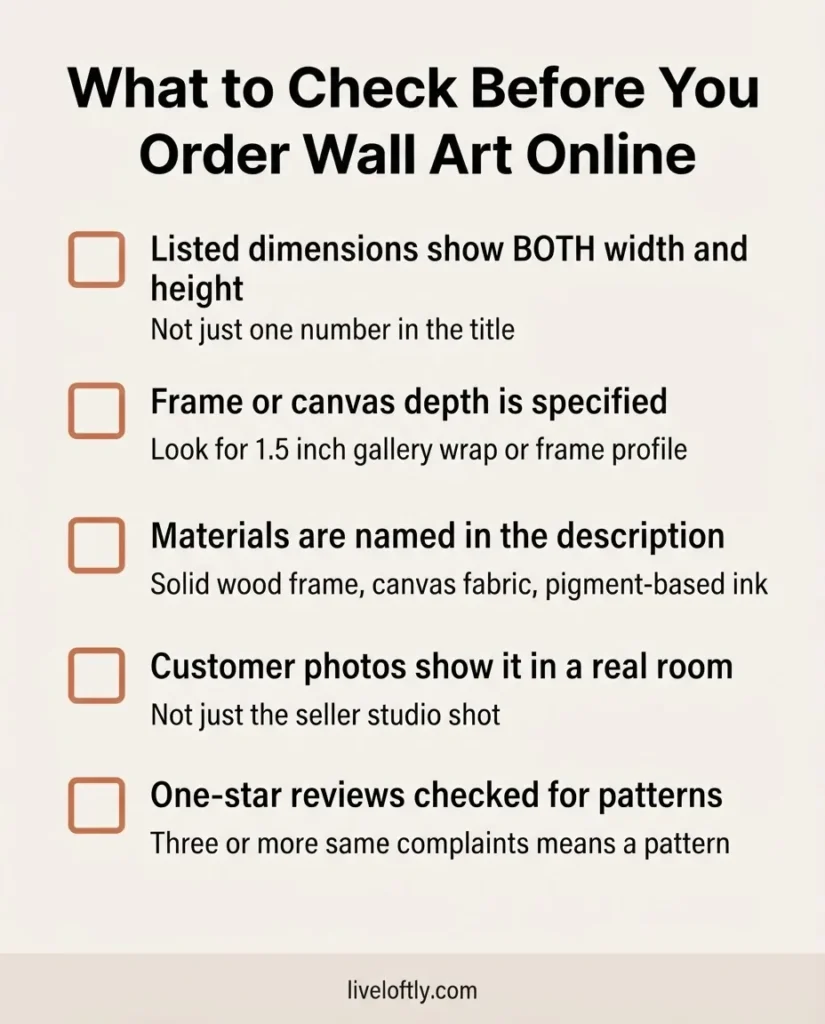
The listed dimensions should tell you face size AND total size including any frame. If only one measurement is listed, check the product description or customer Q&A for clarification. A 24×36 canvas vs a 24×36 framed print where the frame adds 2 inches per side is a meaningful difference in a small space.
Check the product description for materials. Solid wood frame, 1.5-inch gallery wrap, and pre-attached hanging hardware are the things worth seeing listed. “MDF backing” or “PVC frame” are signals of a lighter-duty construction that may warp in humidity.
Look at customer photos, not just listing photos. On Amazon, buyer photos often show the piece in a real room next to real furniture. This is the most honest size comparison you’ll get.
Read one-star reviews specifically. The most common complaints for canvas art are: “colors looked nothing like the photo,” “frame arrived warped or bent,” and “much smaller than expected.” Three or more reviews with the same complaint about sizing or color means it’s a pattern, not a fluke.
Quick Sizing Reference Table
| Placement | Furniture Width | Art Width Range | Notes |
| Above sofa | 84 in (7 ft) | 50 to 63 in | Bottom 8-10 in above cushions |
| Above sofa | 60 in (5 ft) | 36 to 45 in | Works well with a 24×36 single piece |
| Above queen bed | 62 in headboard | 37 to 47 in | Bottom 6-10 in above headboard |
| Above king bed | 76 in headboard | 46 to 57 in | Multi-panel often needed |
| Above fireplace (60 in mantel) | 60 in mantel | 36 to 44 in | 6-8 in margin each side |
| Hallway (narrow wall) | 36 to 48 in wall | 20 to 30 in | Portrait orientation preferred |
| Blank living room wall | 96-120 in wall | 48 to 72 in | Or use gallery arrangement |
The Honest “Skip It” Verdict on Common Sizing Mistakes
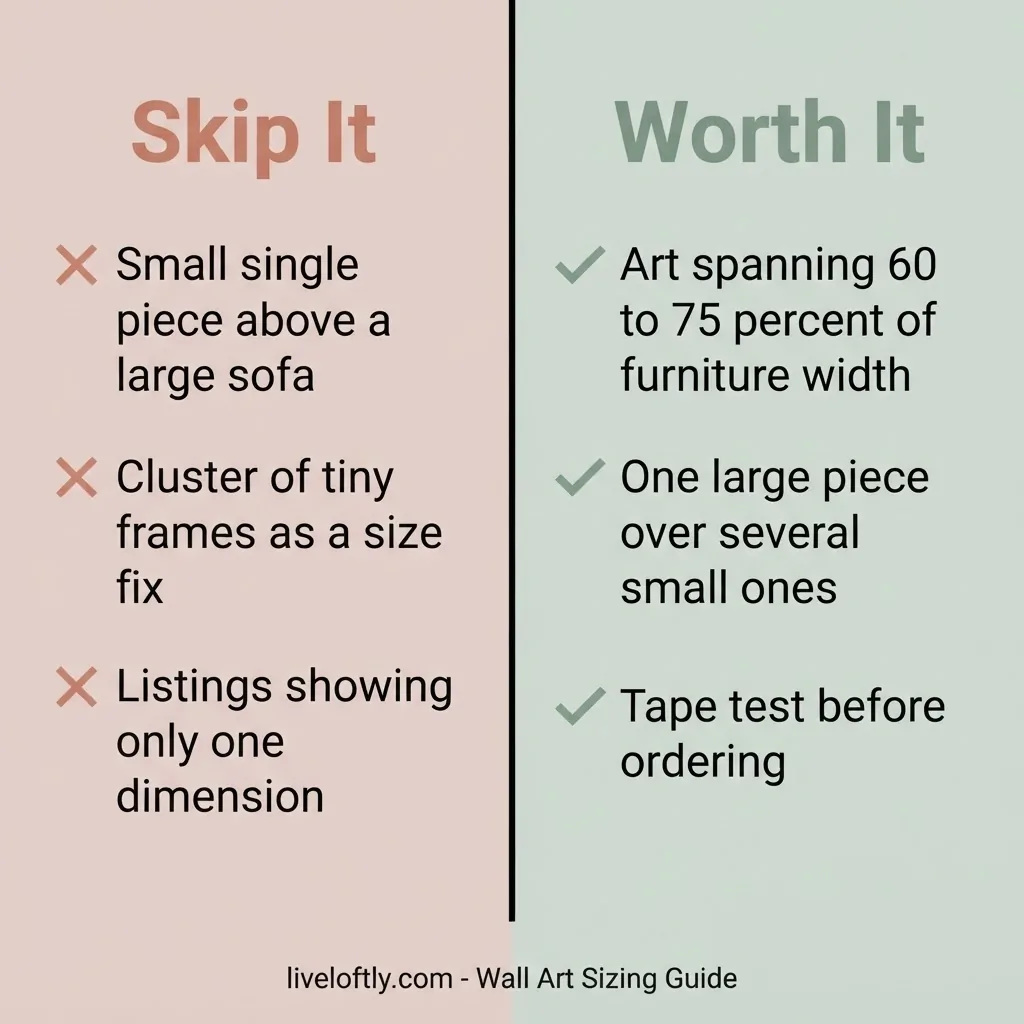
Skip the small single piece above a large sofa. A 16×20 or 18×24 piece above an 84-inch sofa is one of the most common and most noticeable sizing mistakes in home decor. If your sofa is longer than 60 inches, that size is almost certainly too small. You’ll know it the moment you hang it.
Skip the cluster of tiny frames as a size fix. Four 5×7 or 8×10 frames spread across a sofa wall don’t read as one large composition; they read as four small things that don’t quite work. If you want a gallery wall, commit to it with proper planning. If you just want to cover a wall, one larger piece does it better and costs less in total.
Skip anything listed as “wall art” that only gives you one dimension in the title. Reputable listings show both width and height. If you can’t find both numbers easily, that’s a quality signal. Message the seller before ordering.
FAQ
What size wall art should go above a sofa?
Wall art hung above a sofa should be approximately 60 to 75 percent of the sofa’s width, with its bottom edge sitting 6 to 12 inches above the back cushions. For a standard 84-inch sofa, that means art roughly 50 to 63 inches wide. A 3-panel canvas set often hits this range more affordably than a single large piece.
How high should wall art be hung?
The standard gallery hanging height places the center of any artwork at 57 inches from the floor, which is the average human eye level. When art is hung above furniture, the relationship to the furniture takes priority: hang the bottom edge 6 to 12 inches above the furniture piece, and let the center height fall naturally from there.
What is the most common wall art sizing mistake?
Going too small is by far the most common mistake. Art that looks substantial in a listing photo often looks like a postage stamp once it’s on a real wall next to full-size furniture. The painter’s tape test, which means taping the exact dimensions on your wall before ordering, prevents this almost every time.
What size wall art works for a small apartment or hallway?
In small spaces, one well-chosen larger piece almost always reads better than several small ones. For a hallway or narrow wall, a portrait-oriented piece (tall rather than wide) in the 12×24 or 16×20 range typically works well. For a small living room sofa, a single 24×36 framed canvas is often the right anchor piece.
How do I hang wall art without nails as a renter?
Adhesive picture hanging strips work reliably for most canvas prints and framed art under about 10 pounds. 3M Command’s large strips (used in sets of 4 pairs) hold up to 16 pounds on a frame no larger than 24×36 inches. For heavier or larger pieces, a small nail into a stud is genuinely the more secure option, and the hole can be patched before move-out with spackle and touch-up paint.
The Bottom Line
Choosing wall art size comes down to one rule and one test. The rule: aim for 60 to 75 percent of the width of whatever the art hangs above. The test: tape the dimensions on your actual wall before you order anything, step back, and look. Both of these together take about five minutes. They cost nothing. And they prevent almost every sizing mistake that ends in a return.
Measure first. Order second. That’s the whole thing.