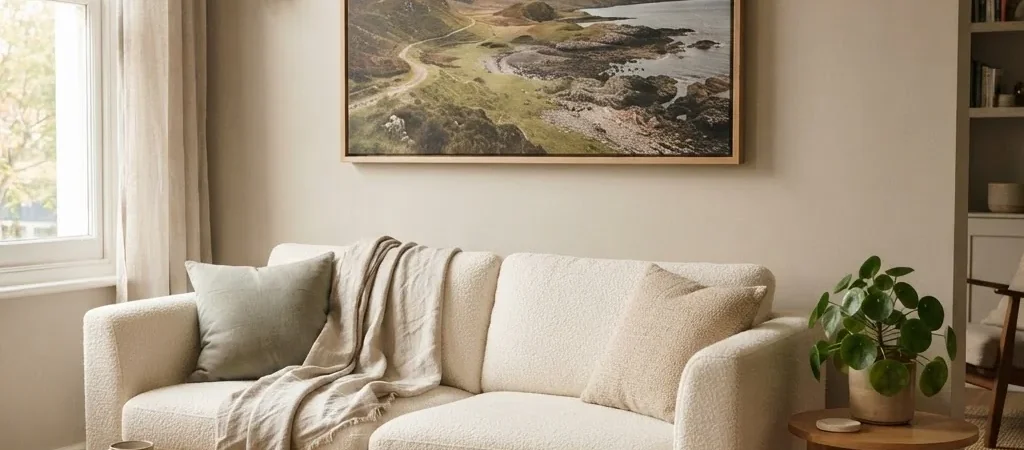
The short answer: Mpix is the best overall pick for print quality, CanvasDiscount is the strongest value for most buyers, and a handful of well-known names are not worth your money at any discount. But the real question isn’t just which site to use. It’s what to look for so you don’t end up with a canvas that arrives washed-out, warped, or completely different from what was on your screen.
I’m going to walk you through exactly what separates a good canvas print from a bad one, compare the sites worth considering, and give you the sizing guidance most people search for and never find. No hype, no fake “sale” cheerleading. Just the honest picture.
What Nobody Tells You About Custom Canvas Printing
Custom canvas prints are one of those product categories where the listing photo almost always looks better than what shows up at your door, at least from the wrong site. The reason isn’t magic. It comes down to five things: the canvas material, the ink type, the frame construction, the color calibration, and whether the site will make it right if something goes wrong. If a company is vague or silent on any of those five things, that’s your answer right there.
The other thing nobody says plainly enough: these are custom products. You can’t usually return them the way you’d return a lamp that didn’t work. That changes the stakes. Picking the right site before you upload your photo is worth more than any coupon code.
What Makes a Canvas Print Actually Good: The Five Things That Matter
Canvas material. Quality canvas uses a tightly woven poly-cotton blend or polyester fabric, typically rated at 360 gsm (grams per square meter) or heavier. That weight produces a dense, smooth surface that holds ink evenly and gives you the slightly textured, painterly look that makes canvas worth having in the first place. Cheaper canvas is thinner, under 280 gsm, loosely woven, and uneven. The ink sits inconsistently on the surface, and you can sometimes see the weave pattern at normal viewing distance. If a company doesn’t list their canvas weight anywhere on the site, that’s a flag.
Ink type. This is the most important variable, and it’s the one most buyers never think about. Quality canvas printers use archival pigment-based inks, sometimes called giclee inks, which resist fading for decades. According to independent testing by Wilhelm Imaging Research, cited by The Stackhouse Printery, quality pigment inks on archival canvas can achieve 100 or more years of display life under normal indoor conditions. Budget printers sometimes use dye-based inks, which look fine initially but can fade noticeably within one to two years, especially if the canvas is near a window. If a site mentions “vibrant colors” but doesn’t specify pigment or archival inks, ask. If they can’t answer clearly, shop elsewhere.
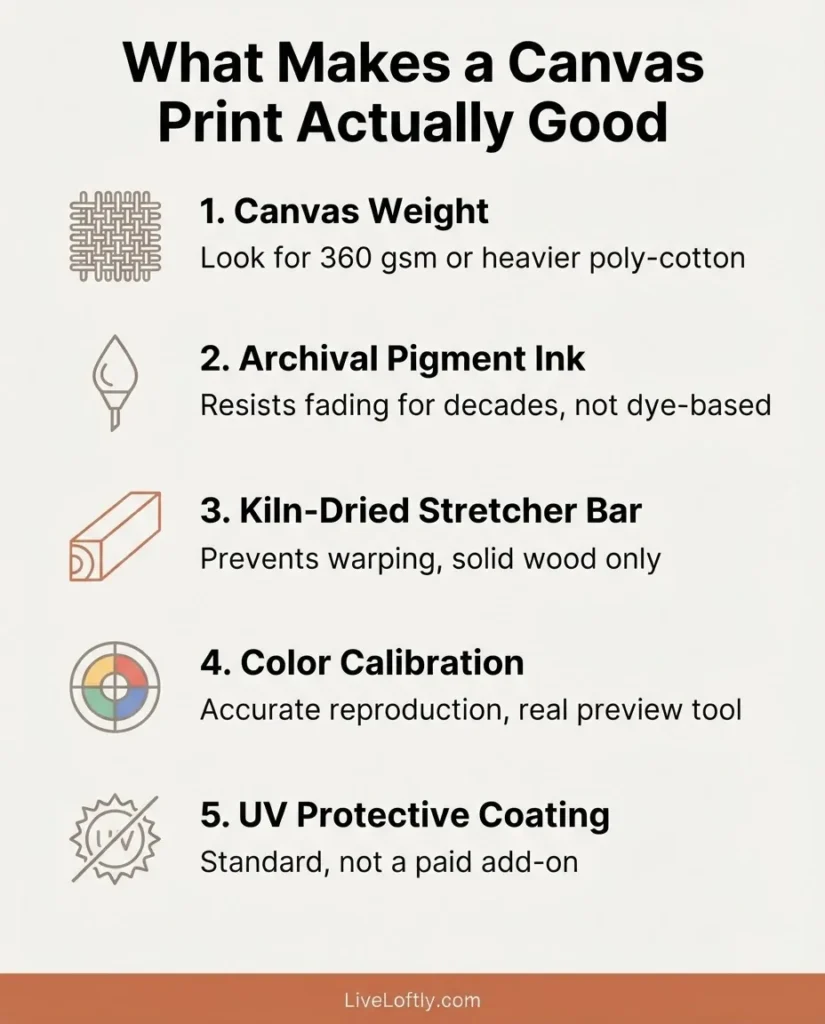
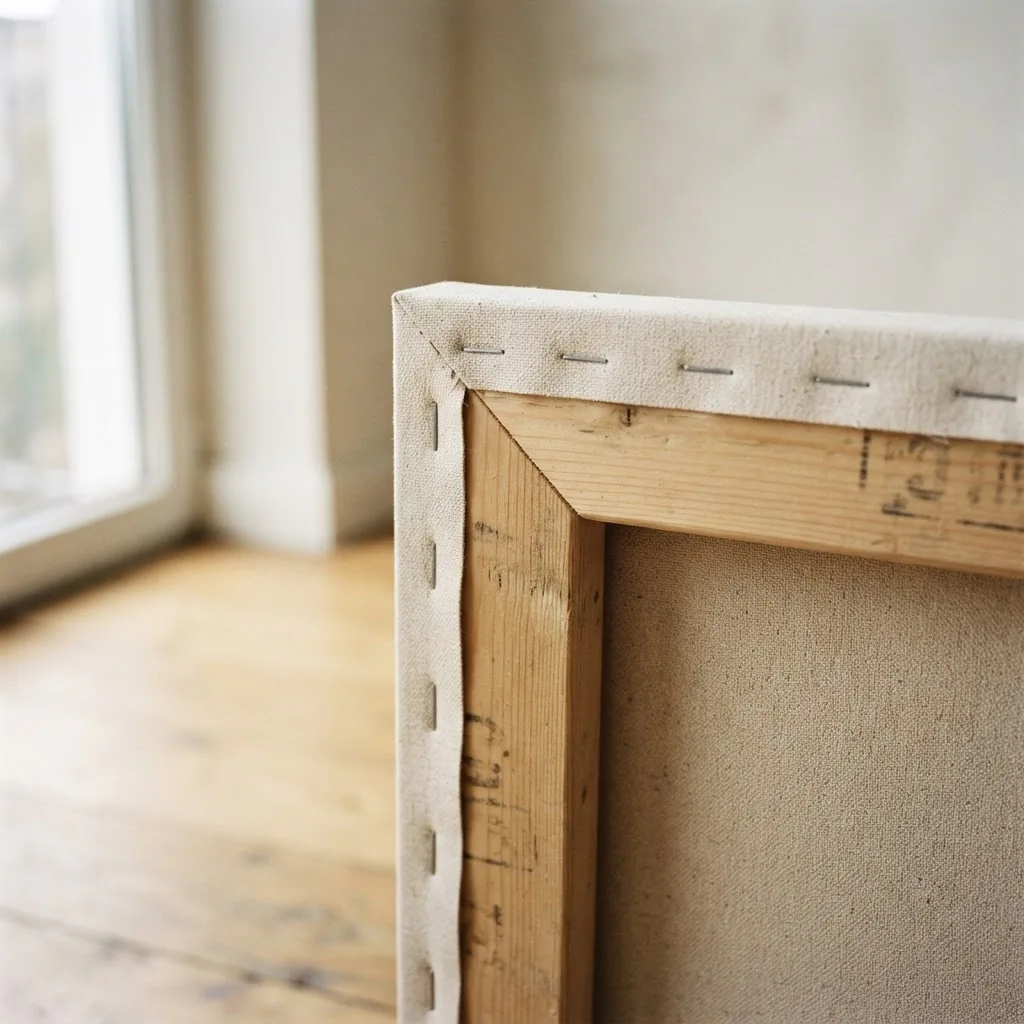
Stretcher frame. The wooden frame behind the canvas determines whether it stays flat and taut for years or starts to sag and warp within months. Quality frames use kiln-dried pine, fir, or basswood. Kiln-drying removes moisture from the wood, which is what prevents it from twisting as it ages. The standard bar depths you’ll see are 0.75 inch and 1.5 inch. According to The Stackhouse Printery’s guide on stretcher bar selection, canvases larger than 36 by 48 inches benefit from the deeper 1.5-inch bars and, for very large formats, a crossbar for additional structural support. Budget frames use green, undried wood or particleboard. Green wood warps as its moisture evaporates unevenly. Particleboard can’t hold staples well, so the canvas can eventually pull free from the frame.
Color calibration. A properly calibrated printer reproduces your photo accurately. Skin tones look right. Blues don’t shift purple. Shadows don’t collapse into solid black. Companies that take color calibration seriously mention it directly, offer a preview tool that shows you a real preview of your uploaded image, and often back it with some form of quality guarantee. Sites that skip calibration or offer no preview of your actual image are guessing, and you’re paying for the result.
Protective coating. A UV-resistant laminate or varnish applied after printing protects the ink from light, repels dust and moisture, and prevents minor scratches. Not every company includes this. Those that skip it are cutting a step that directly affects how long your canvas looks good. It should be standard, not an expensive add-on.
The Photo Question: Will Your Picture Actually Work?
Before you pick a site, look at the photo you plan to use. This is the step most people skip and then blame the printer for later.
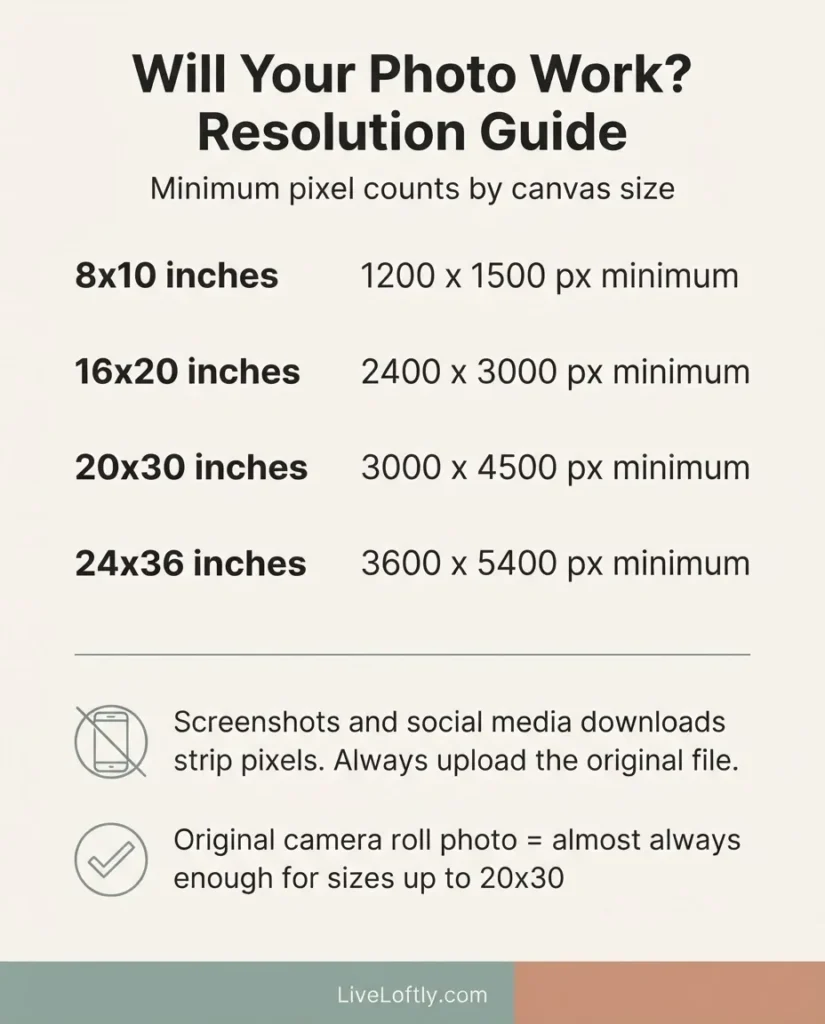
The minimum resolution for canvas printing is 150 DPI at the final print size. The standard is 300 DPI. For a 16×20 canvas, 150 DPI means you need at least 2,400 x 3,000 pixels. Most modern smartphones meet that easily when you use the original photo file from your camera roll. The problem comes when people upload a screenshot, a photo downloaded from social media, or a heavily cropped image. Compression and cropping strip out pixels. A photo that looks crisp on a 6-inch phone screen can look blurry and pixelated blown up to canvas size.
As a practical reference, CanvasPop’s resolution guide lays out the minimum pixel counts for each common canvas size, and it’s worth a quick check before you upload anything. The rule is straightforward: always upload the original file, not a screenshot, and not a copy you sent through text or downloaded from Instagram.
Photos taken in low light, heavily filtered, or with a lot of digital noise also tend to look worse on canvas than they do on screen. Canvas ink absorption and the slight texture of the surface both make noise more visible. If the photo looks soft on your desktop monitor, it will look softer on a 24×36 canvas.
What Size Canvas Should You Actually Order?
This is the question I see most often in comments and in search results, and it almost never gets a real answer. Here’s the practical version.
If you’re hanging a canvas above a piece of furniture, the widely used two-thirds rule works well: your canvas width should be roughly two-thirds the width of the furniture below it.
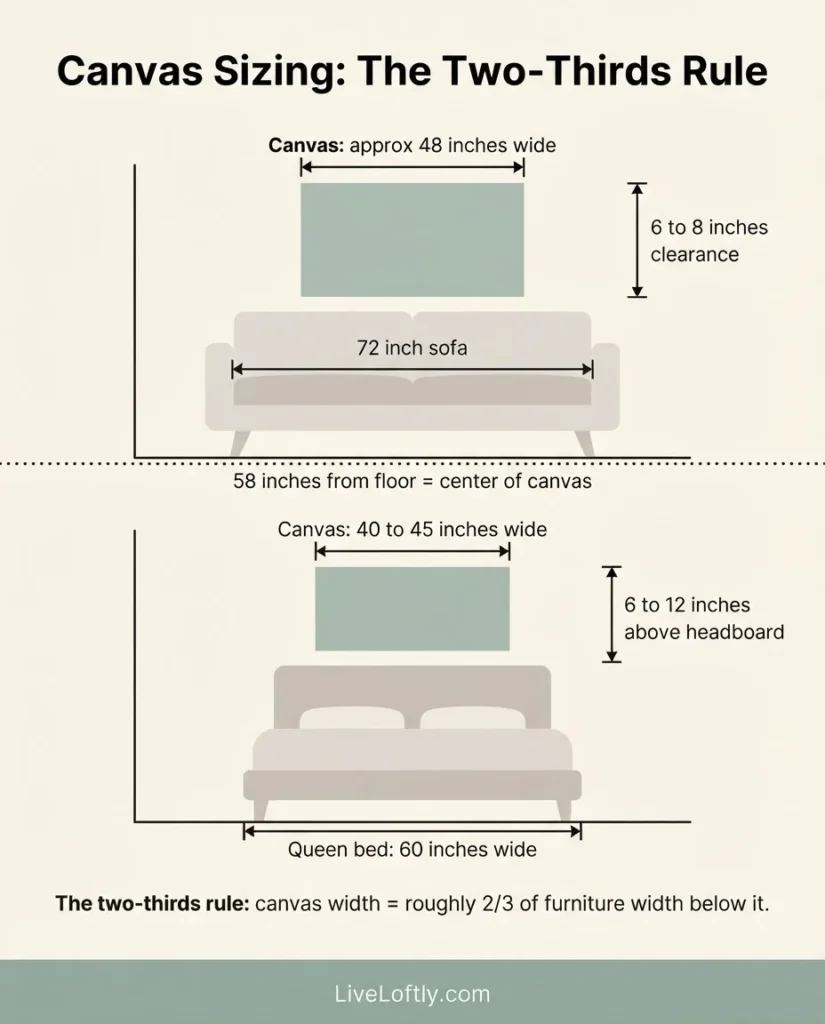
A 72-inch sofa needs about 48 inches of art. A 96-inch sectional can handle 60-plus inches. A queen bed is typically 60 inches wide, so a canvas in the 40 to 45-inch wide range fits well above the headboard. The Nations Photo Lab wall art size guide goes further and gives a formula for calculating the right height too, and it’s worth bookmarking.
The standard guidance on hanging height is that the center of the piece should sit about 58 inches from the floor, which is roughly eye level. If you’re hanging above furniture, aim for 6 to 12 inches of clearance between the top of the furniture and the bottom of the canvas.
For empty walls with no furniture anchor, a canvas should take up roughly 60 to 75 percent of the wall width. Going smaller tends to look lost.
Specific sizing benchmarks that work for most rooms:
- A single canvas for above a full or queen bed: 30×40 or 24×36
- Above a standard sofa (72 inches): 20×30 or 24×36
- A statement piece for a large empty wall: 30×40 or 40×60
- A nightstand or shelf display: 8×10 or 11×14
- A gallery wall anchor piece paired with smaller prints: 16×20 or 20×24
Understanding Edge Wrap Options (This Trips People Up)
Every canvas print site will ask you to choose how the edges of the frame are handled, and most beginners have no idea what the options actually look like. Here’s the plain-English version.
A gallery wrap extends your actual photo onto the sides of the frame. The image continues around the edges, which looks clean and finished, but it means a small strip of your photo gets wrapped out of the front-facing view. If you have faces or important details close to the edges of your photo, some of that will disappear around the corner.
A mirror wrap takes the outer edge of your photo and mirrors it onto the sides. The front face of your photo stays completely intact. If your image has a lot of detail or complexity near the edges, mirror wrap protects it.
A color wrap fills the frame sides with a solid color, typically black or white. It’s the simplest option and looks clean from the front, though less gallery-like from the side.
For most family photos and portraits, mirror wrap is the safest choice if you’re not sure.
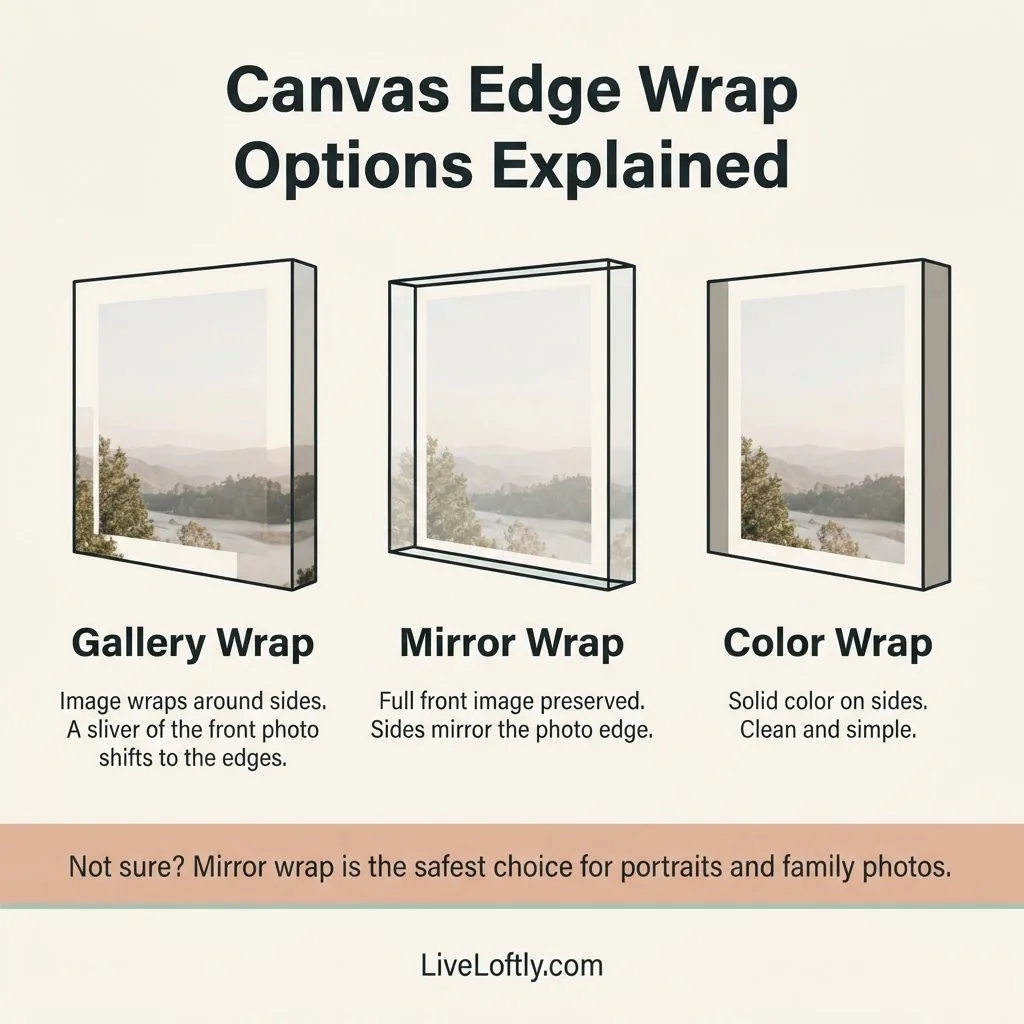
Gallery wrap works well for landscape photos and images where the edges have open sky, water, or simple backgrounds with no detail to lose.
The Sites Worth Considering: Honest Site-by-Site Breakdown
These are the sites that consistently come up in serious buyer research, across photography forums, independent shootout reviews, and verified customer review platforms like Trustpilot. I’m not including every brand in existence. I’m including the ones with enough track record to form an honest opinion.
Mpix
Mpix is based in Pittsburg, Kansas, and it is the standard recommendation among photographers who need accurate, consistent color. Their canvas uses a poly-cotton blend with no optical brighteners (OBAs are additives that can make whites look artificially bright and then yellower as they fade), and they use a giclee printing process with a 100-plus year display life claim. Their 1.5-inch wood stretcher frame is standard across all sizes. The quality guarantee is solid: contact them within 30 days of your order and they will reprint it free of charge if you’re not satisfied with the quality. The caveat is that they note they cannot be responsible for poor image quality from inadequate resolution or improper exposure, which is fair.
The honest limitation: Mpix sits at the premium end of the price range. Starting prices for canvas prints are higher than most of the other sites here, which puts it out of reach for budget buyers who are ordering several prints at once. If you’re ordering one special piece and color accuracy matters to you, the premium is justified. If you’re ordering five prints to fill a gallery wall on a tight budget, Mpix may not be the right fit.
Mpix canvas prints start here if you want to review their full size range and specs directly.

- Canvas Prints with Your Photos: Turn your favorite photos into beautiful custom canvas wall art. Whether it’s a family p…
- High-quality Canvas Prints: This custom poster is crafted using high-quality canvas material and advanced HD printing te…
- Made in USA: Our personalized canvas painting is proudly crafted in the USA using premium materials and professional cra…
CanvasDiscount
CanvasDiscount is the strongest value pick for most buyers. They produce in the US, use HP Latex certified canvas and solvent-free HP Latex inks (which are pigment-based and UV-resistant), and back every order with a 100% money-back guarantee. Their Trustpilot score is high across a very large review base, which is a more meaningful signal than a high score on 50 reviews.
The thing to understand about their pricing: the listed “sale” price is effectively their real price. The “original” price they show crossed out is marketing framing. You are not getting 85% off of anything. But the actual price you pay is genuinely competitive, and the quality-per-dollar is strong. Don’t let the perpetual “sale” banner put you off, but don’t let it convince you you’re getting a steal either. You’re getting a fair price for solid work.
CanvasChamp
CanvasChamp’s real strength is breadth. If you need an unusual shape, a very large format, or a custom size not available elsewhere, they offer more options than most competitors. Their satisfaction guarantee requires contact within 7 days of delivery for issues, which is a tighter window than Mpix’s 30 days, so if you’re ordering for a deadline or a gift, build in time to inspect the order before the window closes.
The honest caution here: their customer review scores on independent platforms are lower than CanvasDiscount and Mpix, and some Reddit threads document inconsistent results, particularly with color accuracy on complex photos. If you’re using them, I’d strongly recommend uploading a simple, high-contrast photo for your first order to benchmark the quality before ordering anything that really matters.
Nations Photo Lab
Nations Photo Lab sits in the mid-to-premium range and prints on archival-quality, museum-grade cotton canvas. Their color consistency is well-regarded among photographers who use them for client work. For a buyer who wants something between Mpix’s price point and the budget end, NPL is a legitimate option worth considering. Their size range covers 8×10 up to 30×40 in their standard canvas line.
EasyCanvasPrints
EasyCanvasPrints is a fast-turnaround option. They advertise fulfillment within 24 business hours, which matters if you’re ordering for a birthday, holiday, or event and can’t wait two weeks. Print quality is generally described positively by buyers, with museum-grade canvas and ready-to-hang hardware included. The review base is smaller than CanvasDiscount, so there’s less data to form a confident opinion, but the track record that does exist is largely positive.
Sites Worth Skipping
Snapfish earns a consistent “disappointing” pattern on Trustpilot, with recurring complaints about blurry prints, color shifts, and poor customer service response. The pricing is low, but the results at the budget end do not justify the risk given the no-return nature of custom products.
Any site advertising genuinely shocking discounts, 90-plus percent off with no clear business model to support it, is worth serious caution. When the price seems too good to be real, check whether the site has verifiable reviews on a third-party platform (not just on their own homepage), a physical address, and a real customer service channel. The Reddit thread history on certain sites in this space is grim.

- Personalized Custom Canvas Prints designed to display your photos with clear detail and vibrant color. Perfect as photo …
- Custom Photo Gifts for special occasions. Turn your favorite memories into meaningful canvas prints for Christmas, Mothe…
- Ideal for pet portraits, family photos, wedding pictures and travel memories. These customized canvas prints fit natural…
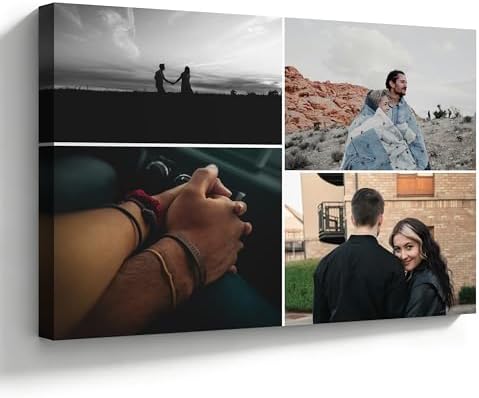
- Custom Canvas Prints with Your Photos: Turn Your Memory into Art in Minutes. Click “Customize Now” to begin. Choose from…
- HD Printing & Modern Gallery Wrap: Your image is professionally enhanced and printed with fade-resistant inks for vibran…
- Solid Wood Frame & Ready to Hang: Each custom canvas print is hand-stretched over a sturdy, 1.5-inch deep, warp-resistan…

- This product is printed and mounted entirely in the United States, ensuring not only exceptional craftsmanship but also …
- We utilize premium canvas and professional UV-resistant ink, combined with gallery-style deep-edge mounting techniques. …
- We offer a variety of sizes and frame colors for you to choose from, helping you precisely customize the perfect artisti…
The Return Risk Nobody Talks About
I want to be direct about something that most roundups skip. Custom canvas prints are not returnable the same way a throw pillow or a lamp is. You uploaded your photo, they made a one-off product. Most legitimate sites will not accept a return simply because you changed your mind or ordered the wrong size.
What they should do, and what the better sites do, is reprint or refund if the print quality is defective, if the colors are badly off, or if it arrived damaged. Mpix will reprint within 30 days for quality issues. CanvasDiscount has a money-back guarantee for quality concerns. CanvasChamp asks you to contact within 7 days of delivery.
The practical protection here is simple: before you order anything, scroll to the bottom of the site and find the return or satisfaction guarantee page. If you can’t find one easily, or if it says something vague about “we aim to satisfy,” that’s your answer. Put your money somewhere with a written commitment.
The second layer of protection is your photo. If you upload a low-resolution image and it prints blurry, the site is not at fault.
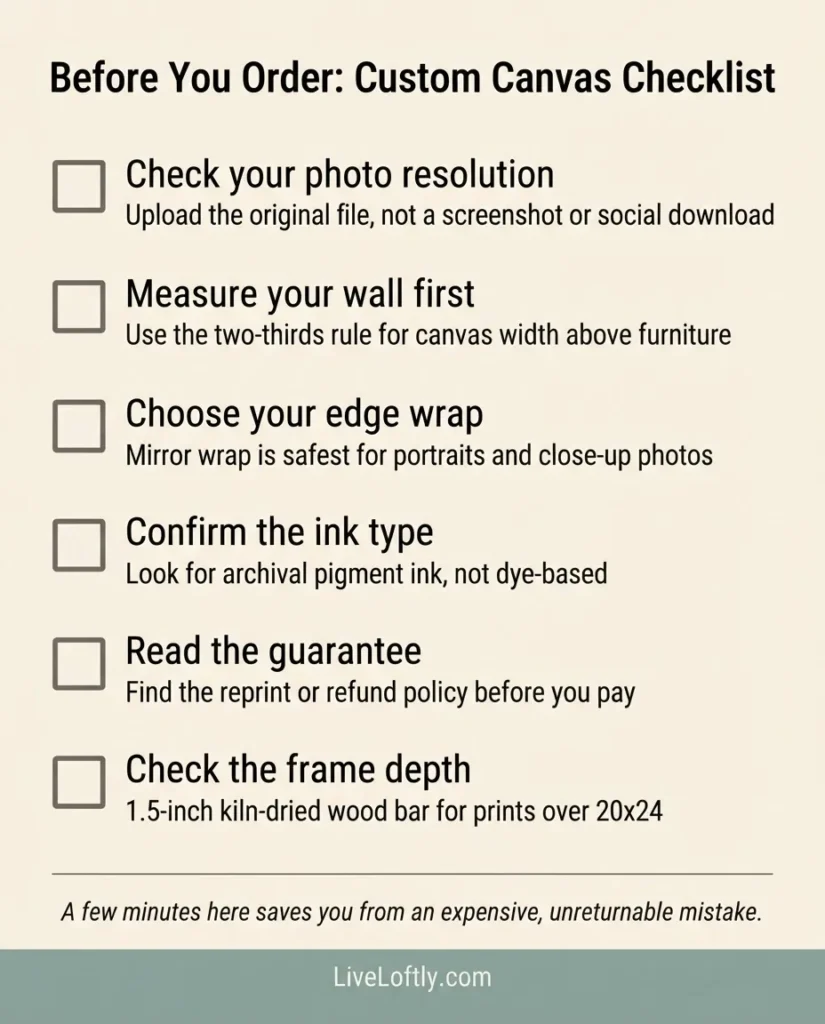
They’ll tell you exactly that, and they’ll be right. Check your file before you click buy.
What About Longevity and Care?
A canvas printed with archival pigment inks and a UV-resistant coating should look good for decades under normal indoor conditions. The caveat is “normal indoor conditions.” Direct sunlight is the enemy. A canvas in front of a south-facing window with afternoon sun will fade faster than the same canvas in a hallway. If your wall gets a lot of direct sun, either hang something else there, frame the canvas behind UV-protective glazing, or accept that you’ll notice color shift over the years.
High-humidity rooms are also a problem. Canvas stretched over wood frames does not belong in a bathroom or above a stove. Wood and humidity are a slow disaster. The canvas stays fine, but the frame warps, and a warped frame creates visible waviness across the print surface that can’t be undone.
For care, a soft dry cloth or a gentle dusting brush is all you need. No cleaning sprays, no damp cloths, no products. The canvas surface is printed, not painted over, so anything that penetrates will affect the ink.
Quick Summary Table: How the Top Sites Compare
| Site | Ink Type | Canvas Quality | Price Tier | Quality Guarantee | Best For |
| Mpix | Archival pigment, giclee | Poly-cotton, no OBAs | Premium | Free reprint within 30 days | Color accuracy, one special print |
| CanvasDiscount | HP Latex pigment (UV-resistant) | HP certified canvas | Budget-friendly | 100% money-back | Value across multiple prints |
| Nations Photo Lab | Archival pigment | Museum-grade cotton | Mid-range | Satisfaction guarantee | Mid-range quality, photographer-grade |
| CanvasChamp | Eco-friendly inks | Premium-grade canvas | Budget | 7-day window | Unusual sizes, custom shapes |
| EasyCanvasPrints | Museum-grade stated | Museum-grade stated | Mid | Satisfaction guarantee | Speed, fast turnaround |
| Snapfish | Not specified | Not specified | Budget | Limited | Skip it |
FAQ: Questions People Actually Ask Before Ordering
What is the best custom canvas print site overall?
For most buyers who want reliable quality without a professional lab price, CanvasDiscount is the best all-around value. For buyers who want the highest color accuracy and are willing to pay a premium, Mpix is the stronger choice. Both use archival pigment inks, quality canvas, and solid wood stretcher frames, and both have real satisfaction guarantees.
What size canvas print should I get for above my sofa?
For a standard 72-inch sofa, aim for a canvas width around 48 inches. A 20×30 or 24×36 are practical sizes that work well for this placement. Hang the bottom edge roughly 6 to 8 inches above the sofa back, with the center of the canvas around eye level.
Can I print a phone photo on canvas?
Yes, as long as you use the original file from your camera roll, not a screenshot or a downloaded copy. Most modern smartphone cameras produce photos with more than enough resolution for canvas prints up to 16×20 or even 20×30. For larger sizes, check the pixel dimensions of your photo before ordering.
Why are some canvas print sites always “90% off”?
The perpetual sale model is a standard pricing strategy in this category. The sites that do this use inflated “original” prices to make the current price look like a deal. The actual price you pay is typically their real market price. It’s not a scam, but it’s not a real sale either. Judge the price on what you’re actually paying, not on what a crossed-out number says.
What does “gallery wrap” mean on a canvas print?
Gallery wrap means the printed image extends around and wraps over the sides of the wooden frame. The result is a finished look on all four sides with no visible frame, so the canvas can hang with or without an additional frame around it. It’s the most common style for home display and the one you’ll want for most photos.