
Canvas prints are ready to hang with no frame needed, while poster prints need a frame to look finished, which means the real comparison is never canvas vs a bare poster, it is canvas vs poster-plus-frame. Once you factor in the cost of a decent frame, the price gap between the two closes fast. Which one wins depends on your budget, your wall, and how long you need it to last.
I get this question a lot, because on the surface it looks obvious: the canvas is more expensive, so it must be better. But that is not always how it plays out once you are actually holding the thing in your apartment. Some canvas prints genuinely look great and hold up for years. Others look plasticky, warp at the corners, or fade within a few years because the seller used cheap ink. And some framed posters look sharp, crisp, and completely polished for a fraction of the total cost. The “is this actually worth it” test applies to both.
Here is how to sort them out.
What You Are Actually Comparing:
Before getting into quality and cost, it helps to get the terminology straight, because the wall art market uses these words loosely.
A canvas print is an image printed directly onto a woven fabric (canvas), which is then stretched and stapled around a wooden frame called a stretcher bar. It arrives ready to hang, no frame required. The image wraps around the sides, giving it a three-dimensional depth. Most retail canvas prints use a poly-cotton blended canvas substrate, while higher-end prints use 100% cotton canvas, which absorbs ink more evenly and tends to reproduce detail better.
A poster print is an image printed on paper, typically on a flat, unframed sheet. It does nothing on its own on your wall. A bare poster pinned to the wall is a dorm room move that looks temporary regardless of how good the image is. To look like finished wall decor, a poster needs a frame. Once it is in a frame, though, it can look every bit as polished as a canvas, and sometimes sharper.
A third term you will see is giclée print, which refers to high-quality fine art prints made with archival pigment inks on premium paper or canvas. It is a process description, not a product category. A giclée can be printed on paper (making it a fine art poster/print) or on canvas. When a listing says “giclée canvas print,” that is a quality signal worth noting.
The Quality Signals That Actually Matter:
Ink type is the single biggest durability factor. This is where a lot of buyers get burned, and it is rarely explained well in listings.
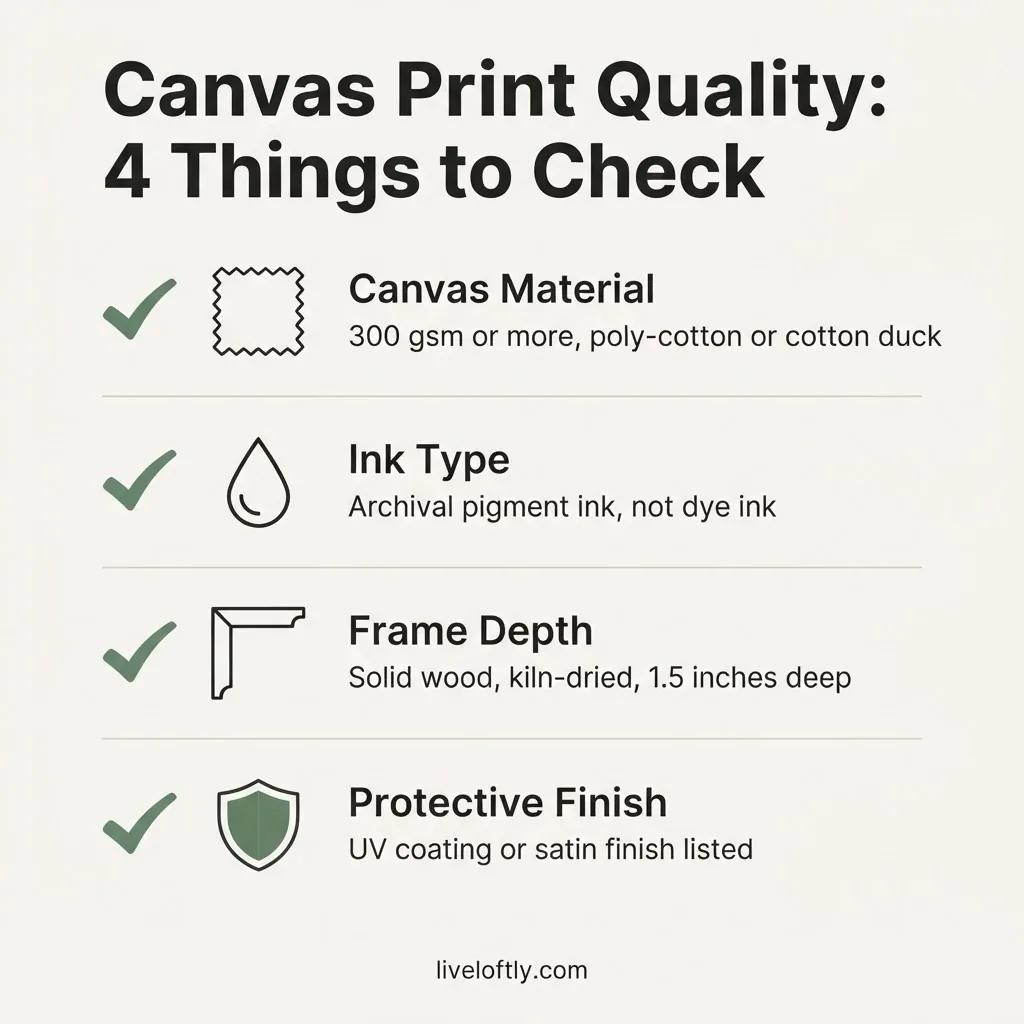
Canvas and poster prints can be made with two types of ink: dye-based or pigment-based. Dye-based inks dissolve entirely into the paper or canvas fiber. They produce vivid, saturated colors, and they are cheap to produce. The catch is longevity. As Red River Paper, a specialist in art and photo printing papers, explains, dye-based inks are prone to fading in a shorter time frame and are not recommended for prints you want to look good for more than 25 years. In direct sunlight or even bright indirect light, cheap dye-ink canvas prints can start showing visible fade within 2 to 10 years. Archival pigment inks, by contrast, use solid color particles suspended in a liquid carrier. They are far more light-stable, and quality prints made with them are rated to resist noticeable fading for 75 years or more under normal indoor conditions.
When you are reading a listing, look for the words “archival,” “pigment ink,” or “giclée.” If the listing only says “fade-resistant” without specifying the ink type, that is not a reliable claim. If it says nothing about ink at all, assume dye-based and price your expectations accordingly.
The same principle applies to poster prints. A cheap poster printed on thin paper with dye inks will yellow and fade. A high-quality art print on heavy stock with archival pigment inks can genuinely last a very long time, especially behind UV-protective glass or acrylic in a frame.
Canvas substrate and stretcher bar depth matter for how the piece holds up physically. Budget canvas prints often use a 0.75-inch thin-profile stretcher bar. At small sizes that is fine, but for anything 16×20 or larger, a thin stretcher bar can warp or sag over time, especially in rooms with humidity swings. The standard gallery-depth canvas uses a 1.5-inch stretcher bar, which is significantly more rigid. You will see this listed as “1.5-inch gallery wrap” or “gallery depth” in better listings. It also looks better on the wall because it has a real presence and the image wraps convincingly around the sides.
If a listing does not mention the stretcher bar depth or calls it a “thin wrap,” that is a flag, especially at larger sizes.
For poster prints, paper weight (GSM) is the quality signal equivalent to stretcher bar depth. GSM stands for grams per square meter, and it is the standard measure of paper thickness and density. As Digital Printing UK’s paper weight reference guide explains, papers in the 130-170 GSM range are typical for standard posters; heavier art papers run 200-300+ GSM and feel noticeably more substantial and premium. A thin, lightweight poster (under 120 GSM) will wrinkle easily when handled, show through on the back in a thin frame, and feel flimsy. When a poster listing mentions “heavyweight,” “premium matte,” or gives a specific GSM number over 170, that is a good sign.
The Real Cost Comparison:
This is the part most guides skip, and it changes the calculation completely.
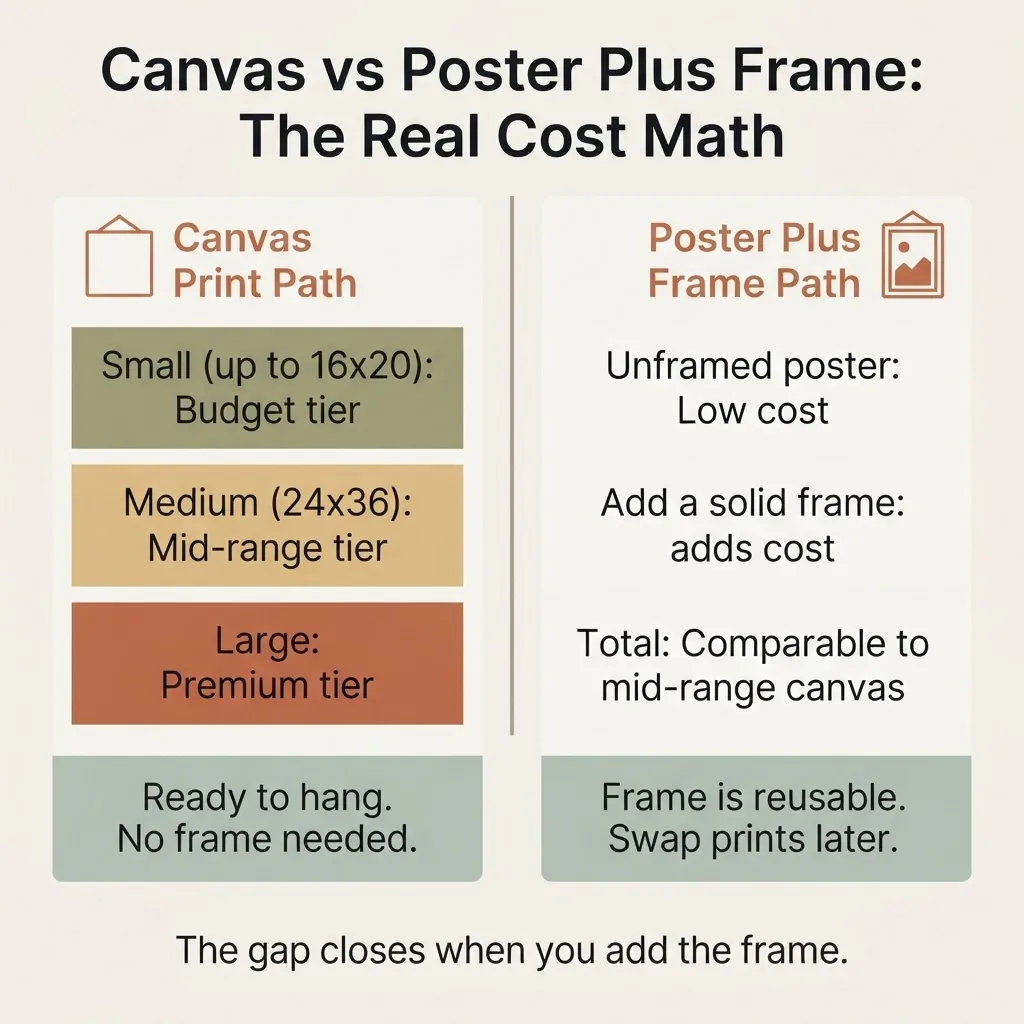
A bare canvas print at mid-range quality for a 16×20 size runs in the budget-to-mid-range tier. A 24×36 canvas steps up from there. That price includes the stretcher bar and hardware. It is ready to hang.
An unframed poster for the same size costs considerably less, often a fraction of the canvas price. But it needs a frame. A decent 18×24 frame from a reliable brand runs in the lower price tier. A solid 24×36 frame costs more. So the total cost of a framed poster lands closer to the canvas price than the bare poster price suggests.
Here is the honest math: if you buy a cheap frame to go with the poster, you often end up with something that looks worse than a mid-range canvas. If you buy a quality frame, you might spend similar to or more than a canvas, but you often get a sharper image and more flexibility (you can swap the print later). The canvas wins on simplicity and has a slightly warmer, more tactile presence. The framed poster wins on image sharpness, flexibility, and the ability to upgrade the print later without buying a whole new piece.
Neither one is automatically the better value. It depends on what size you need, what you want it to look like, and whether you will keep it long-term or swap it out.


What Canvas Does Better:
Canvas wins in a few specific situations, and they are worth knowing clearly.
It is genuinely easier to hang. It comes with hardware, it does not need a frame, and for most standard-weight canvas prints you can use Command Large or Heavyweight Picture Hanging Strips from 3M without putting a nail in the wall. The 3M Command weight limits page confirms their 15 lb Heavyweight strips hold frames up to 24×36 inches and up to 15 lbs. Most mid-size canvas prints (16×20 and under) are well under 4 lbs. That is a genuine win for renters.
The texture and depth of a canvas print also read differently on a wall than a flat print under glass. From a distance, especially with abstract or painterly images, a canvas has a visual warmth that a flat print can’t fully replicate. If the image you love has brushstroke detail or was originally a painting, canvas often suits it better.
Canvas also handles bright-light rooms better in one specific way: there is no glass or acrylic surface to create glare.

A glossy-finish poster behind standard glass in a room with a window behind you can reflect light in a way that makes the image hard to see. Canvas has no reflective surface.
What Poster Prints Do Better:
For photographs, detailed artwork, and anything with fine line work or text, a poster print on quality paper typically reproduces more sharply than a canvas. Canvas has a physical texture, and on highly detailed images, that texture can soften fine lines. A high-quality photo printed on premium luster or matte paper behind acrylic glazing can look stunning, and often sharper than the same image printed on canvas.
Poster prints are also easier to swap. If you change your mind about the image, you take the print out and put a new one in. The frame stays. This makes posters a smarter buy if you are in a “figuring out my taste” phase, which is exactly where a lot of first-apartment people are.
The variety of standard poster sizes also works in your favor. As Frame Destination’s guide to standard poster sizes notes, the most common standard sizes are 18×24, 24×36, and 27×40 inches. Frames for these sizes are widely available, competitively priced, and easy to find. Canvas prints, by contrast, come in sometimes nonstandard dimensions that make framing them (if you ever want to) difficult or custom-priced.
The Framing Path: What Makes a Good Poster Frame
If you go the poster-plus-frame route, the frame matters more than most people realize.
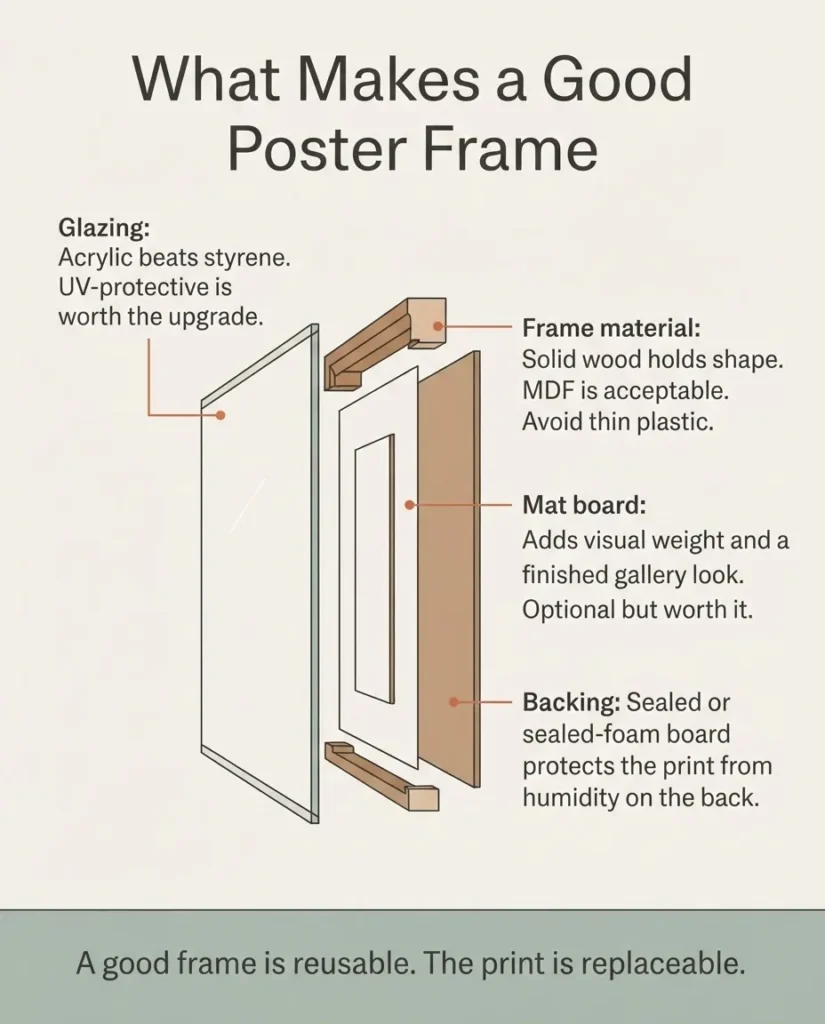
The things worth spending on in a frame: the glazing (the front panel) and the material. Cheap frames use styrene or thin acrylic, which scratches easily and can yellow over time. Mid-range frames use heavier acrylic or real glass. UV-protective glass or acrylic is worth the small upcharge if you are hanging art in a room with natural light, because it significantly slows fading in the print.

- Size: 24×36 Poster frame for 18×24″ picture with mat. Overall dimension is 24.8×36.8 inch, back opening size is 24×36 in…
- Solid Wood: 24×36″ Natural Wood textured frames 2 Pack 100% made of pine wood with transparent plexiglass front that pre…
- Use and Display: Comes with hanging hardware for hassle-free display in both horizontal and vertical formats to hang fla…
Frame material is the other variable. MDF or engineered wood frames are common, functional, and look fine in most settings. Solid wood frames at the same price point feel more substantial and are less likely to warp. For a large format like 24×36, Frame Destination’s guide to frame and mat dimensions is a useful reference for getting the right mat overlap and frame fit so the print does not move around inside.
What to Actually Look For in a Canvas Print Listing
I have bought enough stuff online to know that listings for canvas prints can be wildly misleading, mostly by omission. Here is what to look for before adding one to your cart.
Ink type: look for “archival pigment ink,” “giclée,” or “archival.” If the listing does not mention ink type at all, that is a red flag. The difference between pigment and dye inks is significant for longevity. As The Ugly Cat Studio’s breakdown of archival vs dye-based inks explains clearly, archival pigment inks use solid color particles that resist fading for decades, while dye-based inks dissolve into the substrate and break down over time under light exposure.
Wrap depth: look for “1.5-inch gallery wrap” or “1.5-inch depth.” Avoid “thin wrap” or “0.75-inch” for anything bigger than 11×14.
Canvas material: “poly-cotton blend” is acceptable and very common at mid-range prices. “100% cotton canvas” is the premium tier. Either is fine for home decor. Pure polyester canvas at the cheapest end tends to look a bit plasticky and does not absorb ink as evenly.
UV protective coating: a good canvas print listing will mention a UV-resistant varnish or coating applied over the print. This slows fading significantly. If it is not mentioned, the print is probably uncoated.
Ready to hang hardware: most decent canvas prints include pre-installed hanging hardware on the back. Check that it is listed, because some ultra-budget prints ship with nothing.
Canvas in Humid Rooms: The Bathroom and Kitchen Question
One question that comes up more than you would think: can I hang a canvas print in my bathroom or kitchen?
The honest answer is: with care, yes, but with conditions. Canvas is a fabric stretched over wood. Both of those materials respond to humidity. In a bathroom with good ventilation, a canvas print placed away from direct steam and moisture exposure is generally fine for years. In a poorly ventilated bathroom with a lot of steam from long showers, the canvas can loosen and sag, and the wood stretcher bars can absorb moisture, warp, and buckle over time.
For a kitchen hung away from the stovetop and sink, the risk is lower. For a bathroom, the safer call is a framed poster with acrylic (not glass) glazing and a sealed frame, because the sealed environment protects the paper from humidity fluctuations, and acrylic is lighter and shatterproof if something falls.
The Honest Skip-It Calls
A buying guide that never tells you what to skip is not a buying guide. Here are the cases where I would not bother:
Skip cheap canvas prints without listed ink type or wrap depth. If a listing cannot tell you what kind of ink was used or how deep the stretcher bar is, it is probably a cheap dye-ink print on a thin stretcher that will look mediocre and fade within a few years. The listing photo will look great. The thing on your wall probably will not.
Skip large-format canvases (24×36 and up) with 0.75-inch thin stretchers. At that size and in a real living environment with any humidity, thin stretchers can warp. The canvas goes slack. It is an expensive problem to fix.
Skip glossy poster prints for rooms with direct or bright indirect light. Glossy posters look punchy in a dark room or in listing photos. In a bright room facing a window, the glare is distracting. Matte or luster finishes read better in real home lighting.
Skip a canvas print if you are not sure about the image.
Canvas prints are harder to return than flat items. Shipping a stretched canvas back is awkward, and some sellers have restocking fees on custom orders. If you are genuinely unsure about the image, buy a framed poster first. Swap it out for a canvas once you know you love it in that spot.
Sizing and Fit: Getting the Scale Right
This part trips people up regularly, and it has nothing to do with canvas vs poster specifically. It applies to both.
The wall space available determines the print size. A piece that looks large in the listing photo may disappear on a real wall if the listing is showing it against a small prop surface. Before you order anything, measure your wall space. For a single piece above a sofa (typically 72-84 inches wide), the art should be roughly two-thirds the width of the sofa. For a single piece above a console table or dresser, aim for roughly half to two-thirds the width of the furniture below it.
Standard poster sizes fit standard frames without mats, or with mats at the next standard size up.
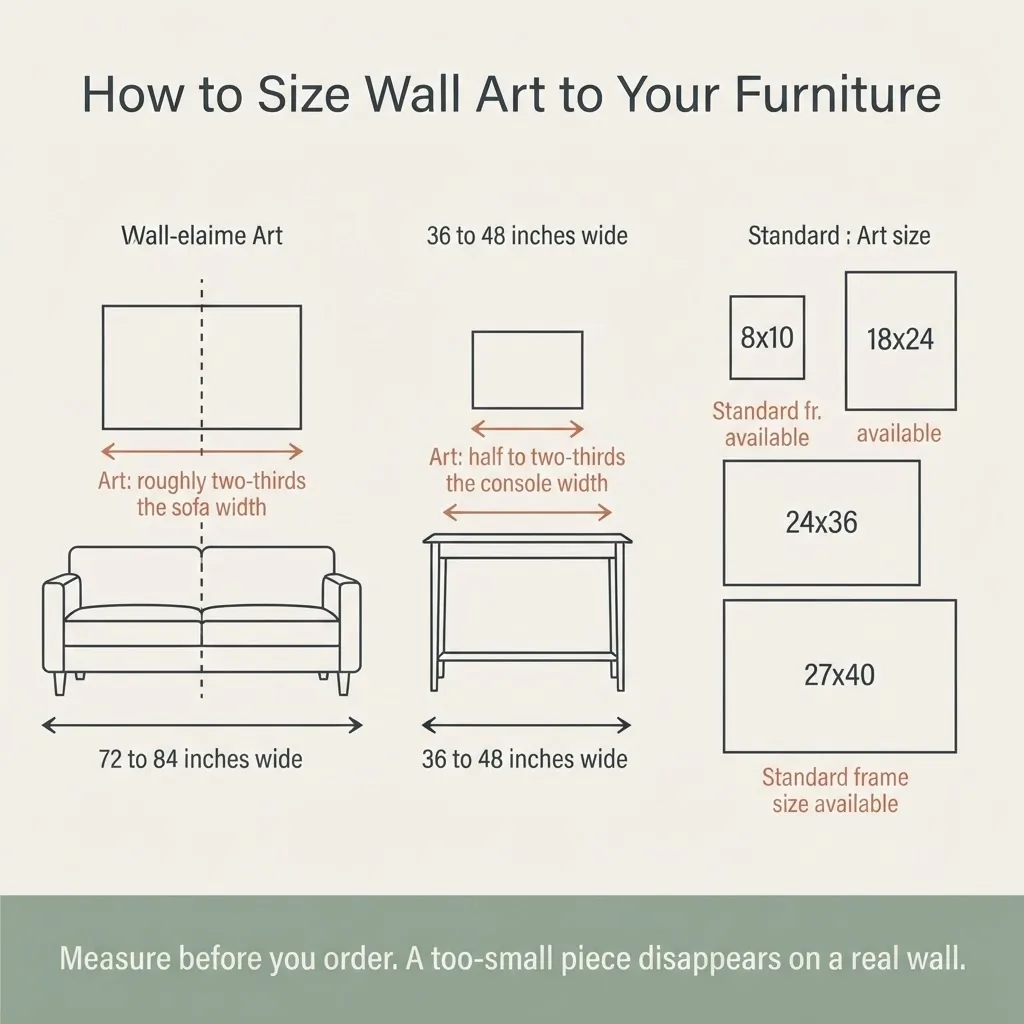
An 18×24 poster fits an 18×24 frame with no mat, or an 22×28 frame with a mat. A 16×20 print fits a 16×20 frame or a 20×24 frame with a mat. Mats add visual weight and a more finished, gallery-style look. For canvas prints, the dimensions you see in the listing are the canvas face dimensions. The piece will protrude from the wall by the depth of the stretcher (0.75 or 1.5 inches), which looks intentional and finished.
Canvas vs Poster Prints: Quick Decision Guide
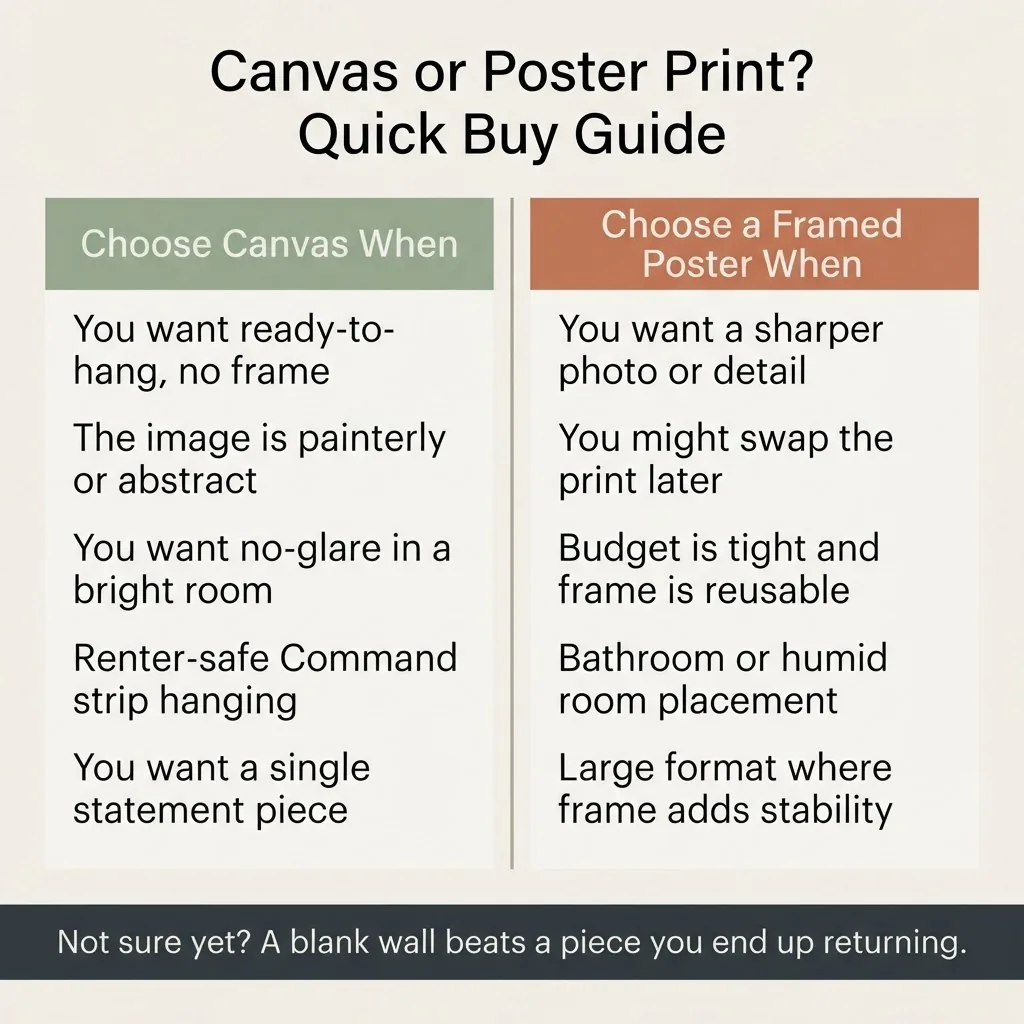
Choose a canvas print if: you want something ready to hang, you want a warm, tactile, no-glare look, the image is painterly or abstract, or you want a single larger piece that makes a statement with no assembly required.
Choose a poster print (with a good frame) if: you want a sharper image for photography or detailed art, you want flexibility to swap prints later, you are on a tight budget and want a quality frame you can reuse, you are in a renter situation worried about nail holes and heavy weights, or you want a piece for a humid room like a bathroom.
Skip both and buy nothing if: you are not sure about the image yet. A blank wall beats a piece you end up hating.
- GALLERY WRAP: Our gallery wrapped canvas prints are made of high-quality cotton poly blended canvas, printed to perfecti…
- ELEGANT HOME DECOR: Enhance the look and feel of your home decorations with our canvas prints wall art. Our exquisite di…
- QUALITY PRINTING: Each canvas wall art we produce is digitally printed with the newest technology which makes them highl…
FAQ
Is a canvas print better quality than a poster print?
Not automatically. Quality depends on ink type and substrate, not just format. A cheap canvas print with dye-based ink on a thin stretcher will look and last worse than a quality poster print with archival pigment ink on premium paper in a solid frame. Check the ink type and materials in the listing, not just the format.
How long do canvas prints last before fading?
A canvas print made with archival pigment inks can last 75 or more years without noticeable fading under normal indoor conditions. Canvas prints made with cheaper dye-based inks can begin fading visibly in as few as 2 to 10 years, particularly in direct sunlight or bright rooms. The ink type is the most important factor in longevity, not the canvas itself.
Is canvas or poster print better for a renter?
For renters who need to avoid wall damage, lighter canvas prints (under 4 lbs for sizes up to 16×20) can hang on Command strips without nails. Larger canvases may need a nail or heavier-duty adhesive. Framed posters behind lightweight acrylic are often a better renter choice for large formats because acrylic glazing weighs less than glass and reduces hanging risk.
What is the cheapest way to get good-looking wall art?
The cheapest path to a polished result is usually an unframed poster on quality paper (170+ GSM, archival ink) in a solid, simple frame at a standard size (18×24 or 24×36). The print costs little, and a reliable frame at those standard sizes is competitively priced. Total cost often lands well below a comparable-quality ready-made canvas.
Can you hang a canvas print in a bathroom?
In a well-ventilated bathroom, a canvas print placed away from direct steam and moisture exposure will generally hold up fine. In a poorly ventilated bathroom with significant steam, the canvas and wood stretcher bars are susceptible to warping and loosening over time. For high-humidity bathrooms, a framed poster with acrylic (not glass) glazing in a sealed frame is a more durable choice.