
if you rent, move often, or just want something low-commitment on your walls, peel and stick art is a solid option as long as you buy the right product and understand what it can and can’t do. If you plan to stay put for a while, want something that holds up over years, and are willing to deal with the hanging question, framed wall art is going to give you more for your money long-term. The tricky part is that neither one is universally better. It really comes down to your walls, your lease, and how long you plan to keep it.
Let me walk you through both options honestly, without the hype.
What We’re Actually Comparing Here
Before getting into pros and cons, it helps to be clear about what falls under each category, because both terms cover a wider range of products than people expect.
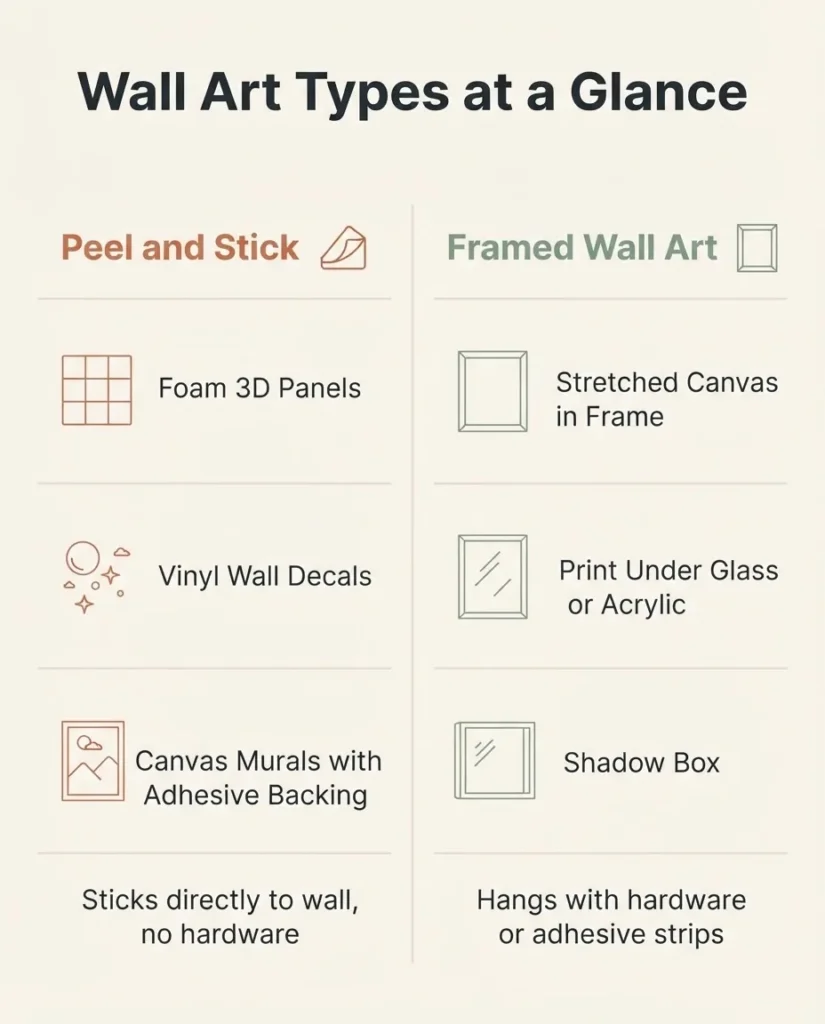
Peel and stick wall art includes foam 3D panels (the kind that create a textured accent wall look), vinyl wall decals, canvas-printed murals with a self-adhesive backing, and repositionable paper or fabric prints. These all share one thing: they stick directly to the wall using a built-in adhesive, no hanging hardware required.
Framed wall art means any print, canvas, or photograph enclosed in a frame, whether that frame is solid wood, MDF, or a composite material. It also covers stretched canvas prints in frames (common in the affordable online art market), which use a wooden stretcher bar inside and may or may not have a traditional frame around the perimeter. What they all have in common is that they hang on the wall using hardware, from a simple sawtooth hook to a wire backing to adhesive strips.
Both categories span a huge price range and a huge quality range. The budget end of each can disappoint you. The mid-range of each can genuinely impress you. Knowing which signals to look for is where the real buying decision happens.
The Case for Peel and Stick Art: Who It’s Actually For
Peel and stick art has one clear, undeniable advantage: it requires zero hardware and zero holes. If you are in a rental and worried about your security deposit, that matters a lot. You can stick it up, take it down, and ideally leave no trace. That “ideally” is doing a lot of work, though, and I’ll get to that in a moment.
The other real advantage is flexibility. If you’re in a transitional season of life, not sure where you’ll be in two years, or just someone who likes to change things up without a big project, peel and stick makes that genuinely easy. The low up-front cost also means less psychological weight on each decision. A peel-and-stick panel set in the budget range costs less than a dinner out in most cities. If you change your mind in six months, you haven’t lost much.
For people furnishing a first apartment on a tight budget who just want their walls to feel less empty right now, peel and stick art earns its spot in the toolkit.
Where peel and stick falls short
The honest problem is longevity. According to wallcovering specialists at Edward Martin, peel and stick products typically last between one and five years in most home interiors, depending heavily on wall surface quality and how well the surface was prepared before application. High-quality products on a clean, smooth, freshly painted surface may push the high end of that range. Budget foam panels on a textured or flat-paint wall? Expect the lower end, and expect edges to start lifting in humid rooms like bathrooms and kitchens.
The other honest problem is the wall-damage risk, which is the exact thing peel and stick is supposed to solve. This is where a lot of renters get burned. The adhesive on cheaper panels can leave a film, pull paint (especially flat or matte paint, which is what most landlords use), or lift drywall paper on walls that weren’t in great condition to begin with. The product itself isn’t lying when it says “removable.” But removable doesn’t automatically mean damage-free. Wall surface condition, paint quality, and temperature at application all affect how cleanly something comes off. If you’re in an older building with layers of paint or textured walls, test a small panel in a closet or inconspicuous corner before covering a whole wall.
What to Look for When You Buy Peel and Stick Art
Not all peel and stick products are built the same, and the quality gap is real. Here’s what separates the ones worth buying from the ones you’ll regret:
The material of the panel matters more than the design printed on it. Foam-core panels are the most common and the most variable in quality. Look for panels described as high-density foam, which hold their shape better and tend to have more reliable adhesive backing than the thin, flimsy versions. PVC or polyester-backed panels are generally more durable than paper-backed ones, and they’re easier to wipe clean.
The adhesive type is critical. Repositionable or “pressure-sensitive” adhesives are easier to remove cleanly than permanent-grade adhesives. The product listing should say removable or repositionable. If it doesn’t, ask yourself why not.
Surface compatibility matters too. Smooth, semi-gloss, or satin-painted drywall is the ideal surface. Textured walls, brick, and flat paint are all higher-risk surfaces for clean removal. Most manufacturers will note this in their product descriptions.
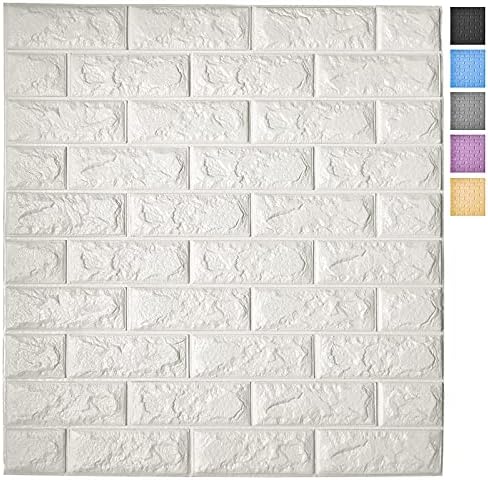
- Extra large size faux brick PE foam wall tile, easy DIY, just peel and stick on wall
- Decorative 3D wall panels made of soft foam, acoustic, collision protection, safety and environmental protection
- Comes in a box of 11 wall tiles in white colour, covers approx. 5.9 m2, size of each tile: 77 cm x 69.5 cm
The Case for Framed Wall Art: Who It’s Actually For
Framed wall art wins on durability and perceived value, and it’s not close. A decent framed piece from the mid-range of the market can look genuinely good for a decade or more without fading, peeling, or lifting off the wall. That’s a different value proposition entirely from a peel-and-stick panel that needs replacing in a few years.
Framed art also tends to read as more finished and intentional in a room. A set of three framed canvas prints on a wall signals “this person furnished this place” in a way that foam panels sometimes don’t. For anyone who plans to stay in their home or apartment for two or more years, the slightly higher up-front cost of framed art starts paying off pretty quickly when you factor in that you won’t be replacing it.
The other underrated advantage is that framed art can absolutely go up without nails if you choose the right hanging method. That takes some of the wind out of the “renters can’t use framed art” argument, which I’ll address directly below.
Frame Materials: What Actually Separates Good from Flimsy
This is the part most buying guides skip, and it’s probably the most important thing to understand before you spend money on framed art. The frame material tells you almost everything about whether a piece will last.
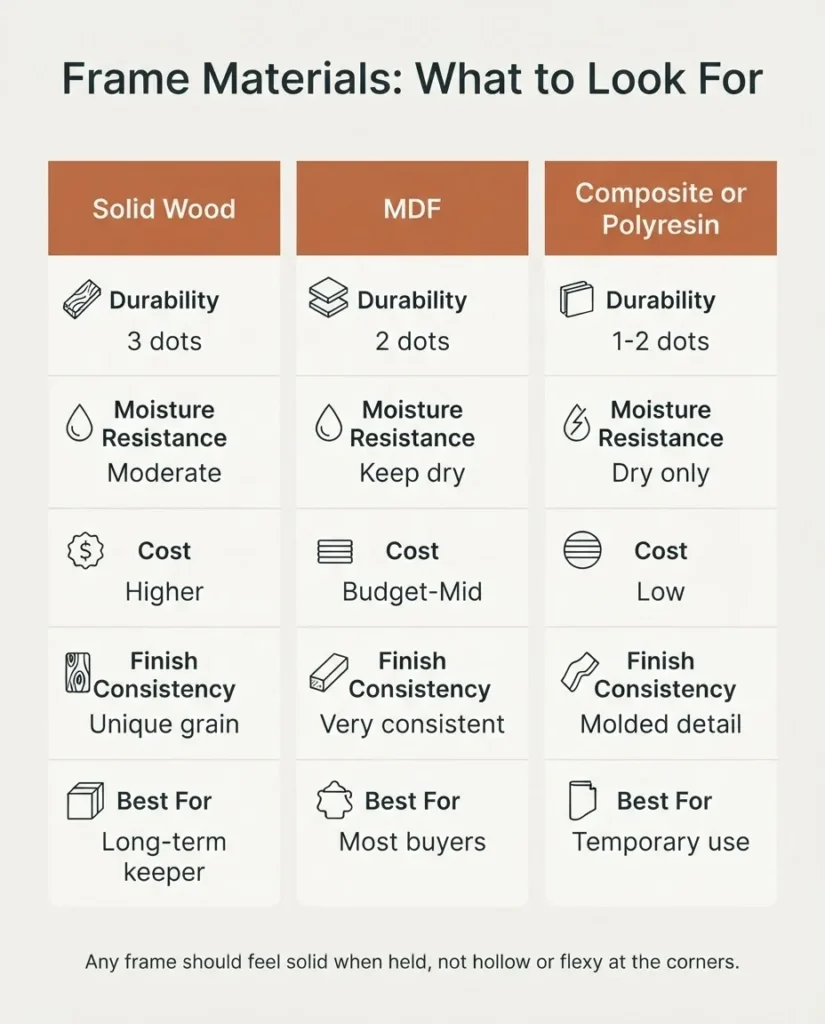
Solid wood frames are the most durable option. They hold their shape, resist warping under normal conditions, and if you pick up real wood grain on the frame, no two pieces look exactly alike. They cost more, but with basic care they can genuinely last for decades. Solid wood is worth the premium for pieces you plan to keep long-term, especially anything going in a spot of honor in your home.
MDF (medium-density fiberboard) frames are made from compressed wood fiber and sawdust, and they’re the material used in most affordable framed art you’ll find online. The good news is that MDF is actually less susceptible to warping from heat and humidity than solid wood under typical indoor conditions, and it’s manufactured to a very consistent finish, so there are no imperfections in the painted or laminated surface. According to frame specialists at Frame USA, MDF frames are a reliable and cost-effective choice for most wall art, and the quality difference between a well-made MDF frame and a solid wood frame isn’t always visible to a non-expert eye. The downside: if an MDF frame gets genuinely wet, it swells and doesn’t recover. Keep them away from bathrooms with no ventilation and spots prone to moisture.
Also, at the cheapest end of the market, MDF frames can feel noticeably light and hollow, which is a real signal of lower quality joinery.
Composite or polyresin frames are less common but worth knowing about. They’re injection-molded, meaning they can achieve very detailed molding profiles at a low cost. They’re durable in dry conditions but can crack if dropped, and they don’t take nails or hardware as well as wood.
A note on what’s behind the glass
Most affordable framed prints use standard glass, which is clear, scratch-resistant, and easy to clean. Acrylic (also called plexiglass or Perspex) is lighter and shatter-resistant, which matters for shipping. According to framing specialists at Frame it Easy, acrylic is generally safer for larger formats and better for pieces that might be moved or shipped, while glass is better for smaller formats where scratch resistance is important and the frame won’t be handled often. For budget framed art bought online, acrylic reduces the breakage risk in transit, which is a real issue with glass-fronted frames shipped in standard packaging.
Can Renters Use Framed Art Without Putting Holes in the Wall?
Yes, and this is where a lot of renters unnecessarily talk themselves out of framed art. The honest answer is that you have real options.
Command Picture Hanging Strips are the most accessible solution. According to 3M’s official weight limits guide, their small strips hold up to 4 lbs and fit frames up to 8×10 in, medium strips hold up to 10 lbs and fit frames up to 18×24 in, and large strips hold up to 16 lbs and fit frames up to 24×36 in. For a standard set of three medium-sized framed prints, medium strips handle the job cleanly. The key is following the instructions: press firmly for 30 seconds, wait at least one hour before hanging, and never skip the removal step (slow pull straight down, not outward, to avoid paint damage).
The weight limit matters here. A thin, acrylic-fronted canvas print in an MDF frame is typically light, often well under 5 lbs for a 16×20 format. A large, glass-fronted solid wood frame can easily run 10 to 15 lbs. Know your frame weight before you reach for the strips, and always buy strips rated higher than the actual weight of your frame.

For heavier pieces, picture rail systems (available in many older buildings) or renter-friendly adhesive hooks rated to 20 lbs are legitimate options. And for anyone who’s willing to fill small nail holes with a dab of spackle and a touch-up paint pen on move-out day, a single small nail leaves a hole about the diameter of a pencil tip. Many leases allow this, and proper patching costs almost nothing. Check your lease first.
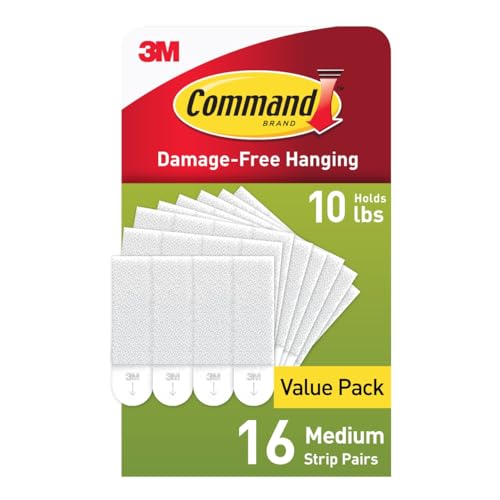
- DAMAGE-FREE PICTURE HANGERS: Includes 16 pairs (32 strips) of White Command Medium (10lb) Picture Hanging Strips, unique…
- WORKS ON A VARIETY OF SMOOTH SURFACES: Wall hanging strips work on a variety of smooth surfaces, including painted walls…
- SURFACE PREP: Clean the desired surface with rubbing alcohol to remove grime and dust to allow the no damage wall hanger…
Peel and Stick vs Framed: The Side-by-Side Comparison
Here’s how they stack up across the factors that actually matter for the buying decision:
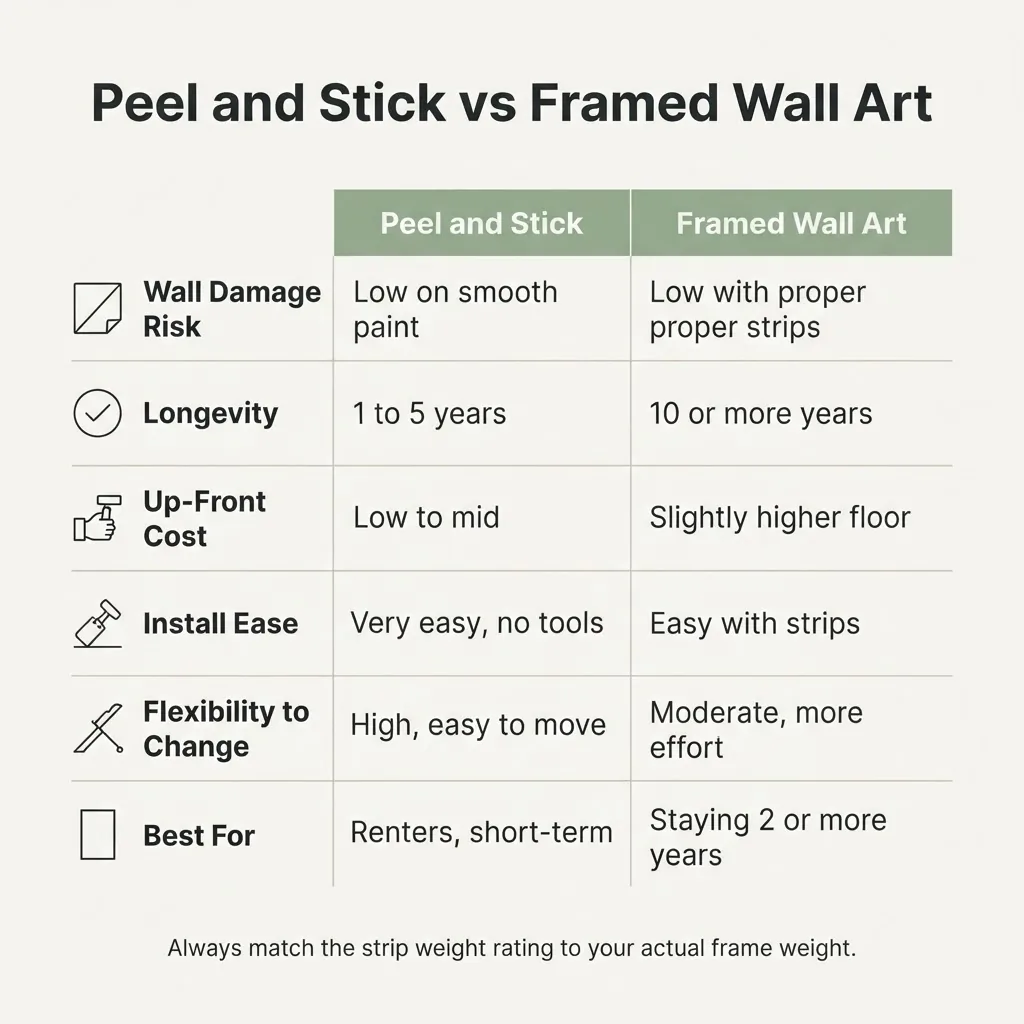
| Factor | Peel and Stick | Framed Wall Art |
| Wall damage risk | Low on smooth/semi-gloss paint; higher on flat paint, textured, or older walls | Low with Command strips used correctly; near-zero with a single small nail + proper patching |
| Longevity | 1 to 5 years typical for consumer panels | 10+ years for mid-range and above; decades for solid wood frames |
| Up-front cost | Budget to mid-range; lower average entry point | Budget to mid-range; slightly higher floor, more value at mid-range |
| Perceived quality | Variable; some panels look great, others read as temporary | Generally reads as more finished and permanent |
| Ease of installation | Very easy; no tools, no hardware | Easy to moderate; requires hanging hardware and a level |
| Flexibility to change | High; reposition or remove easily (usually) | Moderate; more work to move or swap out |
| Return/shipping risk | Low; panels ship flat and are rarely damaged | Moderate; glass-fronted frames can break in transit |
| Best for | Renters, temporary spaces, frequent movers, low-commitment decorating | Anyone staying 2+ years, first-time homeowners, people who want something that lasts |

What About Framed Art You Actually Frame Yourself?
There’s a middle option worth mentioning: buying empty frames and printing your own art. This gives you framed-art durability and a finished look, at a cost that can be lower than a pre-framed set if you shop the frames smartly. You find a piece you love (from a print shop, an artist’s website, or a download site), order a print to size, and drop it in a frame.
The thing that makes this work is buying a quality frame first and letting the art fill it, rather than buying a cheap frame and hoping the art compensates. A set of four solid-wood frames with real 2mm glass is going to hold your prints cleanly for years. A set of four flimsy composite frames with cheap acrylic and weak hanging hardware is going to feel exactly as cheap as it is.
According to the framing guides at Dick Blick Art Materials, the key factors when choosing a frame are color, texture, scale, and quality of materials, and the goal is for the frame to complement the art without overwhelming it. For most budget buyers, that translates to: pick a frame with a real wood or solid MDF moulding in a neutral finish, with real glass or quality acrylic front, and hardware that actually holds the weight of the print.
The DesignOvation Gallery Wood Frame Set is one of the more consistently recommended options in this space for budget buyers who want actual wood frames with real glass and a flexible matting setup that handles multiple print sizes.

- Capture your favorite moments and tell a story with a DesignOvation Gallery Frame set. A gorgeous collection of quality …
- Watch your cherished photos come to life and add interest to a wall or tabletop in your home. Each frame has both an eas…
- Matched frames are a sleek way to display a large collection of photographs and still complement your home decor. The co…
Care, Cleaning, and What to Expect Over Time
Peel and stick panels: Wipe them down with a damp cloth and mild soap. Don’t soak them, don’t use harsh cleaners, and don’t steam clean near them. Foam panels in particular are porous and will absorb moisture if cleaned too aggressively. Edges lifting? Press them back with a small amount of extra adhesive or a specialized seam repair product. If a panel starts bubbling or warping, it’s usually a signal that moisture is working into it from behind. At that point, replacement is generally easier than repair.
Framed wall art: Dust the frame regularly with a dry or slightly damp cloth. For glass fronts, standard glass cleaner works fine. For acrylic fronts, use a product specifically designed for acrylic or a microfiber cloth without harsh chemicals, because acrylic scratches more easily than glass. Canvas prints that are not behind glass can be wiped down with a barely damp cloth to remove surface dust. Keep framed art out of direct sunlight. Even the best print substrate fades under sustained UV exposure, and most affordable framed prints don’t use UV-blocking glass unless the listing specifically says so.
For both types, 3M’s official picture hanging guide recommends checking your hanging hardware every few months, especially in rooms that experience temperature swings. Adhesive strips in particular can loosen in rooms that cycle between heat and cold, like a room with a window air conditioning unit.
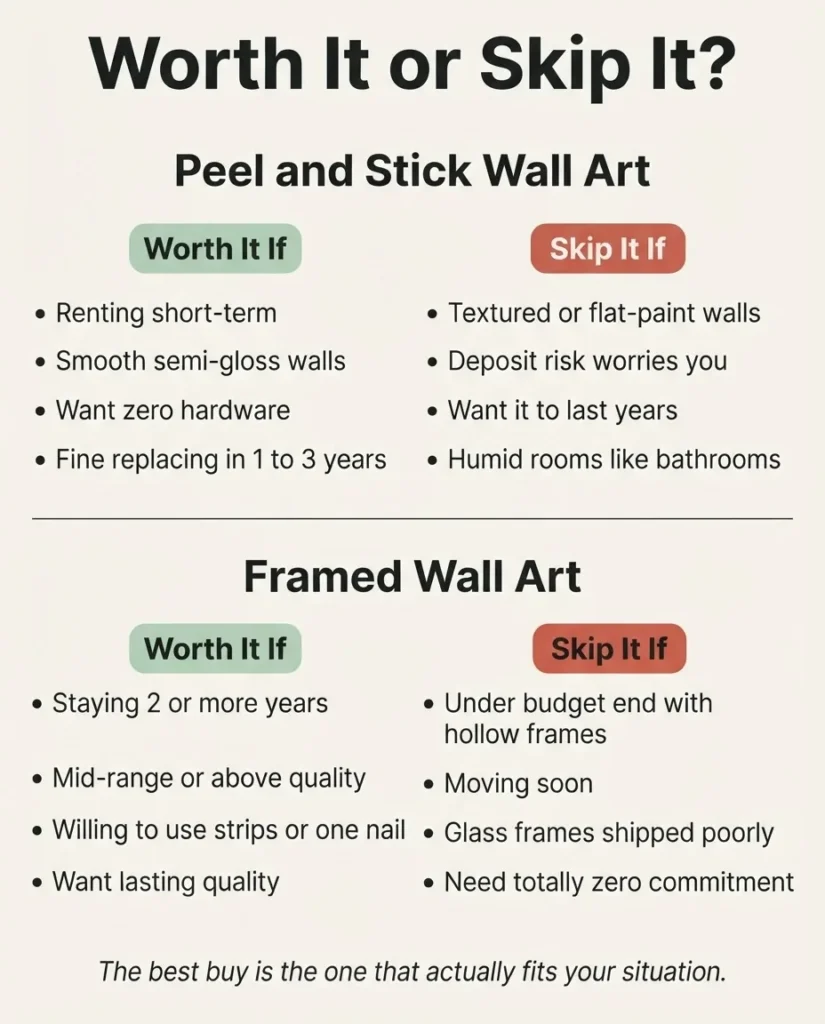
The Worth It / Skip It Verdict
Peel and stick wall art: Worth it if, you’re renting short-term, you want something up fast with zero hardware, your walls are smooth and recently painted in a semi-gloss or satin finish, you know going in that this is a 1-to-3-year solution, and you keep your expectations realistic about removal. Skip it if you’re in a place with textured or flat-painted walls and you’re worried about your deposit, or if you want something that genuinely lasts.
Framed wall art: Worth it if, you’re staying somewhere for at least a year or two, you want something that holds its value in terms of look and longevity, you’re willing to spend five minutes learning the Command strip method, and you shop at the mid-range or above where frame construction is actually solid. Skip the cheapest end of framed art (sub-$20 single prints from unrecognized brands) because the frame material at that price point is often so thin and light that it looks worse in person than it does in the listing photo, which is exactly the problem I’m always trying to help you avoid.
FAQ:
Is peel and stick wall art safe for rental walls?
Peel and stick wall art is generally safe for rental walls if you use a high-quality product on a clean, smooth, painted surface and follow the removal instructions carefully. The risk increases significantly on older walls, flat or matte paint, and textured surfaces, where the adhesive is more likely to lift paint when removed.
Which lasts longer, peel and stick or framed wall art?
Framed wall art typically lasts significantly longer. Most consumer-grade peel and stick panels have a realistic lifespan of one to five years. A well-made framed piece in a solid wood or quality MDF frame can last a decade or more with basic care.
Can you hang framed art in a rental without nails?
Yes. Command Picture Hanging Strips handle most standard framed prints cleanly. Medium strips hold up to 10 lbs and fit frames up to 18×24 inches, which covers the majority of wall art sold in the affordable and mid-range categories. Follow the weight limits on the packaging and the removal instructions.
Does peel and stick wall art work on textured walls?
Most peel and stick art is designed for smooth surfaces. On textured walls, the adhesive makes uneven contact, which reduces hold and increases the chance of edges lifting or the panel falling. Some products specifically claim texture compatibility, but results are inconsistent in practice.
What frame material should I look for in affordable framed art?
Look for solid wood or a well-made MDF frame with a consistent, smooth finish and hardware that’s actually attached to the frame, not just a sawtooth hanger stapled to thin backing. Acrylic front covers are fine and reduce shipping breakage risk. Avoid composite or polyresin frames at the lowest price points where the molding profile feels hollow or snaps under light pressure.